![MaritimeJournal[Seawork]](https://www.maritimejournal.com/wp-content/uploads/2026/09/MaritimeJournalSeawork.svg)

Dutch Coastguard found wanting in fatal ‘Fremantle’ fire
Flaws in response, communication and control need to be put right ‘as soon as possible’, a report into the Dutch Coastguard’s handling of the fatal Fremantle Highway car carrier fire, which resulted in one death, has found.
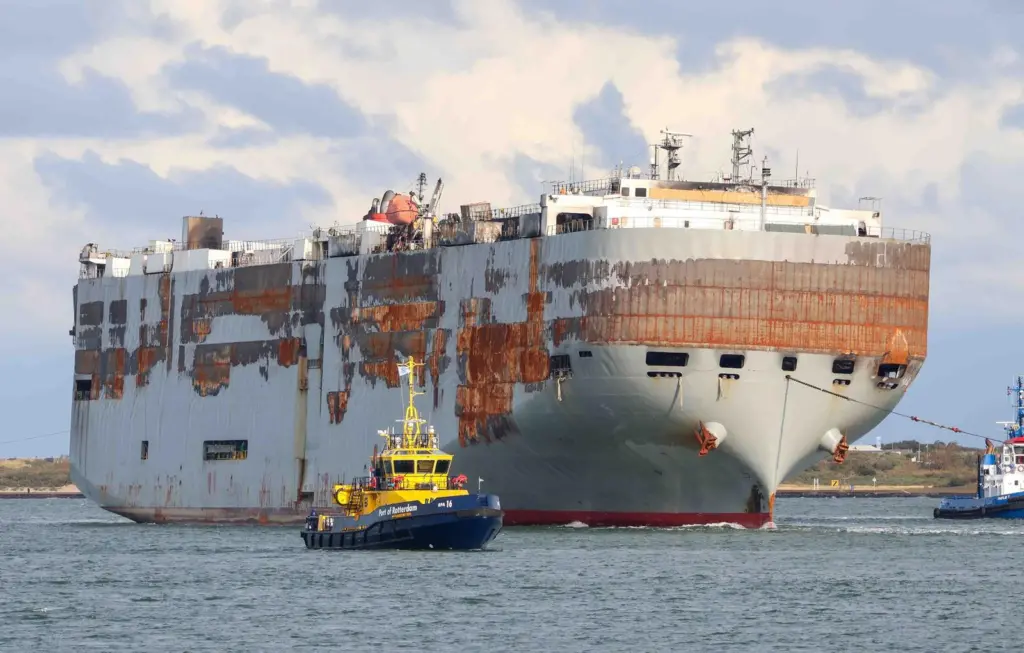
A Dutch Safety Board report has found the Dutch Coastguard’s response to the Fremantle Highway fire in 2023, which resulted in one loss of life, was not ’sufficiently able to assume control’.
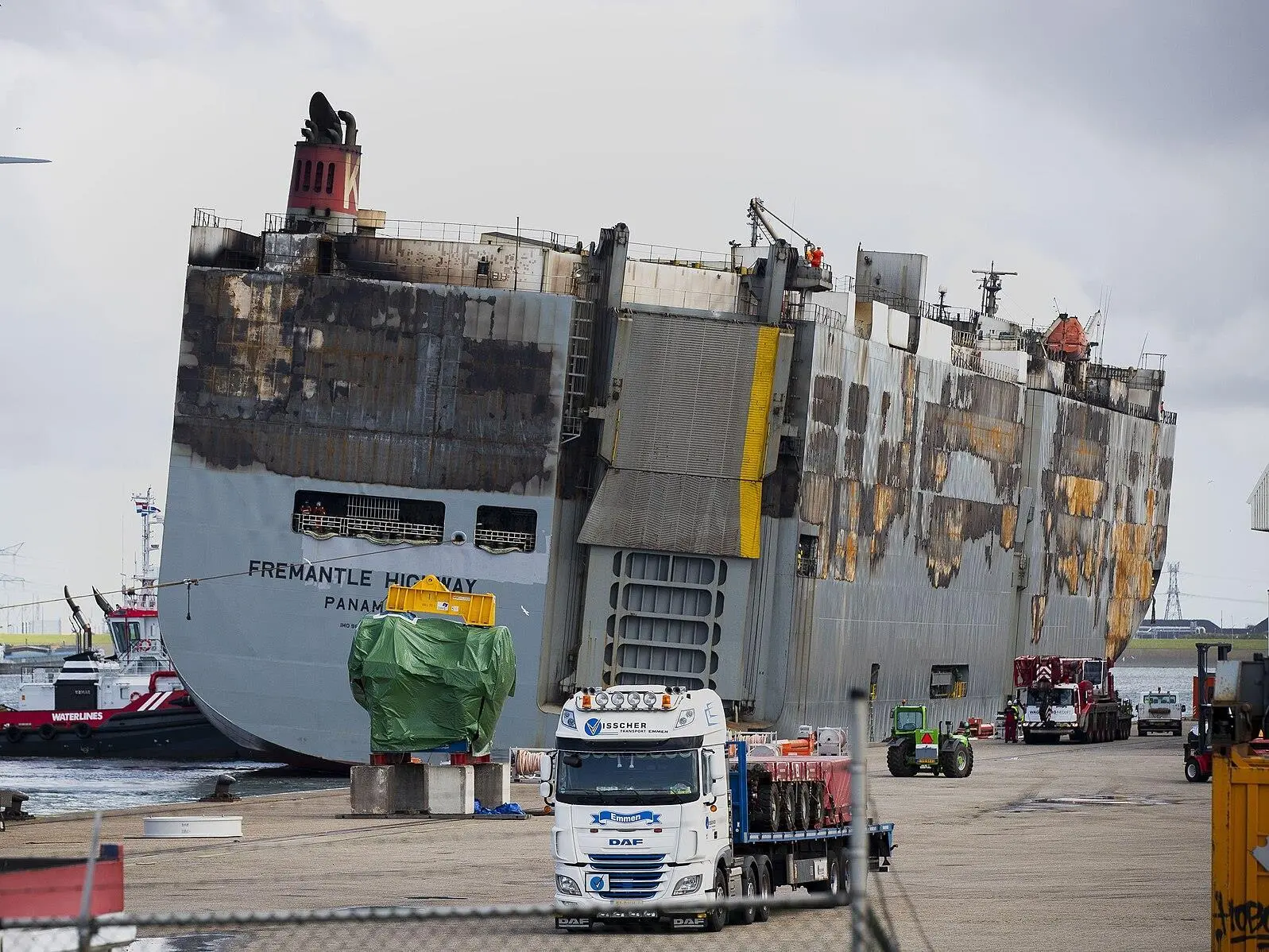
Fire broke out on the Fremantle Highway vehicle carrier’s cargo decks in 2023 around 27 kilometres north of Ameland Island, in the Dutch North Sea.
The incident was initially considered to be a firefighting operation and the Maritime Incident Response Group (MIRG) along with KNRM lifeboats were alerted, but the fire spread for another two and a half hours before the coastguard’s aircraft arrived on scene.
“The Coastguard is not sufficiently able to assume control in the event of a complex emergency response operation,” says the report, and “the system responding to incidents in the North Sea needs to be put in order as soon as possible.”
The key finding of the report is that the Coastguard Coordination Centre initially took action for a fire-fighting operation but it was another two hours before it was established that a search and rescue operation (SAR) was actually required. By this time helicopters were not at their base but under way for a fire-fighting response rather than SAR.
The summary report, Emergency assistance Fremantle Highway, compares the differences when responding to marine-based incidents with those on shore and highlights the diversity of assets available, including passing ships; dedicated and declared SAR units; commercial tug and salvage operators; and voluntary life-saving organisations.
Each coastal state has its own individual protocols when dealing with serious marine incidents, from deployment and coordination of SAR units to what legal powers states have to intervene. Under international agreements, it is the vessel’s captain who bears final responsibility for the situation on board a vessel.
Timeline
In the first few hours after the blaze broke out, the coordination centre had too limited a picture of the situation on board and crucially, no request for evacuation was received from the Fremantle Highway.
Once the aircraft shared thermal images of the vessel with those ashore it became evident that almost the entire vessel was on fire and that those on board were in ‘grave danger’.
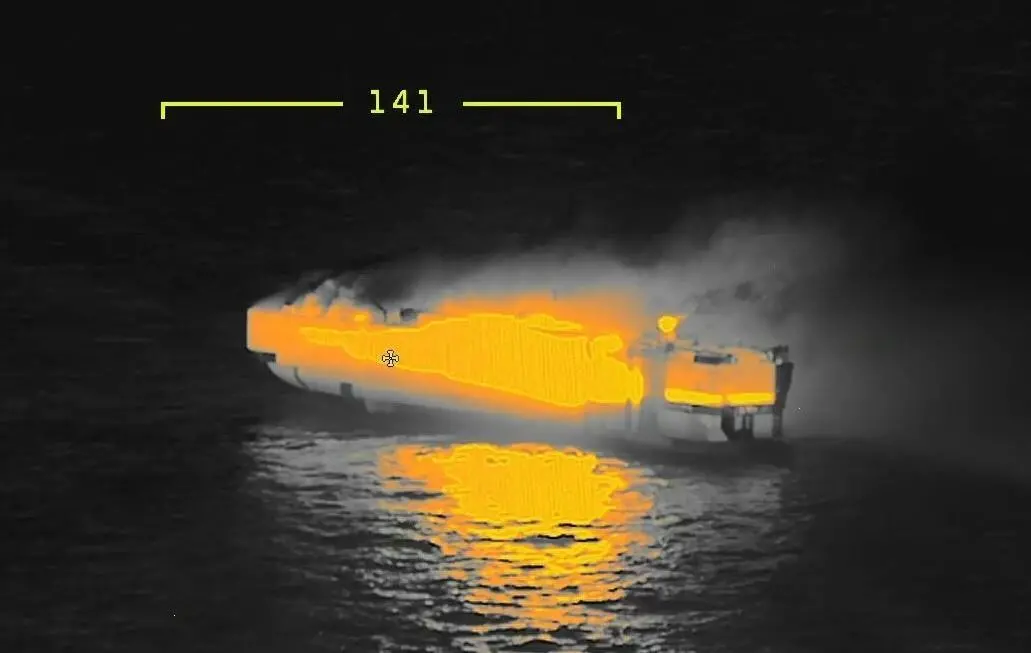
It was quickly concluded that a SAR response was needed, the vessel’s crew no longer able to reach safety by their own efforts because of the smoke. With no SAR helicopters on scene, seven crew members jumped overboard from great height, sustaining serious injuries, and one subsequently died of his injuries.
They were picked up by lifeboats along with a tug that had responded, and SAR helicopters eventually took the remaining 16 people off the vessel, landing them at Groningen Airport Eelde.
Helicopter response
With the initial response assessed as one of fire-fighting, the MIRG group assembled at Rotterdam The Hague Airport, to where the two available SAR helicopters were despatched from their permanent bases at De Kooy airbase, Den Helder and Midden-Zeeland airfield.
There was then a delay in transferring the MIRG team to Fremantle Highway after they expressed doubts about the safety and effectiveness of an on-board deployment. The wait meant the helicopters were reserved for a possible MIRG deployment from Rotterdam and were not available for SAR directly from their own bases.
Several factors including a lack of effective communication between the coastguard and the MIRG, along with a different consultation procedure to shoreside incidents, are cited in the report.
Shoreside reception for the casualties also comes under the spotlight in the report, the focus on fire-fighting resulting in limited contact between the Coastguard Coordination Centre and the joint Emergency Communications Centre for the North Netherlands safety region.
The operation to land those rescued by lifeboats went according to plan, but the reception for casualties on the helicopter proved more problematic, including uncertainty of numbers and where they were supposed to be taken to, the report saying the safety region and emergency services ‘were unprepared for the arrival of sixteen casualties in need of acute medical care’, leading to delays with their transport to hospitals in the region.
Analysis
The key issues identified are stated as difficulties in communication and sharing of information between the Coastguard Coordination Centre and others in the emergency response chain ashore, with parallel lines of information becoming fragmented and the lack of a shared digital (logging) system stated as a factor.
Staffing at the two coordination/communication centres was described as ‘suboptimal’: a problem the Safety Board has pointed out in three previous reports. Several ministries share administrative responsibility for the coastguard, a fact that often compromises the speed with which it can act.
With increasing activity in the North Sea, such complex requests for assistance are likely to become more frequent.
Differences with the gathering of information from marine incidents compared to those shoreside mean emergency response is organised differently. While escalation of the operation to a team beyond the scale of the coastguard was initiated fairly quickly, it wasn’t until several hours after the last casualty had arrived in hospital that such a team actually met. The way crisis management at sea is organised and equipped is stated as ‘not up to the same standard as on shore’.
With the vessel’s master bearing final responsibility for the situation on board the action taken by the coastguard in the first few hours is noted as ‘reactive’ it being observed that a more proactive approach may not conflict with the master’s final responsibility.
A brief consideration is made of the state’s powers in such incidents, the report adding that in cases involving serious danger to persons or the environment, the Dutch Maritime Accident Control Act does authorise the coastguard to resort to measures ‘of a more compulsory nature’.
Each coastal state has a different framework and rules for ‘state intervention’ for maritime incidents.
The UK adopts its SOSREP system, including powers of intervention, an extreme example being if there is a delay with the appointment of a commercial salvor such services can be contracted by the coastguard, the ship owner getting the eventual bill.
There is no suggestion that professional salvage assistance wasn’t promptly arranged here, Multraship Salvage and Smit Salvage appointed under Lloyd’s Open Form for salvage of Fremantle Highway.
It became apparent that deploying the MIRG team can interfere with efforts to rescue those on board, in this case the helicopters not being at their base and their rescue capacity being fully occupied by the fire-fighting team and unable to airlift the vessel’s crew if required.
Described as an ongoing problem, the report concludes that the coastguard was ‘not sufficiently able to assume control in the event of a complex emergency response operation’.
Erica Bakkum (Dutch Safety Board member) said: “The Dutch Safety Board has repeatedly pointed out in recent years that the Coastguard Centre is insufficiently capable of assuming control when it needs to collaborate with other parties.
“It doesn’t help that several ministries share administrative responsibility for the Coastguard, and that set-up makes it harder to take rapid action. We therefore advocate the appointment of a mandated director who can coordinate the necessary improvements in the response to emergencies.”