![MaritimeJournal[Seawork]](https://www.maritimejournal.com/wp-content/uploads/2026/09/MaritimeJournalSeawork.svg)
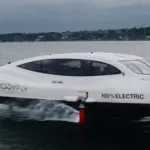
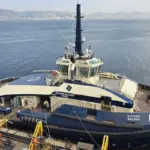

‘Seacat Columbia’ on sea trial in the Solent
The BARTech designed asymmetric- multihull CTV Seacat Columbia has been cutting a very interesting figure among the throngs of racing yachts on the UK’s South Coast, writes Jake Frith.
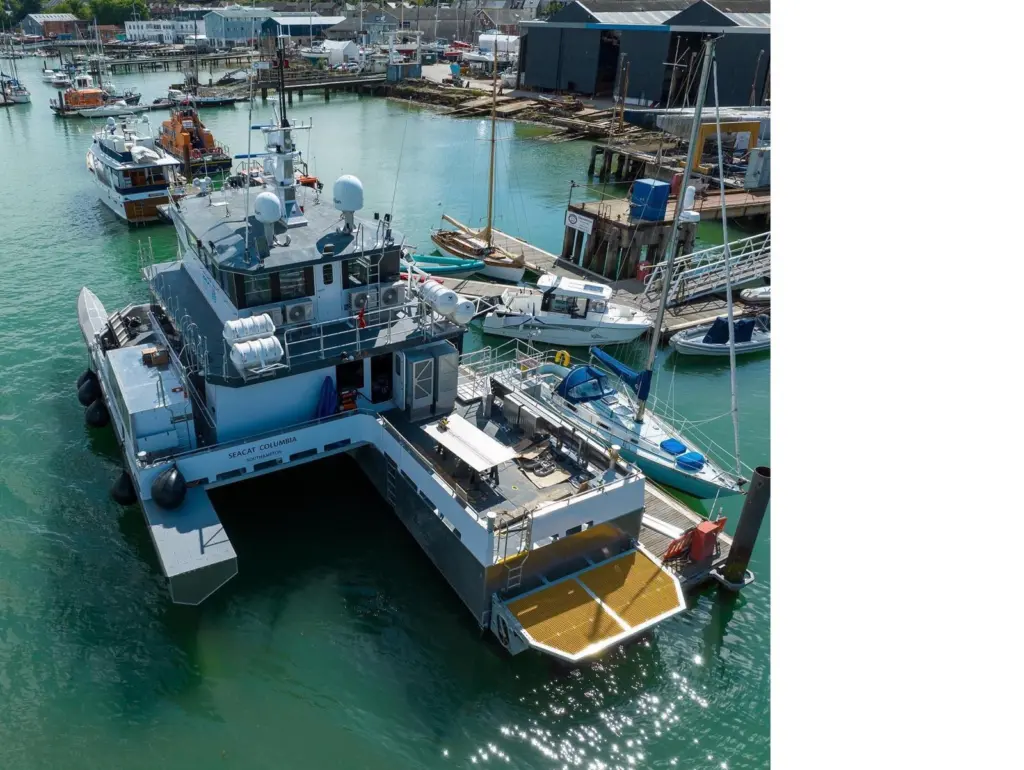
Launched earlier in the summer by Isle of Wight boatbuilders Diverse Marine and with design support from Chartwell Marine, the ground-breaking semi-foiling vessel has been going through its sea trials this week. The BARTech 30 Small Waterplane Area ProA hullform has raised industry eyebrows by claiming reduced vertical accelerations by between 35% and 70%, while also offering 30% to 50% more fuel efficiency with higher sea state capability than a catamaran.
Tantalising clip
A tantalising 11-second clip on Diverse Marine’s social media pages shows the vessel doing its thing to a love it or hate it soundtrack of wailing rock guitar. What’s most notable is where the ‘small waterplane area’ nature of the vessel is apparent on video for the first time.
BAR in particular has been fairly protective in the past about exactly how the vessel will deliver its claimed improvements over a conventional catamaran CTV. Images on BAR’s website stop at the waterline, leaving naval architectural pundits wondering exactly what is going on beneath.
BAR Technologies offers a cohesive team of world-leading naval architects and optimisation specialists; fluid dynamists; mechanical, structural and composite engineers; control strategy and system specialists; and data and simulation engineers with access to the latest commercial knowledge, using bespoke in-house design tools.
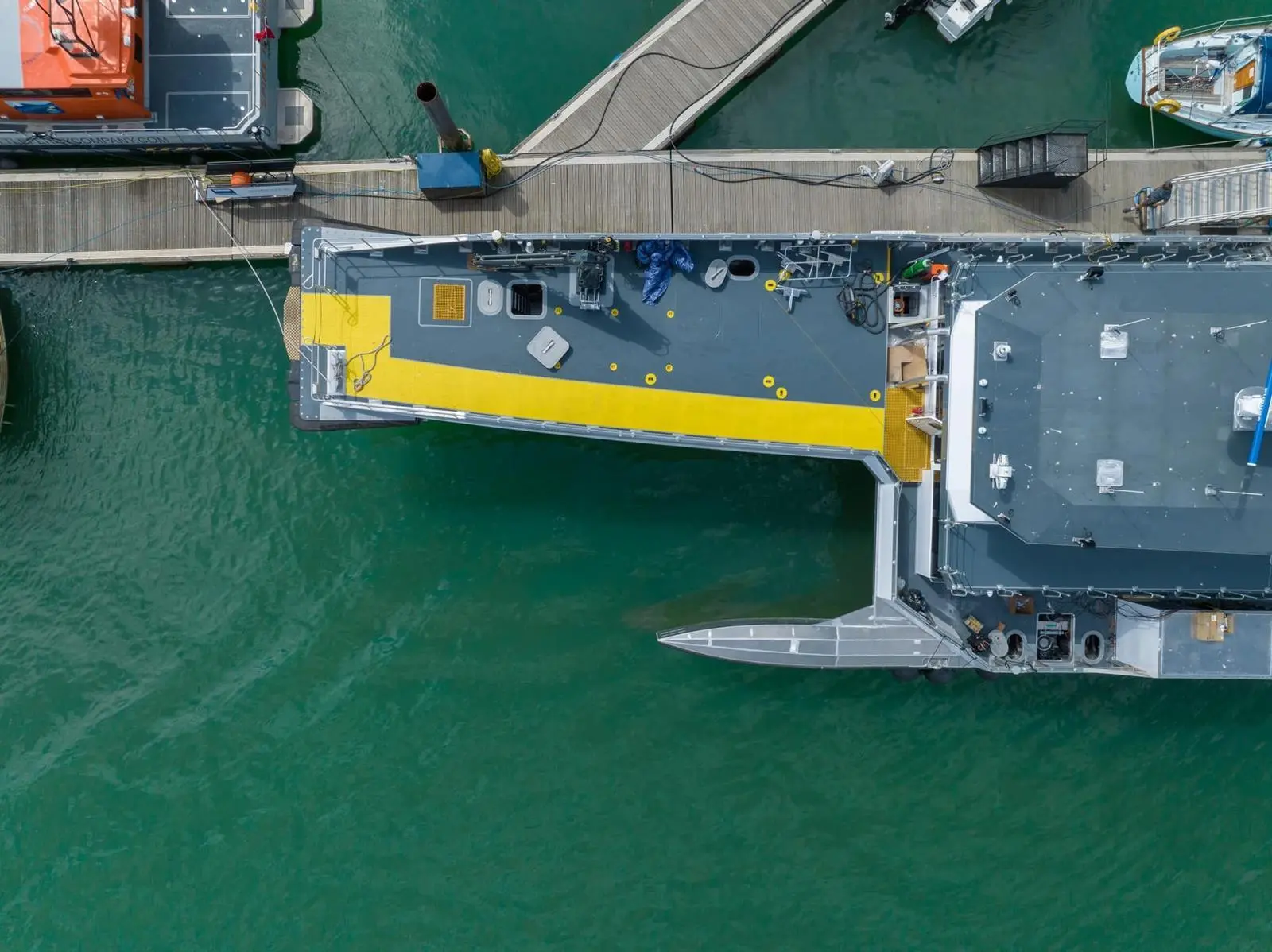
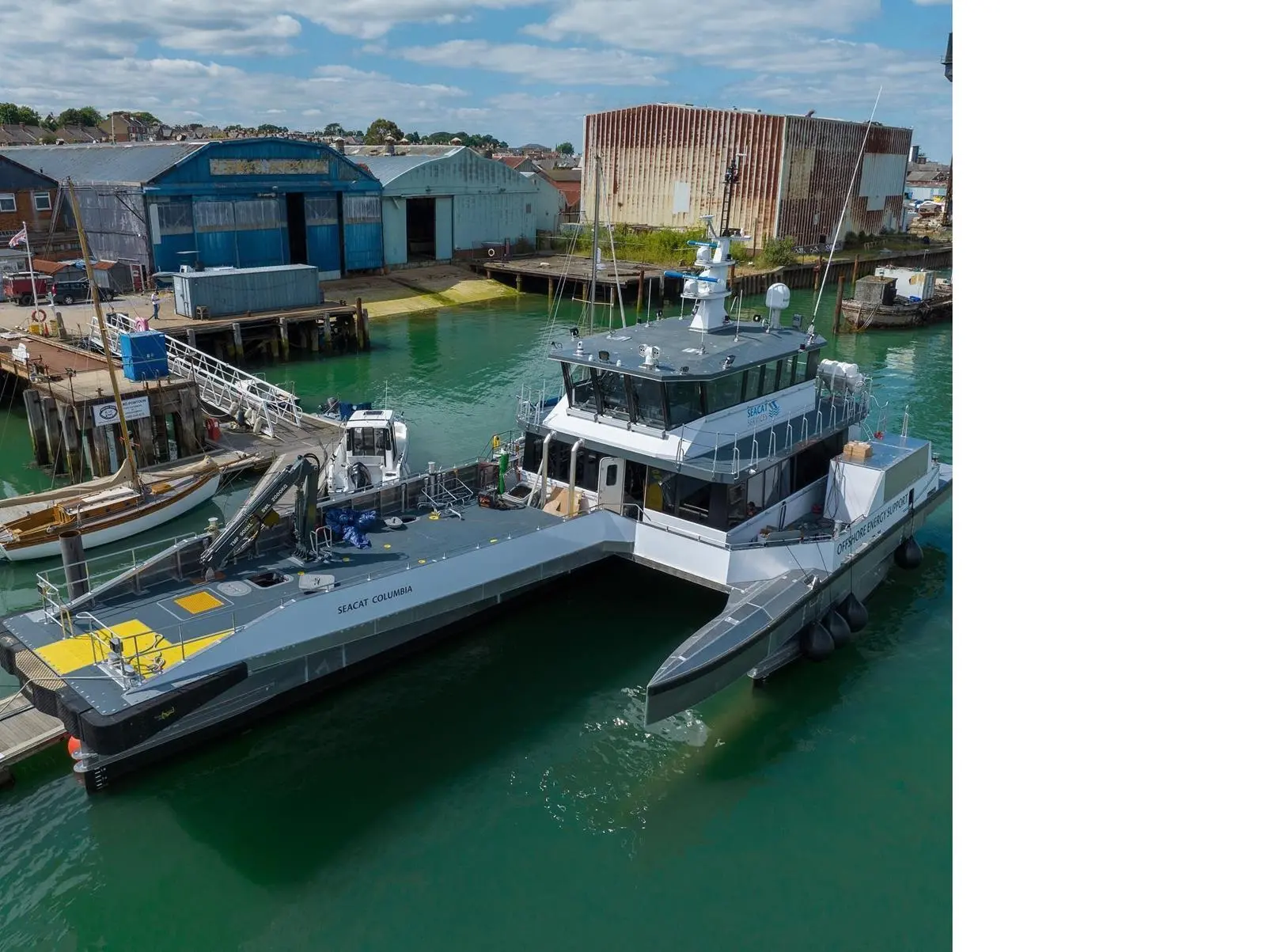
It appears that the upper section of a short, narrow stabiliser hull (or ama, if we’re going to get indigenous about it), is kept at a controlled depth by a foil beneath it. It is an interesting approach as at cruising speed the water only ‘sees’ the very long and narrow main hull, a foil off to one side of it plus the support structure, or ‘mast’ of the foil.
Of interest in the still pictures also recently released by Diverse Marine is that the ama has a deeper, smaller sub hull beneath it, presumably to provide enough buoyancy to keep the vessel on an even keel when stationary – particularly important when pushing onto a turbine. This sub hull could equally be considered as a partially buoyant foil mast.
This is a clever way of achieving a level deck for the vessel from stationary and throughout the speed range, something that commercial operators would consider a ‘must have’. It is likely where the Small Waterplane Area part of the name comes from.
Actually, much more similar to a SWATH (Small Waterplane Area Twin Hull) vessel than a full foiler, it replaces the SWATH’s buoyancy bulb with the actively adjusted foil. The main hull benefits from being especially long and fine, but to be able to cater for significant and differing loads this is not a fully flying foiler in the America’s Cup sense of the word.
Key competencies
Controlling the lift and height of the ama, and hence the stability and safety of the boat, particularly in open sea conditions, must be a marvel of foil control technology, and this is where BAR’s Formula1 and America’s Cup experience have been critical to the project. Speaking last year to BAR’s Simon Schofield and Simon Roberts, the keys to making these sorts of boats work for the first time are advanced modelling and AI (Artificial Intelligence).
BAR builds its own systems and software to virtually test thousands of iterations of designs, long before anything hits the water, and AI-driven stabilisation systems mean that the boat can, to an extent, ‘learn’ a sea-state, and therefore the foil stabilisation systems are not acting reactively like hydrofoil stabilisation systems of old.
This means the foils can be in the right place, or at least moving in the right direction, as a move is required, not some moments afterwards. Effectively this means the foils are leading the charge rather than constantly playing catch-up.
This new BARTech 30 design is a big shift in green vessel design and will work in tandem with Seacat Services’ existing OESVs. The operator has ordered two of these vessels – Seacat Columbia and Seacat Cambria – a real commitment to the decarbonisation of the workboat sector. Two more BARTech 30s are also in build for High Speed Transfers (HST).
Cutting emissions is one of the biggest challenges facing the offshore wind and broader maritime sector, amid rising global awareness of its environmental impact. The designers have focused instead on creating fuel efficiency through a highly optimised multi-hull design. Ultimately this will cut CO2 emissions by up to 600 tonnes a year if working on a 12-hour shift of operation.
Reduced pitch and roll
Crucially for Seacat, these improvements come at no sacrifice to operational performance. With BAR’s FOSS (Foil Optimisation and Stability System), the vessel’s ability to reduce pitch and roll while lowering vertical acceleration in 2.5m wave heights will enable greater comfort during transit and improved push-on performance during operations.
This is of growing importance as offshore wind farms move further out to sea, requiring vessels to travel further for longer while navigating more challenging conditions.
Ian Baylis, Managing Director, Seacat Services, said: “After reviewing the latest options on the market, the BARTech 30 is the first one that has met and exceeded all of our requirements, embracing efficiency gains through design, instead of relying exclusively on hybrid propulsion. Adding this vessel to our existing fleet of OESVs is a simple, effective way to get ahead on emissions reduction without interrupting our current work scope.”
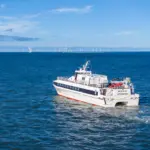
Seacat Services has already been impressed by Seacat Sceptre, an earlier Diverse/ Chartwell/ BAR collaboration launched last year. This more conventional catamaran design uses BAR’s FOSS but with aft-mounted active foils, delivering improved efficiency primarily through wake reduction.
The BARTech 30 design has been awarded approval in principle from the American Bureau of Shipping, providing another class-certified, Jones Act-compliant option for vessel operators looking to enter the US offshore wind space.
Aluminium specialist shipyard Diverse is certainly living up to its name at the moment with CRC Walrus, a three-wheeled amphibious CTV for operation at the intertidal Scroby Sands windfarm, also from the pen of Chartwell Marine and in build at Cowes.
We’ll be looking at this similarly ground-breaking solution to a real-world offshore wind industry problem in a future issue.
Related Articles
 SEAWORK NEWS
 INDUSTRY NEWS
 OTHER NEWS