





Shipyard digitalisation is good news for energy transition
The decarbonisation transition requires new future-proof ships, and fast. Embedding 3D modelling and simulation tools at the heart of the design process will be key to make those innovative vessels a reality, says Mikko Forss, executive vice president for Design Solutions at NAPA.

There is no doubt that the fleets that will navigate in a net-zero world will look drastically different to those operated today.
This future is around the corner, with a net-zero target adopted by shipping’s global regulator for 2050, and fully electric tugs and ferries are already offering a glimpse into the new generation of ships that will incorporate new fuels and energy sources.
One of the most difficult puzzles of the decarbonisation transition is how to reconcile decarbonisation goals with the timelines required to renew global fleets. A commercial ship’s lifespan generally reaches 20 or 30 years, often much longer for tugboats and towboats. This means that many ships being built now will still be at sea by the middle of the century – so we must design the “ships of the future” today.
As these next-generation vessels are designed, shipowners want safety and performance assurances. They also need to know that their decisions will have longevity, and not incur operational or legislative penalties over lifecycles that can easily span three decades.
However, a key challenge is that these commitments are having to be made in a fast-evolving and increasingly diverse technology and fuel landscape. Rather than a “one-size-fits-all” solution, design and fuel choices will depend on the ship type, but also the segment and routes where it will be operated. A direct consequence is that new ship designs are becoming more complex and unique than ever before.
Critical design choices
Tugs, ferries, dredgers and offshore wind farm support vessels typically work closer inshore for shorter periods and have very different endurance requirements than larger, ocean-going ships. This is resulting in the appearance in service of battery powered vessels and hydrogen-based fuel cell projects.
There are several implications from a ship design perspective, requiring naval architects and engineers to innovate on an unprecedented scale and at an accelerated speed. New configurations may be needed to accommodate different engines, extra space for fuel tanks, as well as the additional weight of new power storage systems. For example, lithium batteries are twice as heavy as their fossil fuel equivalent, which may bring a vessel closer to its maximum load mark and needs to be accounted for in the design.
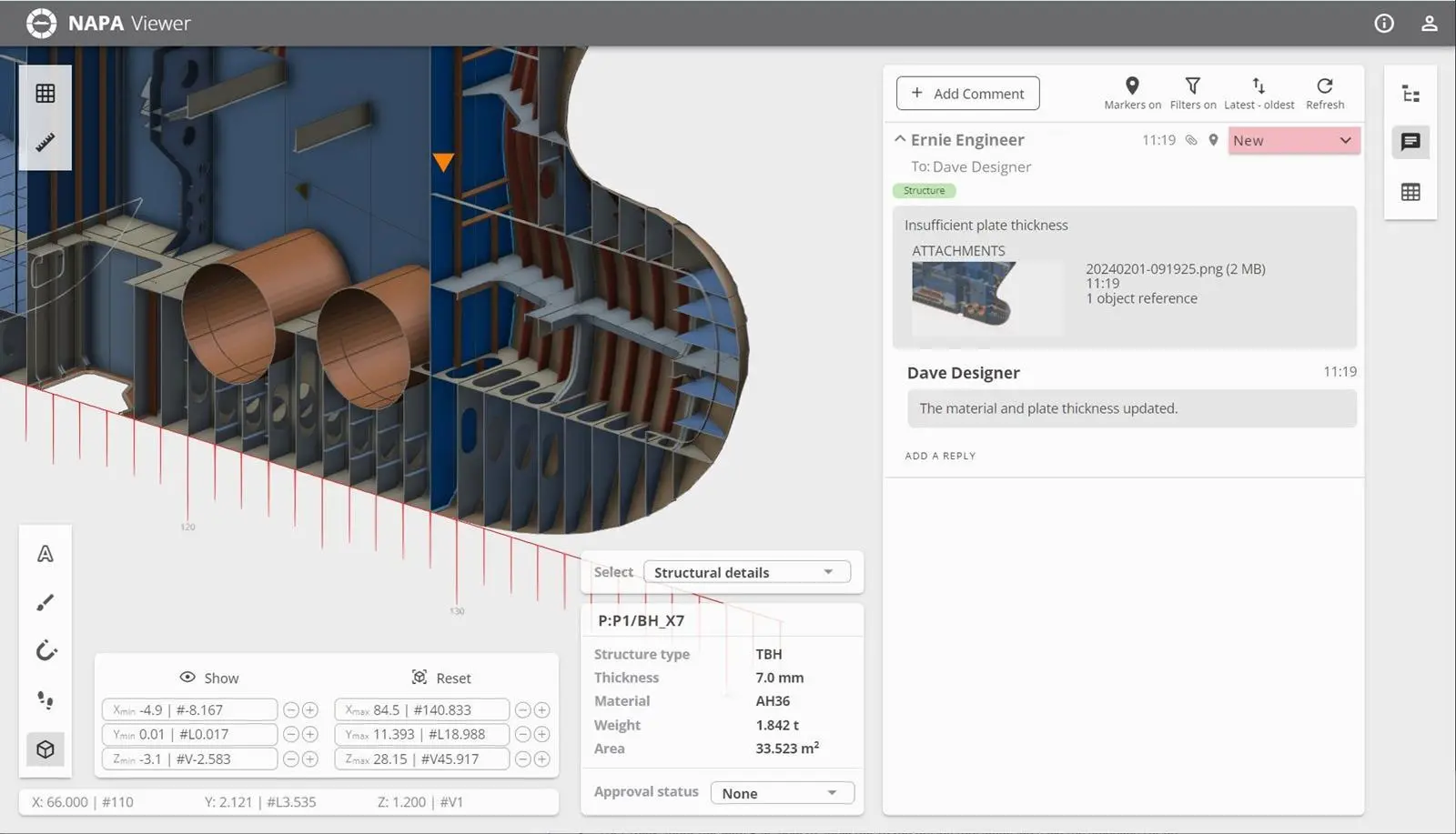
Ensuring the safety, stability and structural integrity of innovative concepts will only happen when two conditions are met: if teams are able to collaborate effectively using streamlined processes; and when naval architects and engineers can simulate and compare different design options to make the best possible choices for each new concept. In short, to innovate they need efficient processes that offer the flexibility to make swift design changes and ensure that everyone involved in a design is on the same page. This is where 3D models can play a key role.
The future is three dimensional
The innovation challenge is accelerating a fundamental (and digital) transformation in shipyards. It is driving a greater use of 3D models to optimise workflows throughout the design process, from the early stages through to classification approvals, detail design, and all the way in downstream production design.
This may sound like a technical point, but it is a fundamental shift, because using the same 3D model throughout the design process helps break silos and enables all the different disciplines and stakeholders to access “a single source of truth”. In practice, this facilitates communication, eliminates duplicated work, saves time, and limits the risk of errors. This more efficient and agile workflow is a prerequisite for innovation, helping teams work collaboratively to deliver the best possible designs.
The potential of 3D processes was illustrated by the recent use by one European shipyard of NAPA’s 3D-based tools to cut design time of a wind support vessel by over a third — to just 10 weeks — to meet very tight building slot availability. Success was achieved because collaborative digital platforms enabled teams from three countries to work in parallel, with the vessel’s structure being adapted on an ongoing basis.
Elsewhere, Damen Engineering recently delivered its first vessel design, a 2,500m3 dredger, to be entirely created, reviewed and class-approved using 3D models. From the very first project, the 3D-based process has proven its value, streamlining communication and saving significant time, with efficient feedback loops between engineers and the classification society.
Eventually 3D models will unlock even greater opportunities, including the possibility to use next-generation simulation tools to test different fuel and technology options. Using data on actual weather conditions on the specific routes where the ship will be operated, we can model the implications of new energy systems for the ship’s configuration, cargo capacity, stability, and even its future performance. This will help engineers, naval architects and owners themselves make the right choices for each vessel, while also providing a goldmine of insights to help optimise performance after it has left the shipyard.
With the right (3D) foundation for innovation in ship design, the multi-fuel and multi-technology era ahead isn’t to be feared – but rather harnessed to build and operate greener fleets with confidence.
* In September 2023, NAPA opened a subsidiary in Germany to support its business growth and intensify its services in central Europe.
Related Articles
 OTHER NEWS
 SPONSOREDSTORY
 INDUSTRY NEWS