




Laying pipes and cables and meeting the challenge of finding them again afterwards
The vast network of cables and pipelines that covers the world’s seabeds continues to grow and the proliferation of offshore wind farms is adding to this. Sometimes buried, sometimes visible on the seabed, pipes and cables can sustain costly damage from anchors and trawl gear so owners work hard to ensure that they are adequately protected.
Failure to do so can result in expensive legal battles with ship operators accused of causing damage through the anchorage of their vessels.
The depth to which pipelines or cables are buried is a key factor in their protection so owners will demand proof from contractors that they have been covered adequately. Measuring the exact depth of their burial is therefore important and this has driven Teledyne TSS to develop systems capable of locating the precise position of pipes and cables below the seabed.
Teledyne TSS is also the name behind the well known range of S G Brown gyro compasses which have a prominent presence throughout the marine industry. The company also manufactures motion sensors and inertial navigation systems and having developed its first technology for pipe and cable tracking over 20 years ago it says it has been dominating the world market ever since.
James Shaw, Applications Engineer with Teledyne TSS explained to MJ; “Pipe surveys are expensive so companies conducting them need the best possible equipment. It must be reliable and produce results that are accurate and can be trusted and the industry recognises these qualities in our systems.
The Teledyne TSS 440 pipeline tracking system uses active pulse induction technology. The use of this technology has significant advantages over passive magnetometer based systems which can also detect metal objects but can lose targets in the inherent background magnetism of the Earth.
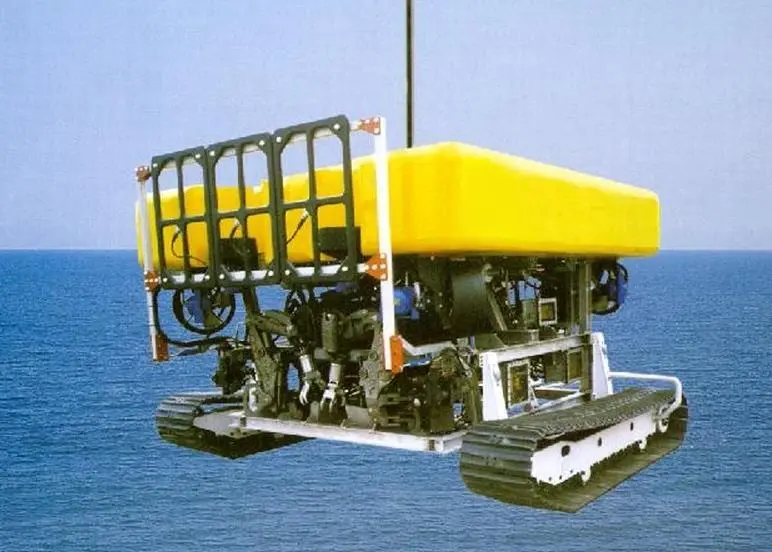
With the Teledyne TSS 440 an electromagnetic pulse is transmitted from three search coils normally mounted horizontally on the front of a work-class Remotely Operated Vehicle (ROV). The electro-magnetic pulse then induces magnetism in any conductive object, such as a pipeline, that it encounters. The induced magnetism is then received by the three search coils and a complex algorithm calculates the depth of burial and position of the object. Because sea water is also conductive the effects of this have to be taken into account and negated by complex sea-water rejection software developed by the company. This technology means that the TSS 440 can also detect and track some cables if they are protected by conductive armouring.
Performance can be further enhanced when survey companies know the size and characteristics of the pipe to be tracked. A technique known as target scaling can be used that adds a scaling factor to the system. To initially measure the characteristics of a specific pipe Teledyne TSS has built a sophisticated facility at its Croxley Green factory where the surrounding barriers, the carrying truck and the track it runs on are made entirely of plastic or GRP to eliminate any magnetic interference. The facility enables pipes to be tested and a scaling factor for the TSS equipment determined. Target scaling is consequently available for all types of pipe at the customer’s request.
The proliferation of subsea cables also introduced a need for a suitable tracking tool so Teledyne TSS went on to develop its 350 detection system specifically for the task. Because cables contain less metal than pipes, this system works by injecting a sine wave tone into them. This tone is then received by two sets of three induction coils mounted two-metres apart on an ROV. Again, using a complex algorithm and through a process of trigonometry and the analysis of power levels induced in the coils, the system determines the cable position. “This system can produce very accurate surveys” added James Shaw. “As with the TSS 440, it has become the industry standard tool for cable surveys and tracking. It consequently brings some interesting and advanced technology to an area of marine activity to which few outside the industry may give little thought.”
By Jake Frith
Related Articles
 OTHER NEWS
 MERGERS & ACQUISITIONS
 MARINE CIVILS NEWS