




UK’s first multi-berth shore power system switches on
Portsmouth International Port has begun supplying shore power to ferries and cruise ships in what it says is the UK’s first multi-berth, multi-user, multi-frequency shore power system.
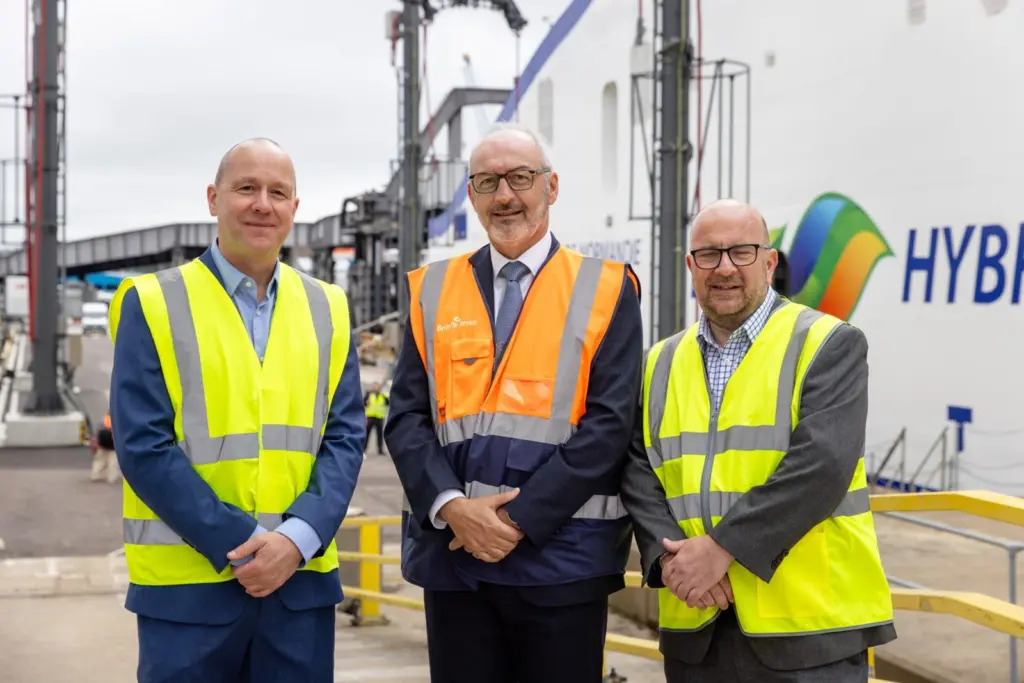
The system has already been used by Brittany Ferries’ hybrid-electric vessels Saint-Malo and Guillaume de Normandie during final commissioning, while cruise ships including AIDA’s AIDAsol and Phoenix Reisen’s Amera have also connected as part of the testing programme.
“This is a huge moment not only for us, but also for the UK ports industry as a whole, as we are now the country’s first port to offer multi-berth, multi-user shore power,” said Mike Sellers, director of Portsmouth International Port.
“There are still challenges we’re facing around the cost of electricity, and we’re continuing to lobby the government hard to ensure they address these and make electrification a more attractive business proposition for us and for ports across the country.”
The system is designed to supply up to three vessels at berth simultaneously, with vessels that have battery systems also able to enter and leave the harbour under electric power.
The £24.4 million (€29 million) project was funded through £19.8 million from the Department for Transport and £4.6 million from Portsmouth City Council, with the council providing a further £3 million to secure the required grid connection.
Sellers said the project would improve local air quality while ensuring the port remains aligned with the increasing electrification of ferry and cruise fleets.
Elsewhere in Europe
Portsmouth’s investment mirrors a broader trend across mainland Europe, where several major ports have already deployed shore power infrastructure.
The Port of Kiel in Germany was among the early adopters, commissioning shore power for ferries in 2019 before expanding the system in 2021 to serve both cruise ships and ferries. A further extension, completed in 2023, enables up to three seagoing vessels to be supplied simultaneously across multiple berths.
In the Netherlands, the Port of Rotterdam officially commissioned its shore power installation for cruise vessels in March 2025, with AIDAnova becoming the first cruise ship to connect. The project is intended to ensure compliance with forthcoming European requirements that will require cruise ships to use shore power in EU ports from 2030.
Norway has also emerged as a leader in shore power deployment. Bergen’s cruise terminal is now capable of supplying electricity to three large cruise ships simultaneously and has delivered more than 110GWh of shore power since entering service, while significantly reducing local air pollutants.
The expansion comes as European ports race to prepare for the FuelEU Maritime and Alternative Fuels Infrastructure Regulation requirements. However, a recent study cited by Reuters found deployment remains behind schedule, with only around one-fifth of the shore power connections required by 2030 either installed or contracted across Europe’s major ports.
Related Articles
 MARINE CONSTRUCTION
 MARINE CONSTRUCTION
 MARINE CONSTRUCTION