![MaritimeJournal[Seawork]](https://www.maritimejournal.com/wp-content/uploads/2026/09/MaritimeJournalSeawork.svg)



Unique subsea tunnel passes major landmark
The first element of the world’s first subsea tunnel of its kind is now on its way to the immersion point.
The Fehmarnbelt Tunnel, which will eventually link Germany with Denmark, has already been delayed by 18 months but is now said to be progressing with the first of 89 concrete elements to be installed off the coast near Rødbyhavn on the Danish island of Lolland.
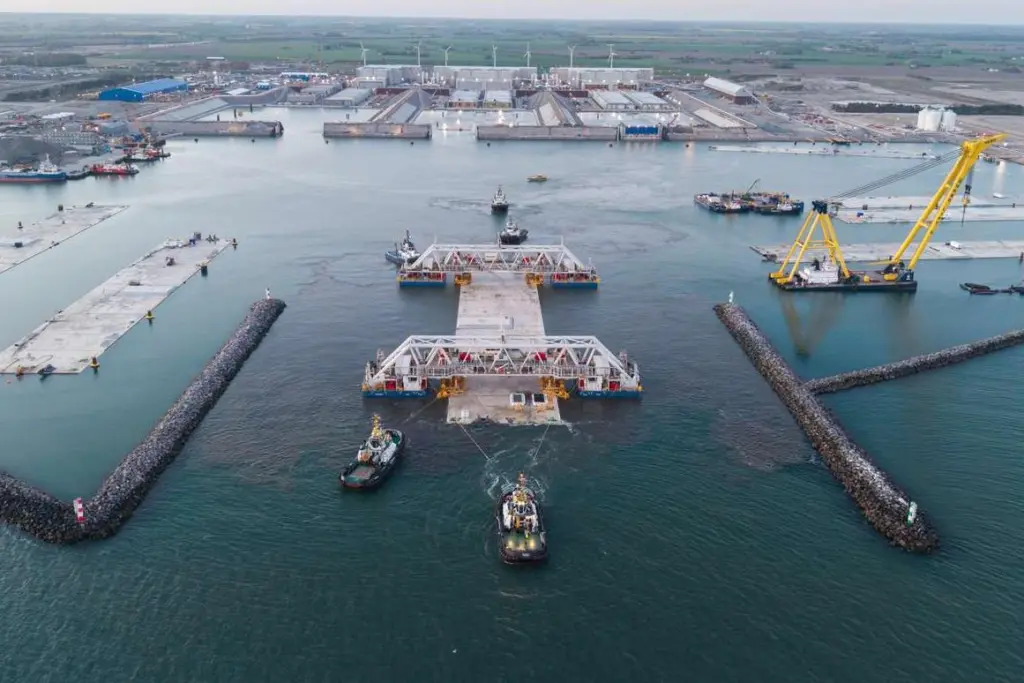
Contractors have added a further 4,500 tonnes of ballast concrete to the first element to make sure it sinks to the seabed. It contains four tubes that will in future see trains and cars pass through them.
Five tugs and a vessel built specifically to immerse elements are now on the 2km journey to the immersion point.
”This is a very complex manoeuvre, which has never been carried out on this scale before,” said Lasse Vester, Deputy Contract Director at Sund & Bælt, which is building the tunnel.
“The elements of the Fehmernbelt Tunnel are both wider, heavier and longer than those used to build the Øresund fixed link (between Copenhagen and Malmö), and we will be working in significantly deeper water.”
Each element is 217 metres long, sealed at each end and filled with air.
Sund & Bælt says that because the road traffic tubes are heavier than the railway tubes, they are not naturally balanced and the railway tubes have to be fitted with temporary water chambers to ensure they stay horizontal while being immersed.
The immersion will take several days, during which time rocks and gravel will be placed along the sides of the element to keep it in position in the tunnel trench.
”It is a major task with very little margin for error. We have to immerse an element that is as long as two football pitches, within just a few millimetres. That places great demands on the equipment and on our contractor, which is why they have been preparing for this task for a long time,” said Vester.