![MaritimeJournal[Seawork]](https://www.maritimejournal.com/wp-content/uploads/2026/09/MaritimeJournalSeawork.svg)





WATCH: Belgium energy island structures completed
Twenty-three concrete caissons for Belgium’s Princess Elisabeth Island have been completed, advancing offshore renewables and offshore wind grid integration in the North Sea.
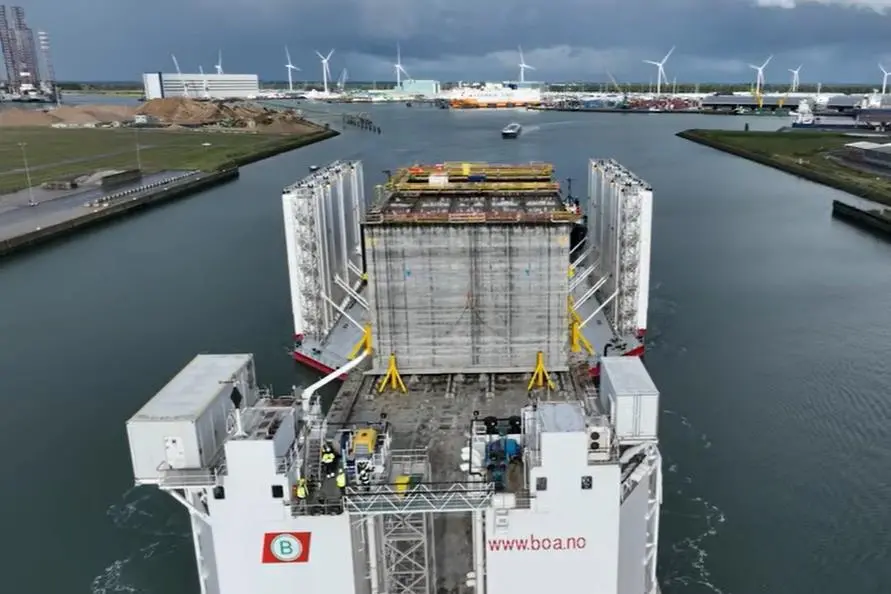
Construction teams at Vlissingen in the Netherlands have successfully built and floated all 23 massive concrete structures that will form the foundations of the artificial energy island.
“The North Sea is set to become the powerhouse of our energy independence and Princess Elisabeth Island will be a crucial part of this process,” said Alexander De Croo, Prime Minister of Belgium.
“Belgium has long been a pioneer in offshore wind, and by continuing to innovate, we are further consolidating our position for the future.”
The units have now been transferred to the Scaldia terminal for final finishing works, with offshore installation scheduled to resume in spring as marine construction activities restart offshore, around 45 km off the Belgian coast.
Joined-up infrastructure
EliaTransmission Belgium (ETB), the utility spearheading the project commissioned the artificial island to collect renewable electricity from offshore wind farms and transmit it to the high-voltage onshore grid, while also linking Belgium with the British and Danish networks.
Built in partnership with Jan De Nul under TM EDISON, the development is located within one of the world’s busiest shipping lanes, adding complexity to logistics and marine construction planning.
With a planned capacity of 3.5 GW, the island is expected to make a material contribution to Europe’s 2030 renewable energy targets and support the rapid expansion of offshore renewables.
It will also serve as an interconnection hub, enabling power flows through links including Nautilus and Triton to balance regional supply and demand.
Environmental measures, including nesting ledges, underwater relief panels and scour protection, aim to enhance biodiversity alongside critical offshore wind infrastructure.
Back in June 2025, MJ reported that construction of the high-voltage alternating current (HVAC) structure for Belgium’s offshore energy hub had begun, following on from the installation of the first caissons for the structure in May.
In the beginning, the project experienced a three-year delay to delivery, because of the rising costs of HVDC infrastructure.