

Change of current: Damen downsizes the eSOV
 Part of our special report
Batteries, boats and the power problem · November 2026
All 7 features
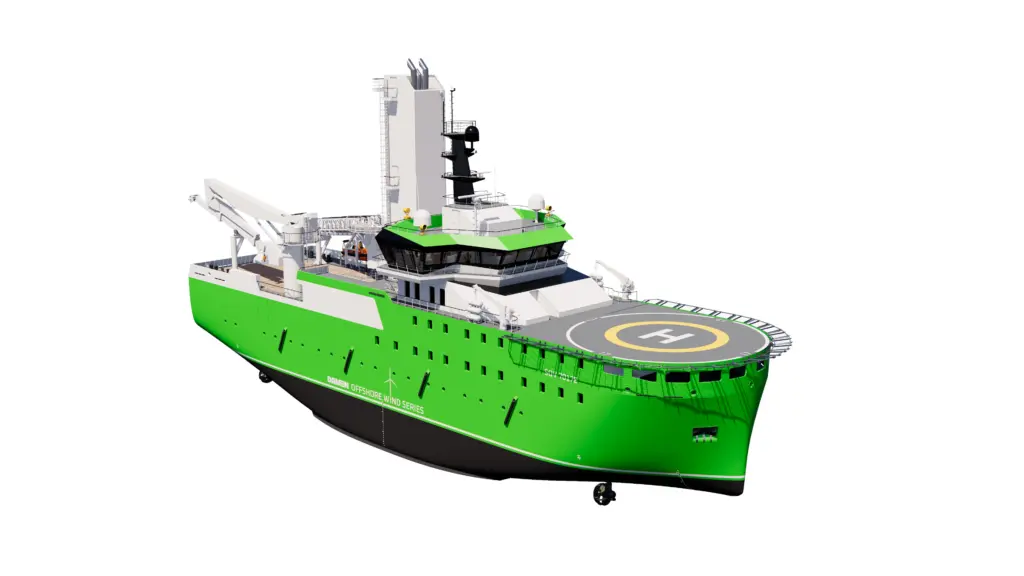
For the past half decade, the construction pipeline for Service Operations Vessels (SOVs) has been dominated by 90-metre platforms. Could this be about to change? Serena Shores talks to Mark Couwenberg, Product Portfolio manager for SOVs at Damen, about market dynamics and the push for up to 98% full-electric operations – something that could drive demand back down the tonnage scale.
“Measuring 70.1 metres in length with a 17-metre beam and a 4.5-metre service draught, our Damen SOV 7017E is the compact sister to the established SOV 9020,” says Couwenberg. “Engineered specifically to balance capital expenditure with advanced green technology, the 4,300GT vessel introduces a highly sophisticated diesel-battery hybrid plant, a double-ended propulsion layout and an integrated offshore charging philosophy. The mismatch between potential excess capacity and the philosophy to favour scale has been the catalyst behind the design.”
By standardising a 70m platform with a 60 single-cabin layout, Damen aims to eliminate the costly engineering hours and operational risks associated with building bespoke asset prototypes.
The platform provides the exact capabilities the industry requires for short-to-mid-term maintenance campaigns without unnecessary structural bloat, and complements the company’s diverse portfolio of targeted maritime electrification projects as part of a clear strategy to become the world’s most sustainable shipbuilder, using an approach that transitions from small workboats to massive offshore vessels.
Propulsion revolution: Double-ended azimuth layout
Damen decided on a radical departure from traditional propulsion geometry in the SOV 7017E. The design moves away from a conventional bow configuration with tunnel thrusters, to use four 900kW azimuth thrusters positioned in a double-ended arrangement that drastically changes how the vessel interacts with localised wind farm environments.
Damen’s layout removes the traditional bulbous bow entirely, creating volume to house highly agile azimuth units that can orient thrust 360 degrees. There is a highly logical hydrodynamic and operational philosophy behind this configuration.
“The four-thruster arrangement is something which is highly viable, operating fully electric in DPX Green DP mode and using less energy than the vessel’s hotel load,” says Couwenberg. “It’s the rationale behind the concept: achieving stable station keeping and low speed on wind farms, which the 7017E easily has the ability to facilitate. Mainly we’re looking at the operation, plus 80 per cent low speed between wind farm and ports, which is perfectly justified. The manoeuvring makes the operation more efficient and uses less power, taking into account wind speeds and if conditions are even. It means the vessel can approach a turbine while at stern so there is an efficiency gain from the system.
“Positioning involves minute, highly efficient manoeuvres and adjustments in the direction you need, because these thrusters, especially in the bow, are most effective compared to tunnel thrusters. This naturally influenced a big change in the hull design.”
This intense focus on low-speed hydrodynamic optimization yields major efficiency dividends, even if it compromises top-end transit speeds slightly.
To move smoothly at sea, the impact of the waves needs to be as minimal as possible, but there is always a compromise: the right balance.
“Basically at low speeds of 10–11 knots we are saving, which is what clients ask for,” says Couwenberg. “At 12.5 knots in this scenario, conventional is sometimes faster.”
LFP versus NMC batteries
For the 7017E, Damen communicates an LFP battery capacity of 10 or 15MWh, enabling approximately 75% or 98% full-electric operations, with two 1200ekW HVO/diesel generator sets as back-up.
This battery system functions as a dynamic spinning reserve and power back-up, ensuring the internal combustion engines run at peak thermal efficiency.
When selecting battery chemistries, Damen opted for lithium iron phosphate (LFP) over lithium nickel manganese cobalt (NMC).
“When it comes to LFP, a large part of the world is using this technology,” says Couwenberg. “Its application makes perfect sense for a lot of reasons, one being cost. NMC in general has better energy density, discharges faster, but is less safe. For what we are trying to achieve, a little bit slower speed for charging is okay.
“LFP was also selected specifically because of its comparatively high level of safety: it is less prone to ignition and a fire is easier to contain. What complicates things is that lots of development is taking place incredibly fast, particularly with aluminium edits to alter and improve the battery’s performance.”
The vessel is also prepared for future conversion to methanol as a fuel, with preparations including all steel construction of tanks, cofferdams, fuel treatment rooms and pipe trunks.
The selected diesel generators can be converted for methanol and the prepared tank capacity is sufficient for two weeks’ normal operation on full methanol.
Direct offshore charging: Stillstrom and MJR Power
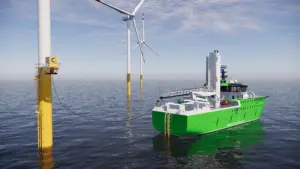
The ultimate goal of the 7017E is achieving complete operational autonomy on battery power while in the field.
Damen envisions an infrastructure where the vessel can transition through its daily task list solely on electrical storage, due to the slow-speed nature of wind farm work. The company is collaborating closely with Stillstrom to evaluate the deployment of a simple crane and messenger line system from the foredeck.
There has also been cooperation with MJR Power & Automation regarding charging via the gangway, with a 4 MW/11kV connector at the stern.
“As a typical SOV, we believe we can give endurance for one day of work – not just sailing – as the demands are for the vessel to be pretty slow, which doesn’t consume a lot of power,” says Couwenberg. “The battery is therefore sufficient on one single charge. However, we are also looking at if it would be beneficial to charge twice a day. There are limitations in that we cannot acquire anything more than 6-8 megawatts as the cable becomes so big. We have been considering using multiple cables which could be manageable. If we were charging using the gangway, this might still be possible.”
A ship-to-quayside charging option puts a line in the connection unit and the cable coil would unravel. Directed from the wheelhouse, charging at a single turbine is predicted to take a few hours; in port this should be no more than 10 minutes. However, implementing that infrastructure requires navigating commercial, regulatory and electrical challenges across the wider wind farm development landscape.
“The status of 7017E is that it’s a concept design that has the potential to trigger the market, thus steps have to be taken and calculations made to make it work,” Couwenberg says. “To make sure we have the wind farm charging infrastructure, it is very much a matter of addressing the obligations and questions about who owns the electricity and who is going to pay.
“Chargers and everything around them have progressed pretty far and there are a lot of different possibilities. One proposal would be to add the charger to the turbine, which would be relatively expensive, but on a new-build wind farm it would be much more feasible.”
With the space for the charger considered, as it would operate from the offshore substation, current research can at this stage say a lot more about the charger itself, not the implications for a significant new build wind farm phase.
Chargers are at various stages of development, from engineering and testing to reading the market about top ups.
“In terms of testing, the fastest appears to be Denmark. It’s interesting stuff,” Couwenberg says. “From a technology perspective it’s a measure of proper engineering.”
Crucially, the hybrid architecture does not discard conventional power backstops. The onboard diesel generators remain an essential component for regulatory compliance and safety insurance. The necessity for installing diesel generators is not counter-intuitive to the drive towards zero emissions, but vital for security to ensure that vessels can still do all their operations, including long trips such as leaving a shipyard for their destination and factoring in charging potential, adverse wind conditions or battery malfunction.
Final thoughts on the future
“In today’s market and operationally, we hardly see smaller vessels of 70m; for the past four to six years demand for 90m has been very strong, with all vessels under construction or being delivered in that range,” says Couwenberg. “However, what I believe is going on, is that the sector is recently beginning to expect demand for smaller vessels.
“We can learn from charterers too that owners are looking to SOVs with more flexibility in mind but building prototypes in this industry involves engineering, thousands of man-hours, plus risk.
“With its battery capacity prepared, there will certainly be an evolution over the next few years for not only 7017E but also our extensive range of vessel types, shifting clean propulsion from experimental pilots into scalable commercial realities.
“This all forms part of our infrastructure ecosystem; it’s a case of preparing these vessels for an exciting future.”