![MaritimeJournal[Seawork]](https://www.maritimejournal.com/wp-content/uploads/2026/09/MaritimeJournalSeawork.svg)



Franco-Dutch dredger co-operation
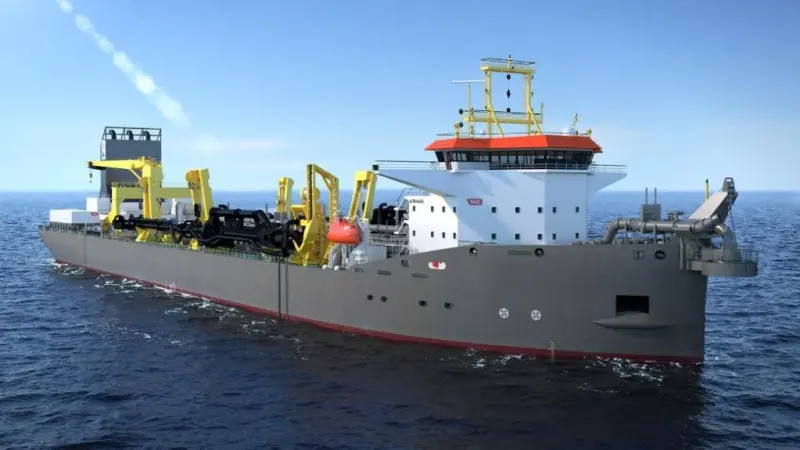
Piriou Shipyards in France has delivered a 2,300 cu/m capacity trailing suction hopper dredger, fitted out with Damen dredging equipment, to the French sand mining contractor CETRA.
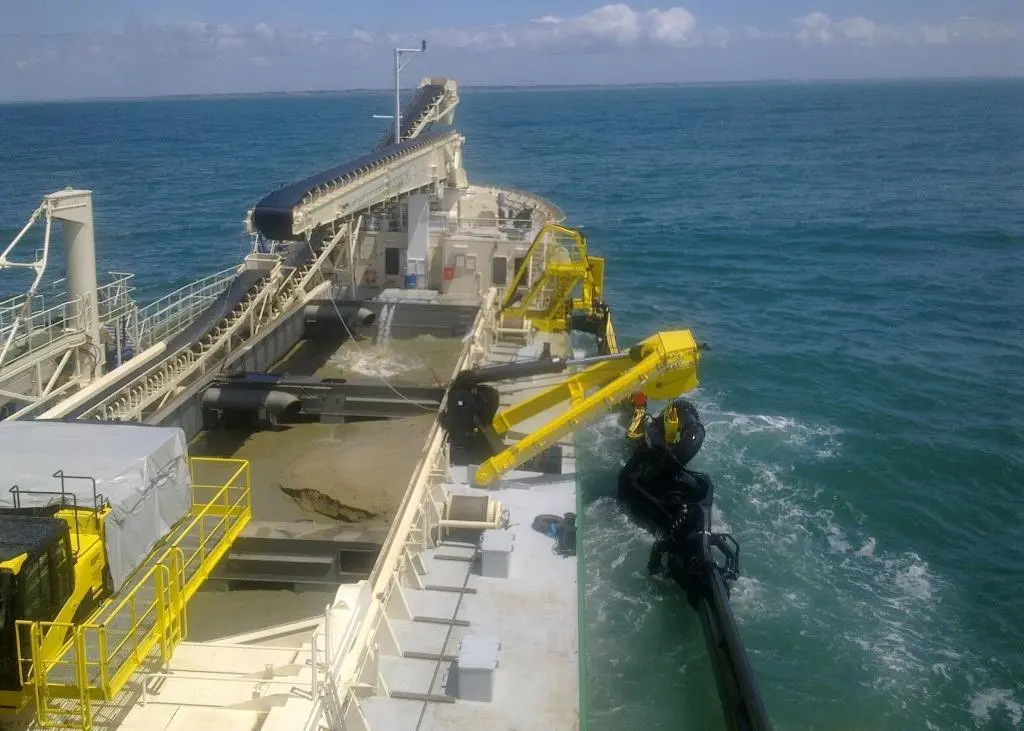
The hopper dredger, named Michel De Sousa Reis, will mine sand and gravel off the Brittany coast and transport it throughout the Loire Estuary. The vessel is a prime example of Franco-Dutch cooperation in dredger building.
The twin screw hopper dredger has been fitted out with a single starboard side 600mm diameter trailing pipe with integrated submerged dredge pump. The vessel is 85m long, 15.85m wide and has a dredging draught of 5.98m.
The bridge and the accommodation are located aft. The spacious seven crew accommodation includes all fully air conditioned facilities such as galley, mess room, etc. The pump room and the engine room are located in the forecastle, near the hull suction inlet. Two 1,920 kW Caterpillar propulsion diesel engines ensure a speed of 13 knots.
The dredger has been designed for an important dredging depth of up to 40m. In order to optimise efficiency and generate high mixture concentrations, the trailing pipe has been fitted out with an integrated submerged dredge pump. This high efficiency Damen dredge pump of type OBP6055LD is direct driven by a 600 kW electric motor.
The jetwater assisted California type drag head has been chosen, as the mining activity concentrates on relatively coarse sand and gravel meant for the building industry. The trailing pipe is remotely operated by three gantries and their hydraulically driven winches. The drag head winch wire runs over a swell compensator which manages a maximum swell of 4m.
The versatility of the ship shows in the unloading systems. Unloading can be done either by using a dredge pump or by the excavator situated over the hopper. The inboard Damen dredge pump of type BP6055HD is installed for self discharging the hopper cargo using the longitudinal self emptying system along the hopper with hydraulically operated Damen dredge valves as suction channel doors.
The 1,800 kW high pressure dredge pump has been provided with wear resistant wet parts and a mechanical shaft seal, and efficiently pumps the diluted cargo to either the side coupling or the bow coupling. The side coupling has been designed to fit land based counter-couplings in various ports. Also, a 600mm bow coupling unit is installed for pumping ashore on several existing floating pipe lines.
When the dry discharging system is used, the vessel does not require any port infrastructure. The Caterpillar excavator of type 385C is based at coaming level and runs over rails located along the sides of the hopper. During dry discharging it moves slowly forward, depositing dry hopper cargo in the funnel which moves along the portside conveyor belt. Another conveyor belt, turned aft during transit, is now directed over the bow or side to deposit gravel on the quay.
The hopper dredger is fitted out with a complete system of Damen dredging instrumentation and dredging automation. The performance of the dredge pumps is closely monitored using the data of the vacuum and pressure sensors, plus the detailed production data from the radioactive density meter and the magnetic inductive velocity meter. The position of the trailing pipe is monitored by the suction tube position indicator using data from inclinometers on the trailing pipe hinges. The course of the hopper loading process versus time is shown on the load and draught system, fed by data from the bilge mounted pressure sensors.
Following satisfactory sea trials and dredge trials, the vessel has been handed over to owner CETRA and has started its productive life from its homeport Saint Nazaire. It is now continuously delivering building materials to many French ports along the Atlantic coast.