![MaritimeJournal[Seawork]](https://www.maritimejournal.com/wp-content/uploads/2026/09/MaritimeJournalSeawork.svg)


Redesign extends life of dredger Kilmourne
A grant from the European Fisheries Fund has led to a major life extension project being undertaken on the dredger Kilmourne, built by James W. Cook of Wivenhoe in 1986 to the order of the Northern Ireland Fishery Harbour Authority.
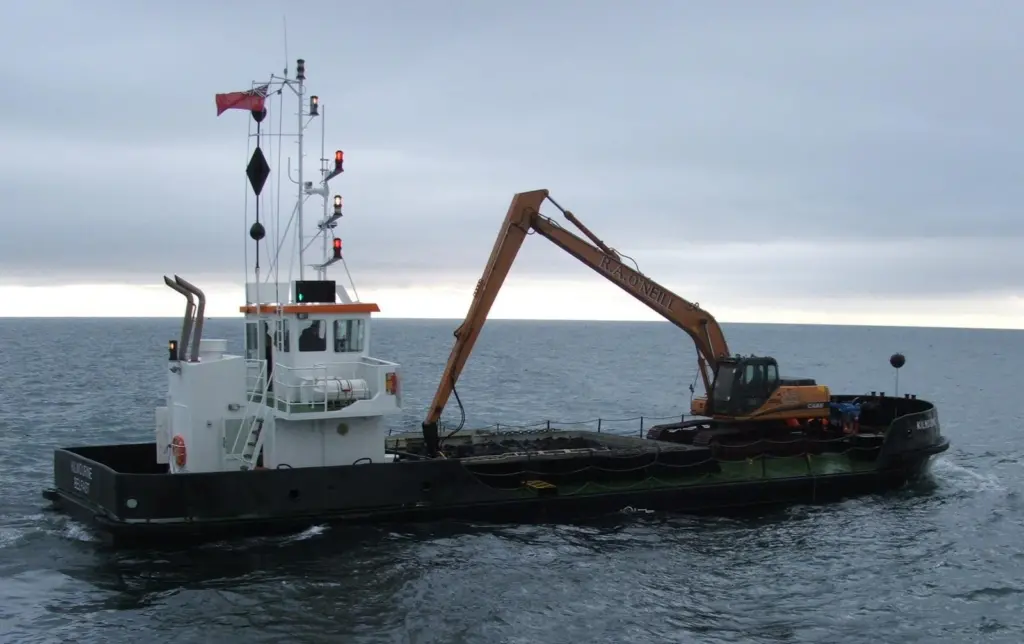
Consultant naval architect Ian C. Darley was responsible for all the design work and preparation of new stability data. He also acted as owner’s representative/agent. Manor Marine of Portland UK won the competitive tender to carry out the project.
When constructed, the vessel was classed 100A1 at Lloyds and powered by a single deck mounted Hydromaster unit with an output of 230 shp. The object of the project was to extend the working life of the vessel by at least 20 years, including a new machinery and stern gear installation, reducing the length to less than 24m and classifying with Mecal as a Category 2 vessel under the UK workboat code.
The hull was shortened by about .75m, an engine room casing and funnel were added for the new machinery, and the main deck accommodation was extended to provide additional mess facilities for the crew.
The new main engines, supplied by WaterMota Ltd, are Doosan MD196TIs, each rated 320 bhp at 2,000 rpm and driving 1,114mm diameter four bladed propellers in fixed propeller nozzles. Stern gear is from Teignbridge Propellers and nozzles are from Kort Propulsion. This package combined with a 550mm bow thruster from Hardy Engineering, gives the vessel exceptional manoeuvrability and has increased the light free running speed from about 5 knots to over 11 knots and the full load speed of 4 knots to over 9 knots. Steering gear is from Wills Ridley and is of the full hydraulic type with a jog lever at the helm and 24v DC power pack located in the engine room. 230/1/50 AC electrical power is from a Beta Marine model Beta Set 17 with an output of 11.5kW at 1,500 rpm.
Crew accommodation is fitted out to a high standard with a mess/galley including hob, microwave, refrigerator, comfortable seating for up to six crew and wash room. The wheelhouse includes adjustable suspension seats for both the helmsman and two crew, with all controls at the helm and a full suite of Furuno NavNet 3D electronics, including 24 NM radar, high definition echo sounder, satellite compass, GPS, plotter, auto pilot, two 12” displays and AIS.
The hopper bottom doors were overhauled, new operating rams installed, and a complete new hydraulic system installed, with pumps powered from the front end of the main engines. This was all designed and supplied by Hardy Engineering.
Normally a long reach excavator is mounted on the foredeck but the area has been deliberately left clear so that a variety of plant can be used, such as cranes, pile drivers or winches.
With the increase in speed and much improved handling the dredger’s main task of clearing Kilkeel Harbour has become much more efficient. Previously, only one or two trips to the dumping grounds, located three miles offshore, were the most that could be hoped for in a day and in onerous wind and tide conditions the vessel was unable to leave port. Now three trips a day is the average, with the vessel having ability to dump dredged material in winds of up to force 5 or 6.