![MaritimeJournal[Seawork]](https://www.maritimejournal.com/wp-content/uploads/2026/09/MaritimeJournalSeawork.svg)



EU must re-industrialise to keep wind afloat
Europe must re-industrialise to stay afloat in pushing wind objectives and maintaining competitiveness, a WindEurope webinar was told by Director of Advocacy and Messaging Viktoriya Kerelska.
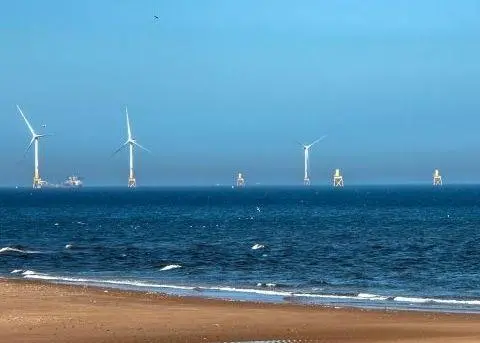
She said there were three main focuses now, in light of the recently revealed Clean Industrial Deal, which has replaced the European Green Deal: “One, there is a huge focus on the fact that we need to make industries competitive again – we need to re-industrialise; two, energy is at the core of our competitiveness, without question; and three, we are not going to negate our committed objectives (on clean energy) and there will be a lot of effort on renewables, in fact that will grow.
“It’s clear that you need to have energy and electricity sources that are clean and affordable and not subject to external pressure.”
Answering a question as to whether US president Donald Trump’s anti-offshore wind stance was likely to harm Europe’s ambitions, she said: “I think it’s really regrettable but it is what it is.
“Ultimately it also allows some investments to come back to Europe or reinforce the European base. We expect things to change under a different administration.
“What’s online will continue to support the US economy. We must make sure in Europe to pick up on the volumes of renewable energy and reinforce the industrial base and not lose sight of this. It’s also important to support and give an example of the value of the industry and what it can bring to national economies – the jobs it’s created and so on.
“A lot of things are happening – the geopolitics of energy are changing by the hour, especially since last Friday (when Trump argued with Zelensky in the Oval Office).
“In Brussels from the EC there’s a certain sense of stability.”
Offshore wind down in 2024
WindEurope had predicted offshore wind installations of 3.8GW last year, but instead it amounted to 2.6GW, said head of Market Intelligence Guy Brindley.
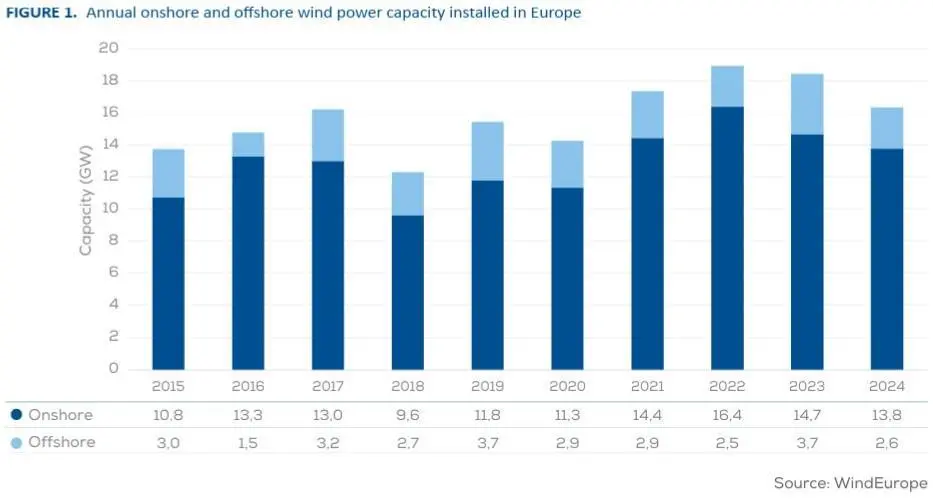
Delays were for different reasons on a project-by-project basis, such as installation issues at Calvados, supply chain constraints at Dogger Bank and other delays at the 900MW Borkum Riffgrund farm, he said.
Europe wide, there is 37GW offshore wind installed, though not necessarily operating, making up 13% of total wind power capacity.
Although wind power supplied 19% of the EU-27’s electricity in 2024 – 20% if you include the UK – offshore wind accounted for just 10% of that. In other words, of the 210GW generated by wind for the EU, 21GW came from offshore.
Permitting, said Kerelska, was still a bottleneck, and while Germany had permitted seven times as much onshore wind as the year before, the story was not the same for offshore or in other countries. Grid connection issues also held up developments, she said.
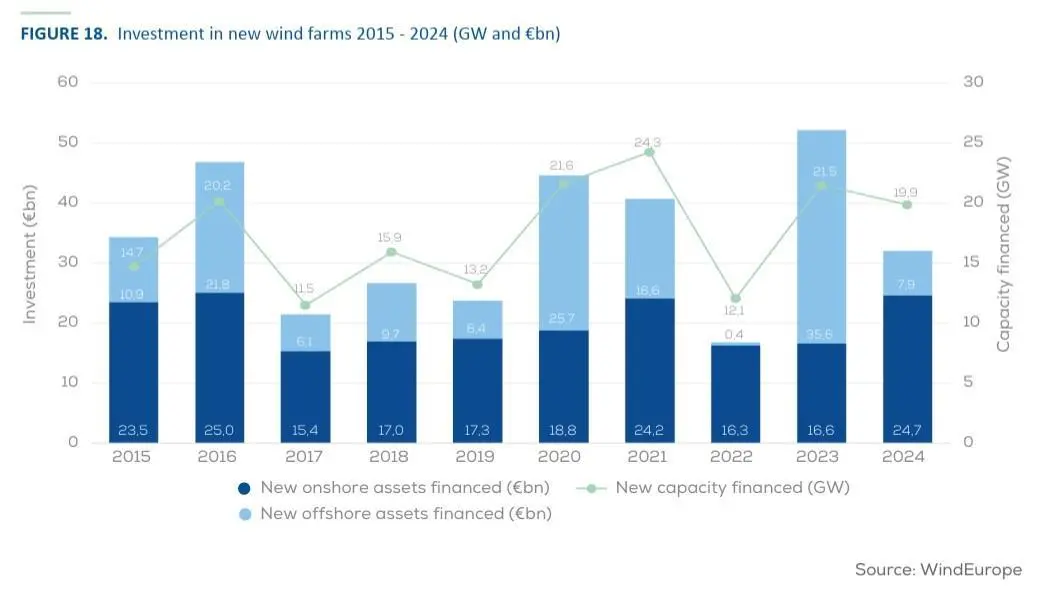
Brindley also said financing was down: offshore, investments totalled €8 billion compared with €21.5 billion in 2023, but this was normal offshore because of the size, number and time taken for such big projects, he said.
WindEurope statistics show that Denmark was by far and away the biggest wind power producer by percentage, with wind covering 56% of its electricity demand in 2024, half of that coming from offshore wind.
Ireland came in at second, with 33% of electricity demand met by wind – but none from offshore.
In the UK, Netherlands and Belgium, roughly half of wind power was produced from offshore wind.
The route to 2030
The EU has set an ambitious target of reaching 450GW of total wind capacity by 2030, including 84GW from offshore sources.
However, project delays have pushed installation timelines further back – such as at Borkum Riffgrund, which has been postponed to 2027-2028, and in the UK and France.
“There are major barriers to the rapid expansion of offshore wind envisaged by 2030,” a WindEurope report ??? said. “This has created uncertainty about the commissioning dates of wind farms, complicating supply chain expansion.
“We therefore expect offshore project delays to become a major bottleneck across Europe from 2029.”
There were also concerns as to the build-out of port infrastructure necessary, and investment in new vessels capable of installing the largest turbines.
In terms of new projects, bottom-fixed offshore wind energy developments awarded in 2024 totalled 18.4GW across Germany, the Netherlands, Denmark, Estonia, Norway and the UK. Floating offshore wind projects amounted to 1.2GW, with France securing 750MW and the UK 400MW.
However, 3.7GW of offshore wind capacity was not allocated in 2024 due to Denmark (3GW) and Lithuania (0.7GW) failing to award contracts in their auction rounds.
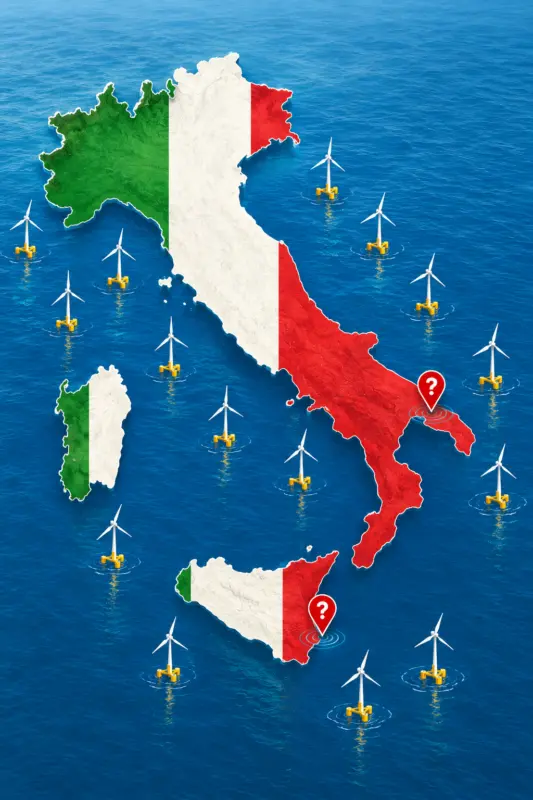
In other countries, several postponed auctions are now scheduled for 2025, including Ireland’s ORESS 2.1 (900MW), and the first offshore wind auctions in Italy and Portugal.
Related Articles
 FEATURES & VIDEOS
 ENVIRONMENT
 OTHER NEWS