![MaritimeJournal[Seawork]](https://www.maritimejournal.com/wp-content/uploads/2026/09/MaritimeJournalSeawork.svg)






Latest UK offshore wind farm given green light
Another 90 offshore wind turbines will be installed offshore England’s south coast, adding to 116 turbines already operating alongside.
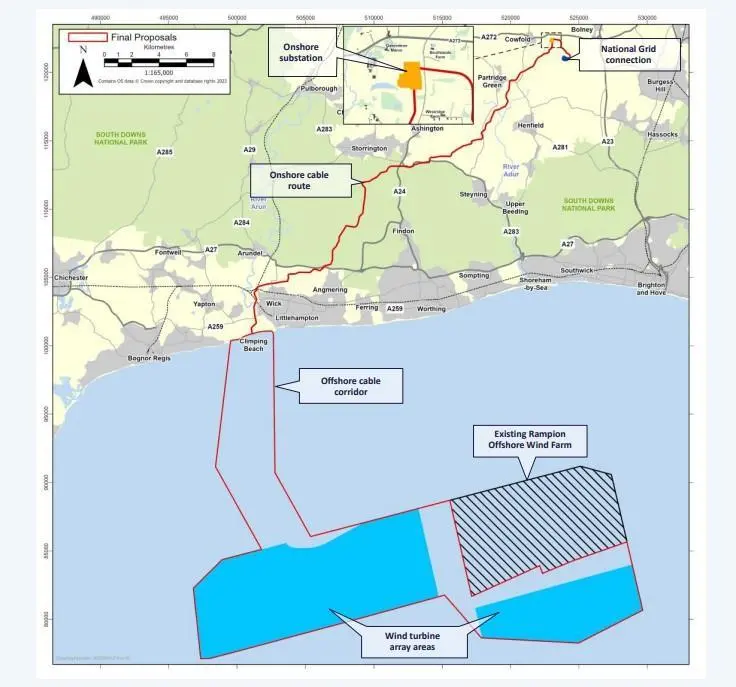
’Rampion 2’ will be installed as an expansion of its older brother Rampion, which was fully commissioned in 2018 and is about a third of the size of its newer relation in terms of wind turbine generation capacity and size.
Where Rampion 1’s 116 turbines have a generation capacity of around 400MW, with each turbine generating about 3.4MW each, the second project will produce 1.2GW among 90 turbines, which means each turbine can put out 13.3MW each.
They are much taller, too – the blade tip height will be up to 325 metres, compared with Rampion 1, with a blade tip height of 140 metres.
Where Rampion 1’s rotor diameter was 112 metres, the newer ones will be almost three times that size, at 295 metres.
“Turbine technology has advanced at a rapid rate,” says the developer RWE. “Since procuring Rampion over a decade ago, turbines have become more powerful and there have been significant improvements in what can be technologically achieved.
“A scheme of fewer, larger turbines increases efficiency and reduces the cost of deployment thereby reducing cost to the end consumer. Larger rotor diameters also means greater spacing between turbines to avoid the ‘wake’ effect downwind, which reduces electrical output.”
Sub-optimal cables and grid
In 2024, offshore wind farm owners were paid £176 million (€202.5 million), according to the National Energy System Operator press office, to switch off their turbines because the grid infrastructure is too congested and cannot cope with the extra power. Rampion, which is named after a distinctive flower indigenous to the area, is believed to have been paid £2.5 million in 2024.

Known as ‘curtailment’, as well as paying owners to switch off, the government also has to spend vast sums on replacement power – often from gas-fired plants.
Where Rampion is concerned, the existing 27km of cables that send electricity onshore cannot be used for the expansion of the farm because ‘they do not have the capacity to accommodate three times more power from Rampion 2 to connect the project to the transmission network’.
It means new cables will be buried underground along the whole cable route.
“The practical experience gained from the work undertaken delivering the Rampion I project has been fed into the planning for Rampion 2,” said Rampion 2 Development & Stakeholder manager Chris Tomlinson.
Related Articles
 FEATURES & VIDEOS
 ENVIRONMENT
 OTHER NEWS