![MaritimeJournal[Seawork]](https://www.maritimejournal.com/wp-content/uploads/2026/09/MaritimeJournalSeawork.svg)

Study reveals worst North Atlantic areas for plastic waste
A new study has revealed the five areas in the North Atlantic where floating plastic litter poses the greatest threat to marine life.
Up to 23 tonnes of plastic waste entered the planet’s waterways and oceans in 2016 with this figure predicted to triple by 2030. Items such as bags, bottles, food containers and cutlery are often transported far from their source via ocean currents making the problem difficult to monitor and manage.
Over 4,000 marine and coastal species are known to be affected and scientists at the Plymouth Marine Laboratory have been mapping exactly how this debris travels into and around the North Atlantic to identify which species are at the greatest risk.
“These findings highlight the potential of spatial risk assessment analyses to determine the location of high-risk zones and understand where plastic debris monitoring and management should be prioritised,” explained Dr Sam Garrard, lead author of the study and marine ecosystem services researcher at Plymouth Marine Laboratory.
“This enables more efficient deployment of interventions and mitigation measures.”
The team modelled the movement of plastic from 16 countries surrounding the North Atlantic between 2000 to 2015.
The movement of these particles was driven by surface currents and wind, and after a 15 year run, the model showed where plastic was accumulating.
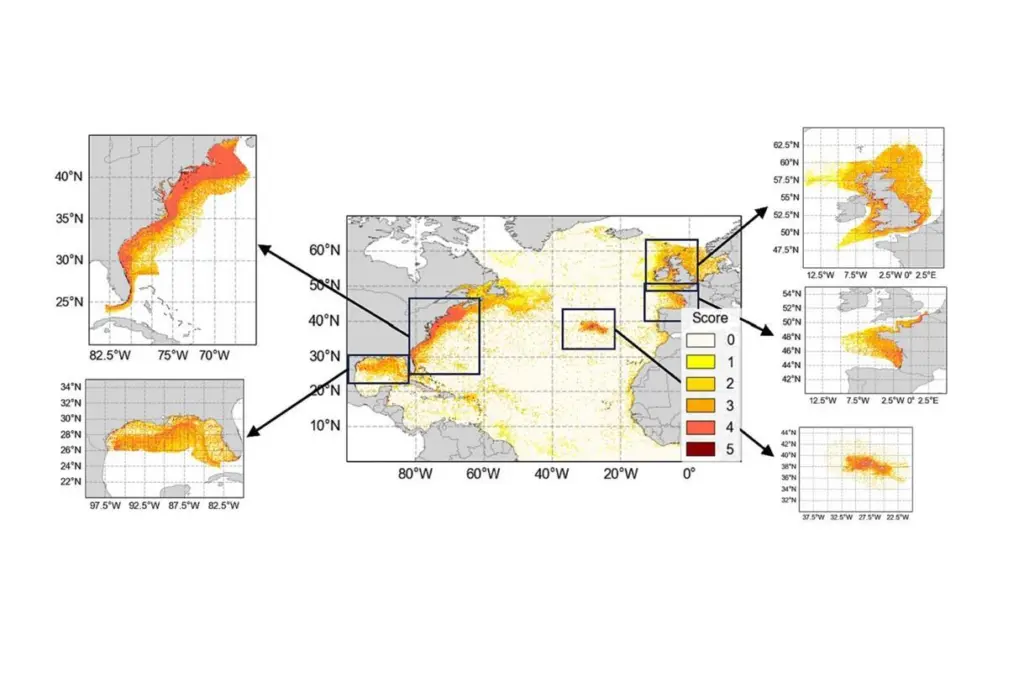
To assess risk, modelled concentrations of the plastics were combined with the distribution and vulnerability of various species and shallow water habitats. Vulnerability scores were then determined by assessing the extent of predicted ingestion, entanglement and environmental smothering.
Key findings
The modelling analysis identified high-risk zones as UK waters, the Azores, the French and US Atlantic coasts and the US Gulf of Mexico.
The marine megafauna most at risk were shown to be seabirds, whales, dolphins, porpoises, turtles and sharks, rays and skates.
Sheet-like plastics such as plastic bags and food wrappers were the most commonly ingested type of land-derived plastic litter for most marine megafauna, except seabirds which were generally more at risk of ingesting hard plastic fragments.
The habitats most at risk were mangroves and coral reefs, where entanglement and smothering by plastic appear to be significant threats.
UN member states have come together on the Global Plastics Treaty, an international agreement to tackle plastic pollution, negotiations on which are expected to complete by the end of the year.