![MaritimeJournal[Seawork]](https://www.maritimejournal.com/wp-content/uploads/2026/09/MaritimeJournalSeawork.svg)





VIDEO: New platform could revolutionise floating wind
The PivotBuoy project, developed by X1 Wind in collaboration with nine industry partners, has completed its offshore demonstration project successfully with plenty of lessons learned for the future.
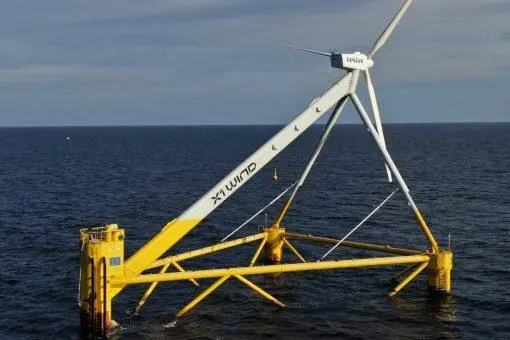
The Spanish firm’s X30 platform was tested in full operational conditions at PLOCAN from October 2022 to May 2023. During the seven month demonstration, the device became the world’s first fully functional floating wind Tension Leg Platform (TLP) feeding its electricity to PLOCAN’s Platform via a 1.4km 20kV subsea cable.
“The PivotBuoy Project marked an important phase in the development of our innovative technology,” said Alex Raventos, CEO, X1 Wind.
“It allowed us to retrieve large amounts of data for a sustained period of time in full operational conditions. These findings have provided crucial insights which are now being incorporated into X1 Wind’s ongoing commercial-scale projects, including the NextFloat Project.”
Lessons learned
The project aimed to demonstrate the advantages of combining a single point mooring (SPM) with a small TLP mooring system, allowing the platform to reach deeper waters and minimising the footprint and impact on the seabed.
During the project, the platform validated its lightweight and stable floater, which was easily wet towed by local vessels, simplifying and accelerating the installation process.
Mr Raventos said that the recently published results illustrate excellent performance across a broad range of parameters including platform stability, passive alignment, structural behaviour and power production.
During the project, data was collected from multiple sensors installed across the platform through a dedicated and proprietary SCADA called Floating Management System.
Importantly, data showed very good alignment with the wind using its passive orientation system. The platform showed better alignment than publicly available data for traditional active yaw systems for strong winds (>7.5m/s) and similar alignment for lower wind speeds (<7.5m/s).
In terms of power production, energy generated by the modified Vestas V29 – which operates in a downwind configuration – was well aligned with theoretical models, with no sign of power loss or increased 3P vibration due to the tripod shadow.
The results confirm that X1 Wind’s streamlined tripod arrangement eliminates the known drawbacks typically associated with downwind operation.
In addition, the platform overcame several harsh storms, with maximum wave heights reaching 6.7 metres, equivalent to more than 20 metres in full-scale. During these extreme events, the unit behaved well with motions and accelerations matching the predictions in simulation models.
Industry milestone
Mr Raventos added that the decommissioning process, which was a requirement after the end of the EU funded project in March 2023, also proved the ease of disconnection of its innovative single point mooring system, successfully completing the disconnection, unhook and towing in less than one working day.
The X30 platform was towed to Arinaga Port for its full decommissioning, removing the key elements for further analysis and offering some parts to the Instituto Técnológico de Canarias (ITC) for educational purposes at its facilities in Pozo Izquierdo.
“This is another milestone for the industry, especially taking into account that we use a TLP mooring (which provides many advantages but historically was very difficult to hook and un-hook),” he said.
“By proving that our PivotBuoy mooring system can be easily hooked and unhooked we’ve shown that TLPs can easily be installed, decommissioned or maintained at port in case a tow-to-port maintenance operation is needed. All this learning is key in the development of the commercial scale units.”
The PivotBuoy Consortium comprised of nine partners from five different countries (X1 Wind, EDP, DNV, INTECSEA, DTU, WavEC, PLOCAN, ESM, and DEGIMA).
Related Articles
 FEATURES & VIDEOS
 ENVIRONMENT
 OTHER NEWS