![MaritimeJournal[Seawork]](https://www.maritimejournal.com/wp-content/uploads/2026/09/MaritimeJournalSeawork.svg)






VIDEO: North Sea carbon capture in progress
A 20km offshore carbon dioxide pipeline has been installed in the North Sea to send the gas to storage reservoirs.
The Netherlands’ Porthos project has involved a tremendous amount of civil engineering work, and this next stage has involved the pipeline being sunk in trenches along the entire 20km then covered with a layer of sand.
The pipes were welded together onboard a vessel then lowered to the seabed, where it was sunk in trenches before being buried.
The CO2 will be captured from the various industries based at the Port of Rotterdam and transferred into a compressor station on the Maasvlakte, from where it will be sent to platform P18, above depleted gas fields.
It will then be piped some 3km underneath the seabed where it will be stored ‘permanently and safely’, according to the project leaders.
PORTHOS stands for the ‘Port of Rotterdam CO2 Transport Hub and Offshore Storage’. It is one of a handful of carbon capture and storage projects that have been springing up around the world, mostly in North America.
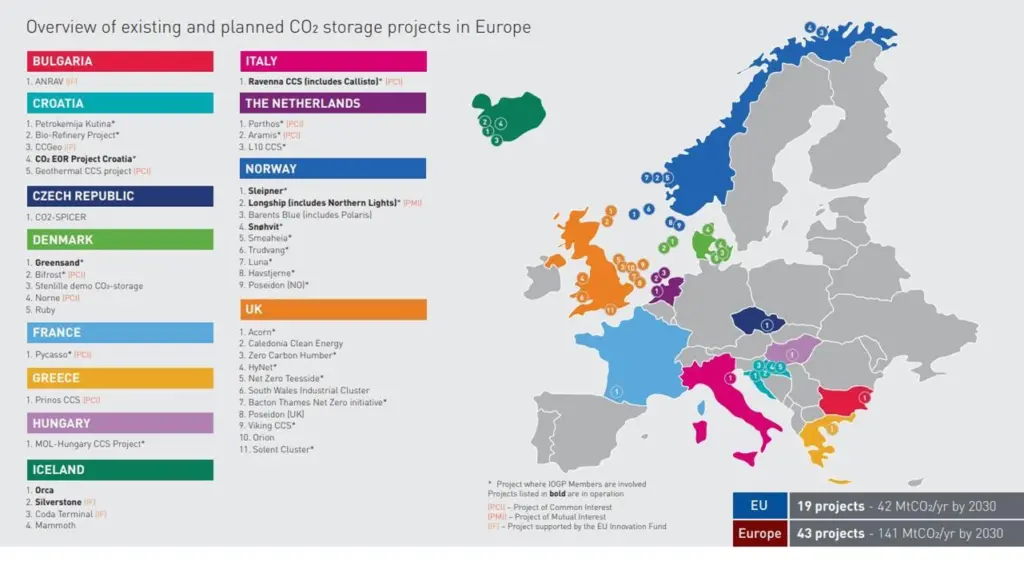
According to the International Association of Oil & Gas Producers (IOGP), which is involved with many of the projects, there are eight actually operating in Europe, including Norway’s Sleipner project, which began operations in 1996, and captures CO2 from natural gas production then injects it into deep saline aquifers for permanent storage.
Others include Croatia’s CO2 EOR Project; Denmark’s Greensand; Italy’s Ravenna CCS; Iceland’s Orca and Silverstone; and in Norway, the leader with three, there is Sleipner, Longship (Nothern Lights) and Snøhvit.
Another 43 projects are in certain stages of development. Denmark has allocated almost €4 billion to help it to achieve carbon neutrality by 2045; Norway plans to spend about €2.3 billion; and the UK has a budget of €25.5 billion to spend across 11 projects.
Some are disused oil and gas fields, some are aquifers, and they include on and offshore projects.
Related Articles
 FEATURES & VIDEOS
 ENVIRONMENT
 OTHER NEWS