![MaritimeJournal[Seawork]](https://www.maritimejournal.com/wp-content/uploads/2026/09/MaritimeJournalSeawork.svg)



Spanish PM opens WindEurope 2026 on a war footing
Spanish prime minister Pedro Sánchez officially opened WindEurope’s annual event in Madrid this week, echoing calls from multiple speakers on the first day to speed up the development of on and offshore wind across Europe in response partly to the Iran war.
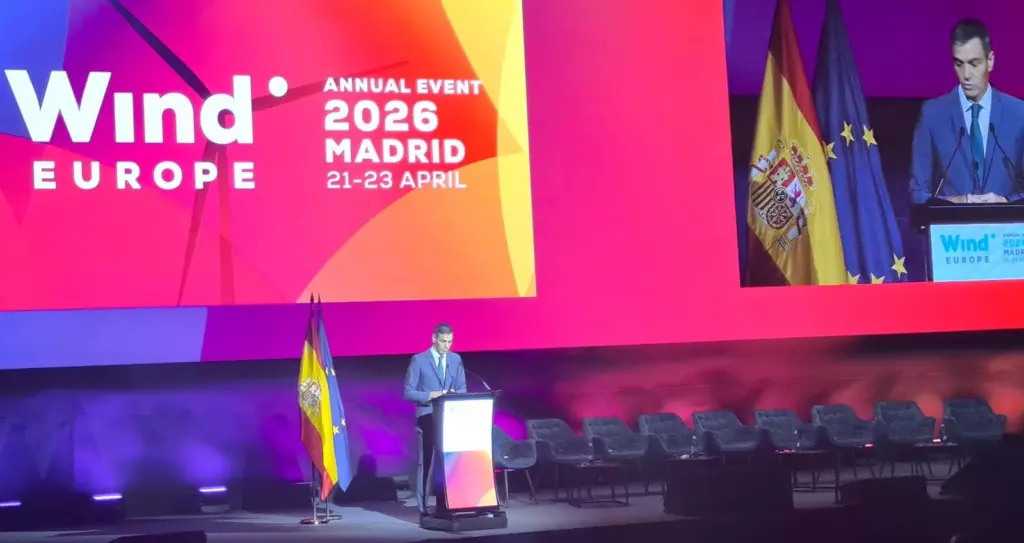
“Renewables is the only way forward and the only path to prosperity,” he told a packed conference hall as the 90-minute inaugural session, moderated by new WindEurope CEO Tinne van der Straeten, drew to a close.
Today’s haste to deploy renewables is being framed against the backdrop of war, from Russia to Iran, rather than fear of climate change, which until recently has been the driving force.
”If just one link in the supply chain of oil breaks down, the world economy can fall into recession,” said Sánchez. “One world leader makes a decision and 27 economies are at their mercy. The war with Iran has been the latest warning. These are not bottlenecks. These are ropes around our necks.”
The same three messages echoed by multiple speakers in various sessions on the first day were ‘Boost, Connect, Empower’ – boost electricity supply, including ‘repowering’; connect supply to demand, including grid upgrades; and empower demand, ie make it affordable.
“Spain shows what’s possible,” said van der Straeten. ”Fossil fuels must be replaced by home-grown energy and not imported any more.”
More than half of Spain’s electricity last year came from renewables, according to data site Statista, although none of it was from offshore wind, which is still in the planning stages. Very deep waters around the country make it difficult to install fixed-bottom wind turbines, but many floating wind technologies are being developed, as we reported from Bilbao two years ago.
In April 2025, a major blackout affected of the Iberian Peninsula, including Spain, and was partly blamed on high renewable generation, although investigations found that they were not the sole cause – in addition, voltage instability, grid management issues and other issues contributed to conditions that made the system harder to control.
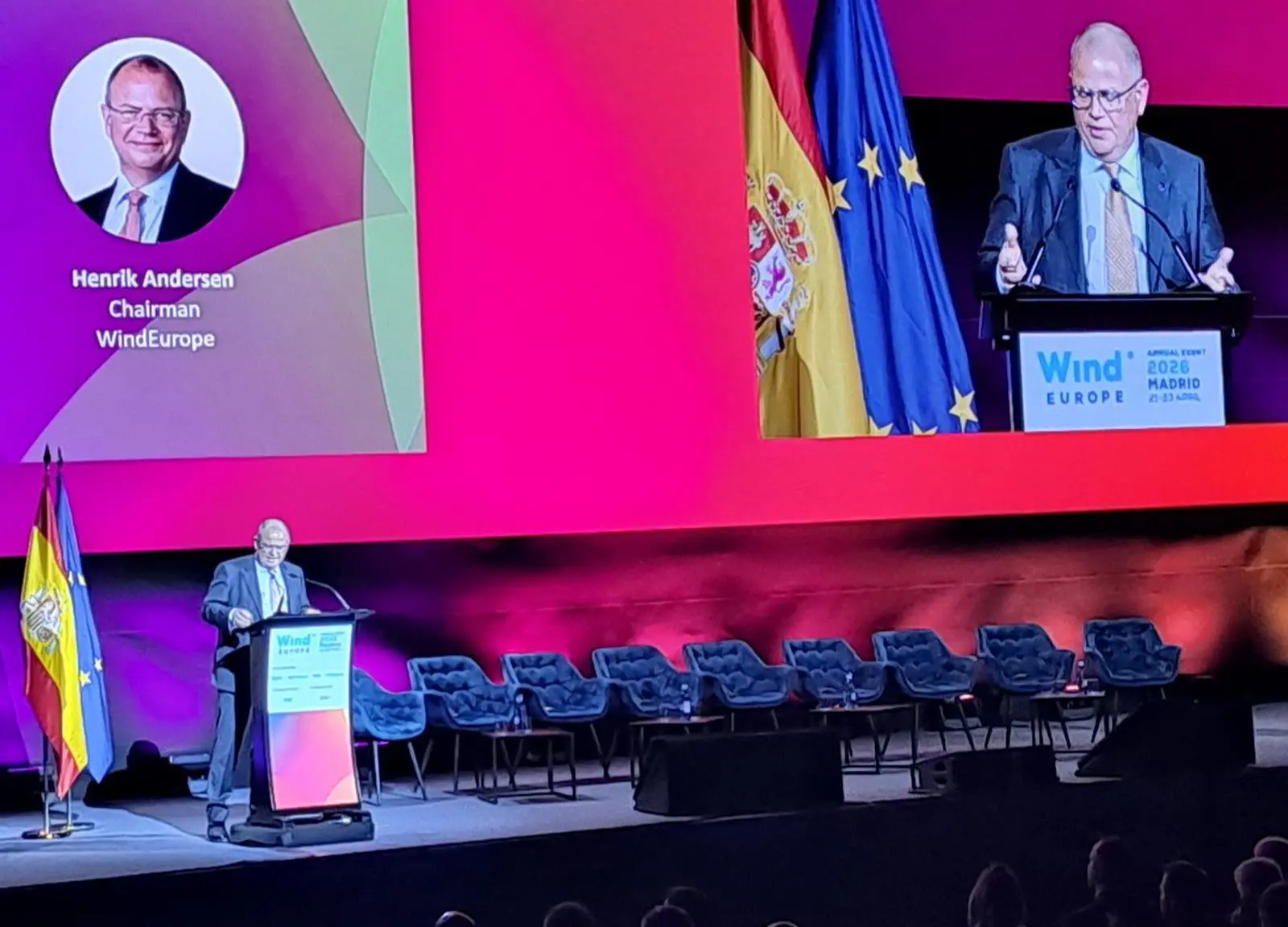
Henrik Andersen, WindEurope chairman and also Vestas CEO and president, said €trillions of savings were possible by ramping up renewables and he called for taxes to be cut across the board.
“We must have stable energy prices,” he said. “The current scenario doesn’t add up. This is a matter of strategic priority. If we want to accelerate electrification, stop taxing it.Tax what we want less of, not what we want more of. I’m reminded of the old saying: ‘Maybe you shouldn’t cross the river to get water.’”
’We need to go much, much faster’
“Countries that have had the least disruption from this crisis are the countries that have had more renewables or nuclear,” said Timmy Dooley, Minister of State for Ireland, which holds the Presidency of the Council of the EU from July to December 2026.
”Renewables was largely driven by the climate crisis agenda. There’s been a bit of back sliding and it’s in a good place now because it’s about security as well, To meet demand we can’t leave ourselves open to the behest of other unregulated environments. We have the capacity to generate our own electricity within our own domain – we just need to get on with it.”
“We need to go much, much faster,” said Keith Anderson, chief executive of Scottish Power, which is fully owned by Spanish energy giant Iberdrola.
“We need more auctions coming through, in more countries. We need faster permitting – this can take from five to 10 years.”
In Poland, a nascent offshore industry is making plans.
“Here we are in doom and gloom in yet another fossil fuel crisis,” State secretary Urszula Zielińska told delegates. “Poland is on a firm path. We have a lot of fresh, new renewable power development and the first offshore wind power will flow to 1.5 million households this July. We are aiming to have 100GW of renewable energy by 2040.”
WindEurope, which organisers say is 20% bigger this year than last year’s event in Copenhagen, finishes tomorrow, Thursday. More than 620 exhibitors were packed into two giant halls at he IFEMA conference centre in the Spanish capital.