![MaritimeJournal[Seawork]](https://www.maritimejournal.com/wp-content/uploads/2026/09/MaritimeJournalSeawork.svg)






New S-Boom delivers triple the power
Great Yarmouth UK based underwater technology company Applied Acoustics launched an entirely new sub-bottom profiling boomer plate at the recent Ocean Business exhibition in Southampton.
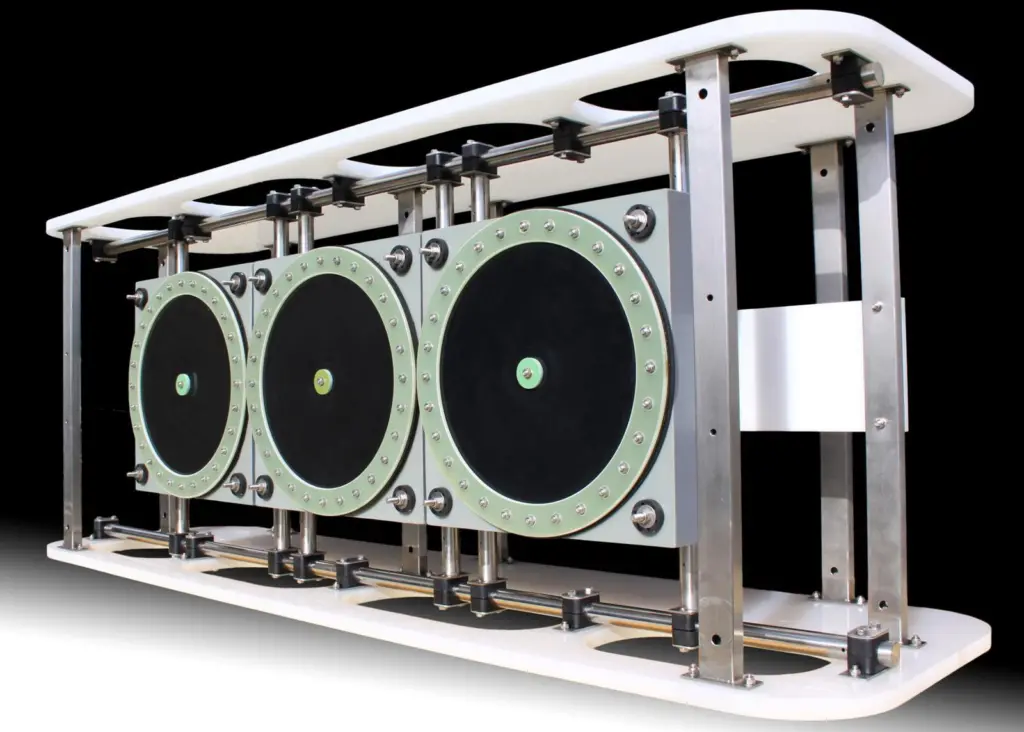
Taking a traditional design and multiplying the sound source, the new technology is used in 2-D sub-bottom profiling when interrogating subsea sediment layers for geophysical and hydrographic survey work.
By harnessing the combined power of three of their AA202 Boomer Plates to provide a single pulse, the Applied Acoustics’ S-Boom System is re-defining the boundaries of shallow seismic surveying. Already recognised for producing high resolution seabed profiles, the fusion of these three transducers delivers a source level high enough to significantly increase sub-bottom penetration without loss of data quality.
Capable of operating at a maximum energy setting of 1000 Joules per pulse, and firing at three pulses per second, the S-Boom has achieved penetration results of over 200mS through sand and limestone whilst delivering the high quality resolution records expected from boomer systems. The high repetition rates and pulse stability allow for faster surveying, adding to the system’s overall versatility.
As with all Applied Acoustics’ sub bottom systems, the S-Boom forms part of a modular package able to operate from a number of energy sources from the CSP range. For optimum results, the fast charging CSP-S1200 power supply has been designed as the energy source of choice for this system, although the system can operate just as well with a source from the larger CSP-S range. Furthermore, some existing variants of the CSP-D range can also be used at lower settings and longer pulse intervals.
Trials have recently taken place in New Zealand and a unit is already undertaking survey work off the west coast of the UK prior to offshore wind farm construction.