![MaritimeJournal[Seawork]](https://www.maritimejournal.com/wp-content/uploads/2026/09/MaritimeJournalSeawork.svg)

Corvus agrees to install batteries on CSOVs
Boat builder Ulstein has contracted marine storage system developer Corvus Energy to equip two CSOVs.
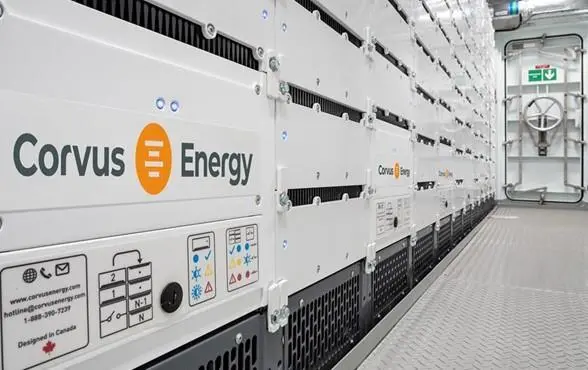
Marine energy storage firm Corvus Energy has been contracted by boat builder Ulstein to provide battery systems for two construction service operation vessels (CSOVs) for Norwegian shipowner Olympic.
The two CSOVs will be based on the Ulstein SX222 design, says Corvus Energy, with a Twin X-Stern that is designed for low-energy consumption.
“During operation, the offshore wind service vessels stay positioned at the turbines most of the time, and with the main propellers fore and aft, these vessels will reduce the energy requirement to a new level when on dynamic positioning,” the company says.
Ulstein has selected the Orca Energy system by Corvus, which has been installed on more than 250 vessels worldwide, Corvus says.
Developed in 2016, it can be deployed in applications ranging from ferries to port cranes, yachts to tugs, partly because of its modular design, which means it can easily be scaled up or down.
According to the industry association WindEurope, Norway aims to allocate 30GW of offshore wind capacity by 2040, although licensing schedules have already proved problematic, with doubts over Havsul I and II.
”The construction of the new wind farms will take place over the next 20 years,” says WindEurope. ”Norway doesn’t have any commercial-scale offshore wind farms today. But they have already identified two zones for development and are planning to run an auction for a 1.5GW floating wind farm in one of them next year.
”They’ll now start working to identify other zones and to simplify the permitting procedures for offshore wind farms.”
“This is a very important market for Corvus Energy as we see increased interest for batteries from the entire offshore wind segment along with larger and larger battery installations,” said Vice President Sales, Pål Ove Husøy. ”This contract will be the largest battery installation for SOVs so far.”
The vessels are prepared for methanol fuel and have available space for additional battery capacity for full-electric repowering when the infrastructure for such is available.
Related Articles
 SEAWORK NEWS
 INDUSTRY NEWS
 OTHER NEWS