![MaritimeJournal[Seawork]](https://www.maritimejournal.com/wp-content/uploads/2026/09/MaritimeJournalSeawork.svg)



EXCLUSIVE: Ground-breaking RIB runs on battery, methanol or petrol
A fascinating concept in marine methanol hybrid propulsion could redefine the way vessels, particularly small commercial high-speed craft, are powered, writes Jake Frith.
UK company and Seawork 2022 exhibitor Mathwall has a strong background in motor racing up to Formula 1 level, and is especially involved in historic racing engines, particularly Ford engines.
Genesis
A lot of racing engines run on methanol, which acts as a carrier for hydrogen, but from a marine decarbonisation standpoint it also has roughly double the energy density of pressurised liquid hydrogen, so it will allow boats to have an acceptable power-to-weight ratio and high-speed range that hydrogen boats struggle with and full electric boats are many decades away from providing. Mathwall Marine, and related consulting company PurpleSector, with their extensive methanol and hybrid experience, have found themselves in a good position to develop a hybrid marine propulsion system that can run on methanol, petrol, battery electric or a combination of these.
The technology of both an internal combustion engine and a pure electric drive gives the benefit of both technologies to achieve power, lower CO2 emissions and range of use that could not be achieved by any of the technologies on their own.
The venture is the brainchild of boat owner, Mathwall CEO and former Maclaren Chief Powertrain Engineer Mark Mathieson MBE.
This combination of internal combustion and electric to get the best of both worlds is well trodden ground for Mathieson, as he led the development of the Maclaren P1 supercar’s epoch-defining and multi award-winning hybrid drivetrain, which in concept is not a million miles away from this one.
Mathieson and the team’s racecar backgrounds also meant that, with some financial assistance from Innovate UK, and with the help of project partners, the prototype RIB shown here went from drawing board to high performing on-water test bed in just seven months.
This test bed, called the CHAMP Project (Clean Hybrid Alternative Marine Powertrains) was funded by Innovate UK as part of the government’s Clean Marine Demonstration Competition. The project aims to demonstrate the potential performance that can be achieved with the introduction of hybrid technology in recreational, defence and small to medium-sized commercial vessels.
Halfboard™
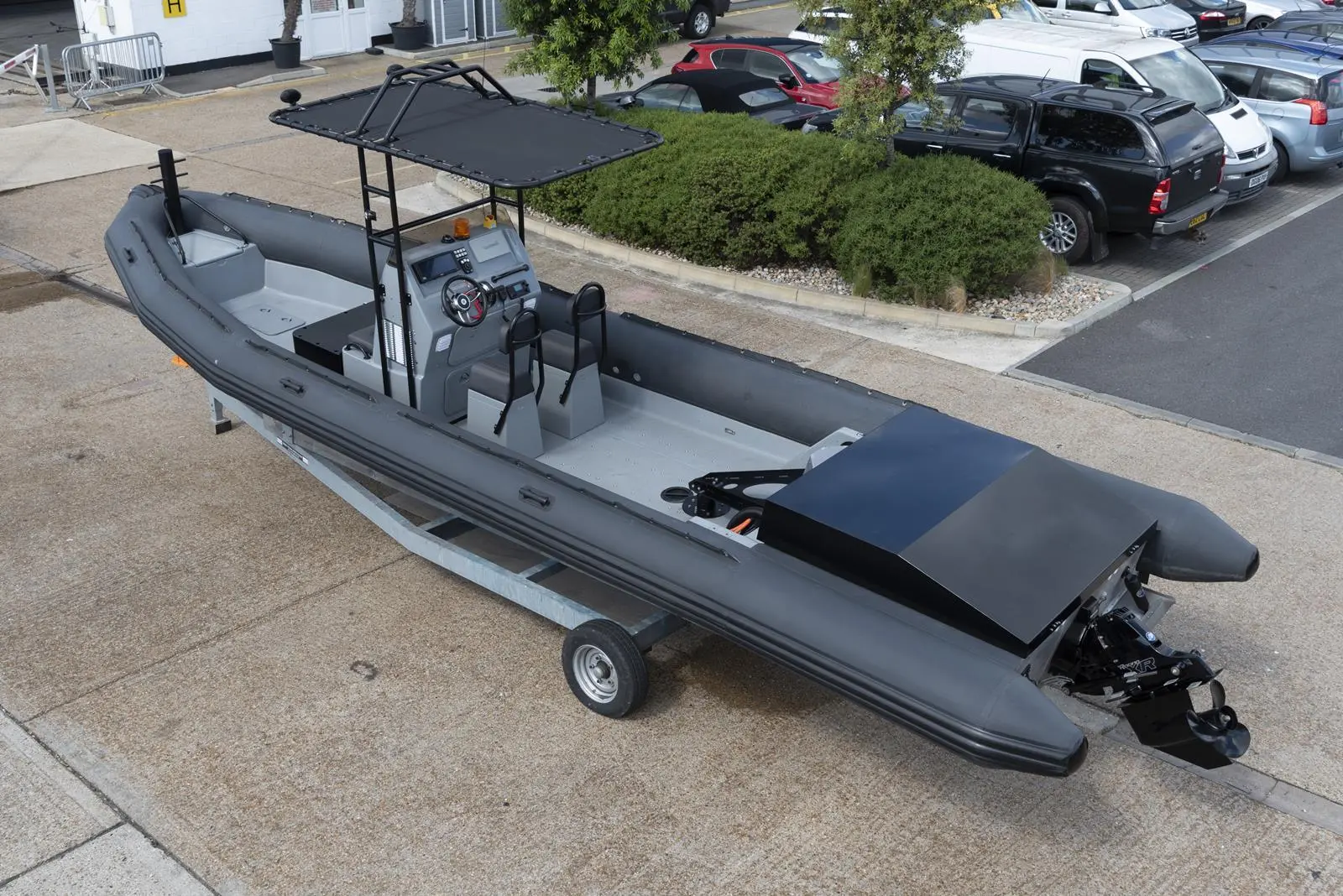
Fundamental to the success of the project so far has been a new, trademarked and patent-pending technology that Mathwall is calling the Halfboard, which gets its name from being halfway between an inboard and an outboard.
The Halfboard places the weight of the drivetrain in a continued watertight, buoyant planing surface bolted onto the boat’s existing transom. It is another racecar technology, as drivetrains are often mounted in a similar way in the rear of racing cars for strength, lightness, rapid swapping out for faster development.
The system means that existing boats can be repowered easily: it’s just a hoist and a number of bolts – not much more work than changing an outboard. In the case of RIBs, the tubes are extended further rearwards to accommodate and stabilise the unit.
Of course, different RIBs have different deadrise angles at the transom and different transom angles, arrangements of planing rails etc., so to get a fair hull continuation on all hulls, some degree of custom fabrication work will be required.
For the CHAMP project’s single boat prototype, Mathwall has partnered with Ballistic RIBS and Portsmouth’s Trafalgar Boat Club, and Mathieson believes that partnering with boatbuilders to ensure Halfboards exactly fit certain hulls could be one route to market.
Another could be to provide less bespoke halfboard units that are slightly shallower than the transom and mounted a little higher, thus adding the further high-speed efficiency benefit of an aft planing step.
As it is, the halfboard prototype with its LS3 engine (a V8 monster that most commonly lives under the bonnets of Chevrolet Corvettes) has been a great success.
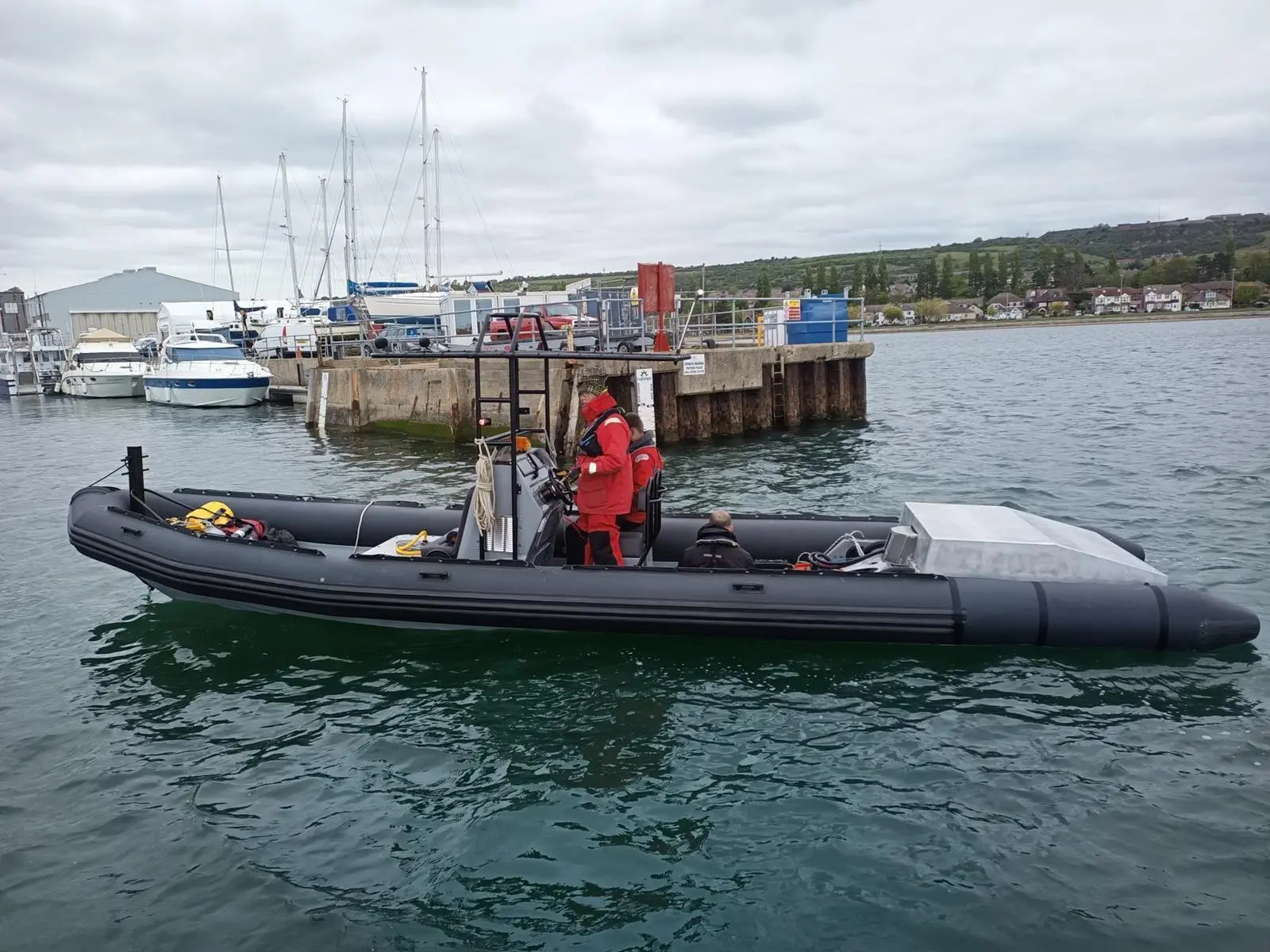
It’s a big engine and hence the longest possible halfboard that will ever likely be made. Production models will all, most likely, be shorter. This long construction, and the high power, tests the loadings in the worst possible scenario, so according to Mark, it’s the best end of the spectrum to start from, development-wise.
What it brings to the party that an outboard does not is an increase in waterline length for better sub-planing trim and economy; plus the weight that is added to the boat through the hybrid system is more than supported by the added buoyancy of the increased hull and tubes, so increasing the weight of the boat does not drag it down further in the water, creating a greater hull inefficiency. A full hybrid system like this could also simply not be built into anything as compact as an outboard motor. Mathwall quotes a possible drag reduction of 28% with the halfboard concept compared with adding the extra weight of a similar hybrid system to an unchanged hull.
What it brings to the party that an inboard does not is easier adding as a retrofit or upgrade to an existing boat.
Mathwall believes that as well as retaining an element of fossil fuel, or ‘Flex Fuel’ use for certain parts of the duty cycle, an effective marine energy transition also has to consider how new technologies can most easily be integrated into existing hulls.
Complex control
A complex control system allows for the optimum use of battery power and methanol, based on how an operator intends to use the boat using real-time data and feeding back to allow for offline monitoring and future improvements.
Using a 63kWh battery, the boat has a range of up to 30 nautical miles in full electric mode and with a 420 litre methanol fuel capacity, 230 nautical miles range is easily achievable with a sustainable fuel source and up to 360 nautical miles in eco mode.
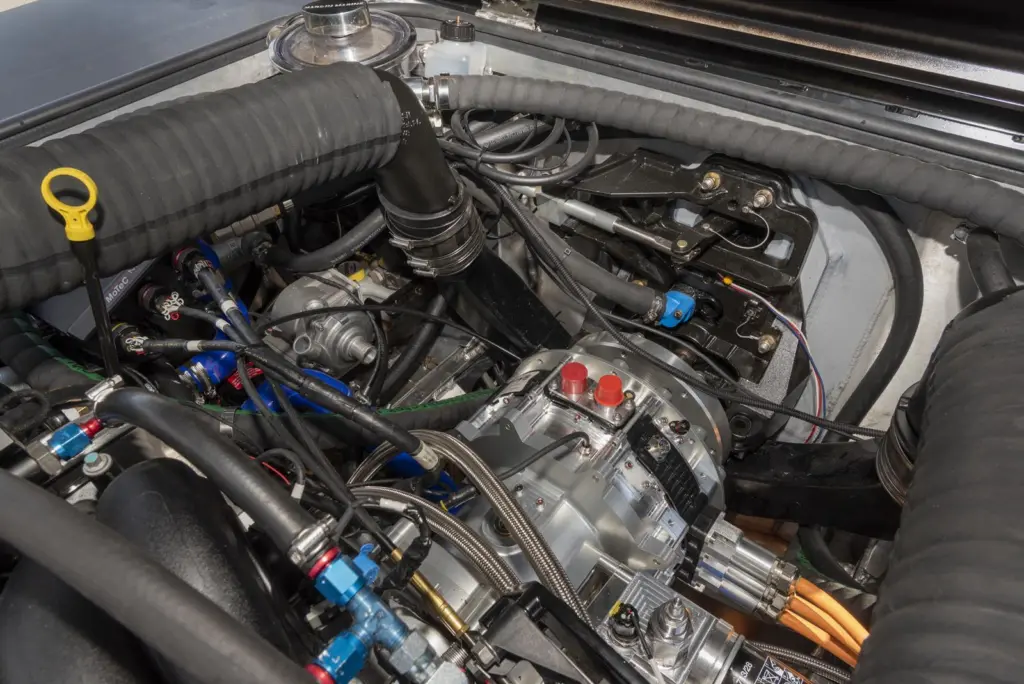
In the CHAMP project prototype, the internal combustion engine provided circa 450 horsepower with the hybrid drive motor adding an additional 150 BHP (and up to 200 BHP for limited periods), either for additional top end power, or more likely, quiet zero carbon operation at harbour speeds.
Methanol is an environmentally sustainable fuel source identified on the Government’s Maritime Plan, but at present has limited supply dockside. By calibrating the engine to be able to run on pure methanol or gasoline or any blend of the two, Mathwall has reduced the issue of methanol not being available dockside. This means the technology can be rolled out immediately, even though access to methanol dockside is still limited at this time.
There are some elegant engineering touches that Mathwall has been able to demonstrate with the CHAMP project.
One is the closed freshwater cooling circuit for the hybrid drive motor, which is shared with the engine’s cooling circuit. This means if the electric motor is used, as will be likely, to get the vessel off its berth and within a harbour for some minutes, the internal combustion engine has been gently warmed up by the spent heat from the motor and is already at operating temperature.
It can be used at wide open throttle if necessary from the moment it kicks in without worry of increased wear or damage.
Engaging
Speaking further to Mark Mathieson, it’s clear that engaging with marine industry stakeholders, particularly at events such as Seawork, has been a key part of the project.
“We learn things and get to hear of opportunities when we get closer to potential end users of the technology,” he said. “For instance, it was recently pointed out to us that eco-tourism could be a great use of boats powered with this system. The energy density and grunt to get out to a location can be provided by internal combustion, then the vessel can switch effortlessly to silent battery power when close to sensitive wildlife.
“We have also had the opportunity to successfully show our abilities when it comes to getting concepts built. Out of 55 projects funded by the Clean Marine Demonstration Competition, we were one of two that actually got a vessel on the water by the end of the funding period.
“Now Innovate UK would like us to find companies we can partner with to take things further with multiple prototypes for multiple sectors with different duty cycles.
“We’d like to look at the leisure and superyacht tender markets, but it’s clear that commercial marine will most likely provide our first customers, with the RNLI, the defence sector and harbourmasters showing early interest. We’re keen to talk to any potential partners who are interested in the concept, from boatbuilders to potential future end users.”
Related Articles
 SEAWORK NEWS
 INDUSTRY NEWS
 OTHER NEWS