![MaritimeJournal[Seawork]](https://www.maritimejournal.com/wp-content/uploads/2026/09/MaritimeJournalSeawork.svg)




Glosten and ABB introduce methanol-hybrid tug
Naval architects Glosten and technology specialist ABB have joined forces to develop a methanol-hybrid shiphandling tug design.
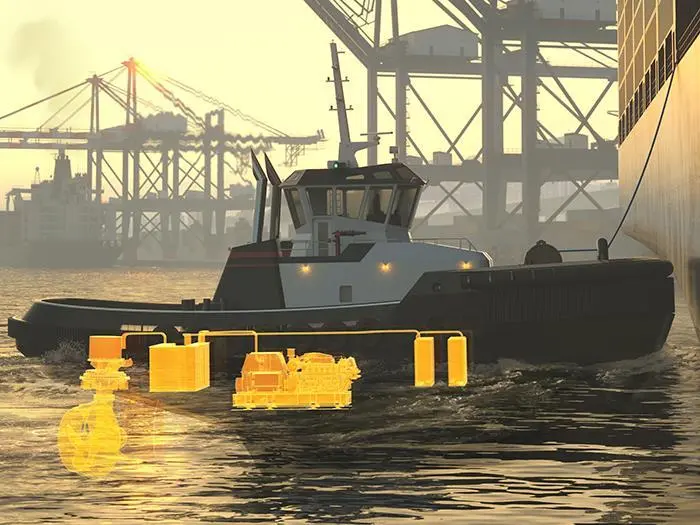
The vessel will provide “a viable path to carbon-neutral operations while minimising operating costs”, they claim.
“Every tug operator is trying to determine their company’s path through this new hybrid and electric world,” says Dave Lee, VP of sales with global workboat responsibility at ABB Marine & Ports, as he and other tug owners contemplate the different choices around new tonnage.
While various combinations of hybrid propulsion options are now well established, the increasing appearance of alternative fuels and pure battery-powered tugs are adding to those choices. Shiphandling tugs generally lead long lives and owners will want to ensure their new investments are future proofed at a time when technological developments are fast moving and various fuel options face availability and price volatility issues.
The design, referred to as the SA-100, is a 30.48m ASD harbour tug propelled by two methanol-compatible Caterpillar 3512E gensets powering electrically driven L-drives. The gensets are complimented by battery banks for zero-emission operation when transiting, peak shaving during general operation and as a boost for achieving the tug’s peak bollard pull of 90 short tonnes.
The tug was also designed to measure under 100 gross registered tons.
“This is the perfect stepping-off point for those that cannot leap headlong into all-electric propulsion,” says Lee. “With this design, the operator will reap some of the instant power availability and operational savings of an electric vessel, without the need to ‘plug in’ at the dock. At the same time, it will allow them to realise a substantial reduction in EPA criteria emissions.”
Peter Soles, of Glosten, leads the conceptual development of the firm’s tug designs.
“We had three primary design objectives in developing this tug, all intended to benefit the owner/operator,” he said. “First, to provide assurance of regulatory compliance and future adaptability; second, to achieve meaningful improvement in environmental performance; and lastly, to control OPEX costs such that assist services can still be offered at competitive rates.”
ABB’s field of expertise covers a wide spectrum, including marine, with involvement in virtually all vessel types from offshore to passenger to Coast Guard vessels. Glosten’s area of expertise is also wide ranging and includes development of hydrogen-hybrid as well as methanol-hybrid designs.