![MaritimeJournal[Seawork]](https://www.maritimejournal.com/wp-content/uploads/2026/09/MaritimeJournalSeawork.svg)



PROFILE: Leo Hambro, Tidal Transit commercial director
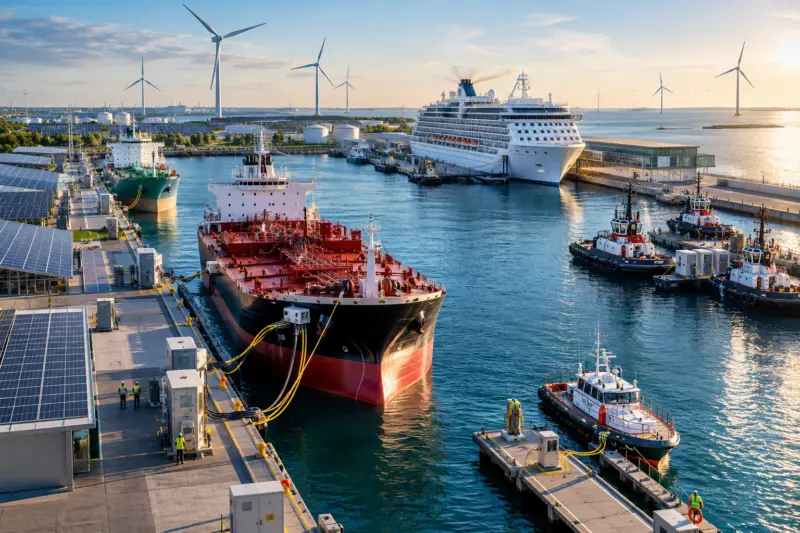
Thanks to new vessel designs and offshore charging technology, Tidal Transit’s zero-emissions crew transfer vessel should be a reality within two years.
Tidal Transit already has a fleet of six CTVs, which have been on regular long-term charter with developers and operators including Orsted, Equinor, RWE and SSE for more than 10 years.
And that’s what’s been the driving force behind the company’s new concept, says commercial director Leo Hambro – first-hand experience of working at such different projects, whether they’re near shore or at more distant wind farms.
The company is in the process of raising the funds to build out an entire fleet of ‘green’ vessels to meet predicted demand as renewable energy projects gain ground; and this in parallel with a slightly different boat that it’s developing with Artemis Technologies and other companies in the latest round of the Clean Maritime Demonstration Competition, which awarded the consortium £3.4 million (€3.8 million).
“They fill slightly different roles,” says Hambro. “With Artemis, we are using the efoiling technology on vessels that we anticipate will be travelling much further distances on pure electricity. Because it can get out of the water it can go further and faster, but it’s more about taking people.”
“The Tidal Transit vessel is more of a multi-functional CTV, which will take cargo and can operate for days at a time. A genset will give it redundancy if it needs it, or if electric charging isn’t available.”
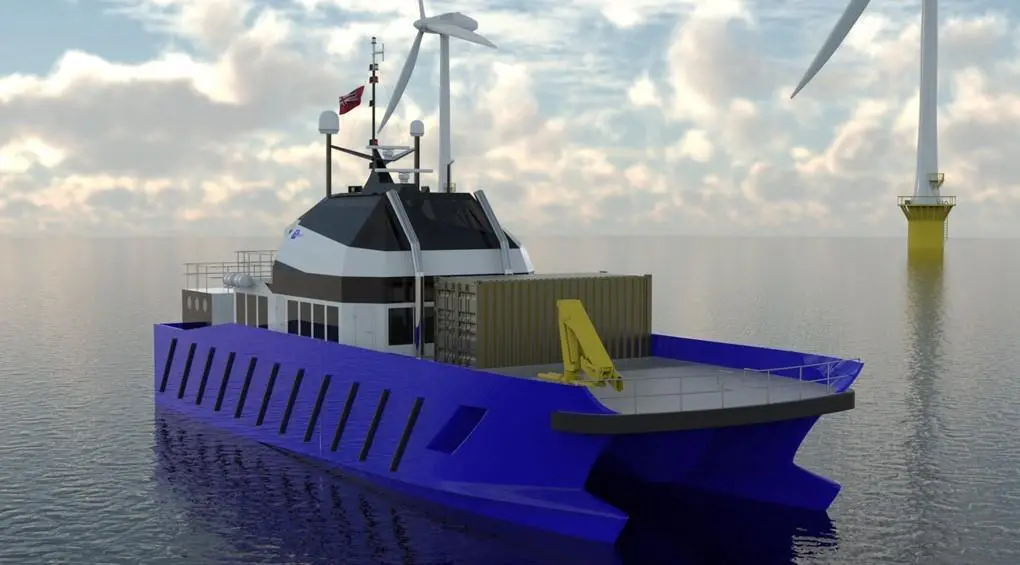
The concept is based on a Capilano hull with quad propulsion for redundancy, and expertise from Seaspeed on how to optimise the hull, says Hambro. Power will mainly come from modular battery packs, the quantity of which will depend on the wind farm site.
Batteries and offshore charging

Crucial to a wider roll-out is MJR’s charging technology – whereby vessels can be plugged in at the turbines and charge while they’re at sea. The technology is now ready to go and while designed initially as a retrofit product for wind farms, the scalable technology should eventually be built into wind farms as opposed to being added to them afterwards.
“Now the MJR charging concept is waiting to be delivered, it’s sitting there waiting to be installed, so this makes it possible,” says Hambro.
“We are talking about vast quantities of batteries – our vessels will have 3.5MWh or more – and in fact we also intend to retrofit some of our vessels to battery for the very near shore work. We have had to wait for the battery density to go up and the infrastructure to be there.”
But won’t all these batteries be extremely heavy?
Hambro says that compared with the weight of heavy fuel tanks and systems there isn’t a huge difference.
“It’s also a constant weight, whereas fuel will fluctuate,” he says. “You do need to have a charging point for the workhorse before you can do it. But already, there are multiple onshore charging solutions where you can plug in overnight for 12 hours.
“Offshore charging has multiple benefits – you can have a higher charge rate, it’s effectively free electricity, and we’d be able to recharge our boats in about two hours.
“It’s actually going to be easier to install them offshore rather than onshore and there’s much more kilowatt capacity from the turbine than you could ever dream of getting from the grid.”
More than a CTV
The Tidal Transit concept makes it more than a CTV, says Hambro.
“It’s much more of a workhorse, carrying cargo, potentially bringing hydrogen back from the wind farms – you need different types of vessels for different wind farms with different distances and so on,” he says.
“Our CTV will be able to carry 12-24 passengers, up to 4×10’ containers (or 2×20’), as well as providing above deck, 24hr marine crew accommodation. We intend to build out multiple vessels along this line.”
The offshore wind industry is crying out for decarbonisation due to the vast quantity of power produced there, says Hambro.
“Although there are opportunities for fuels like hydrogen to be produced, the most efficient use of the power is as electricity, without CO2 or NOx.”
For operations far from shore, when a CTV might stay in the field for up to a fortnight, fuel savings will become even more significant, and Hambro estimates that several sites off the east coast of Britain could save around 30,000 litres of diesel within two weeks.
Delivery of both vessels is expected in the next 14-16 months, he says – the main delay being supply chain issues.