![MaritimeJournal[Seawork]](https://www.maritimejournal.com/wp-content/uploads/2026/09/MaritimeJournalSeawork.svg)

Vessel launched on German waterways
A new shallow-water vessel has been designed in a way that enables it to carry cargoes in very low water.
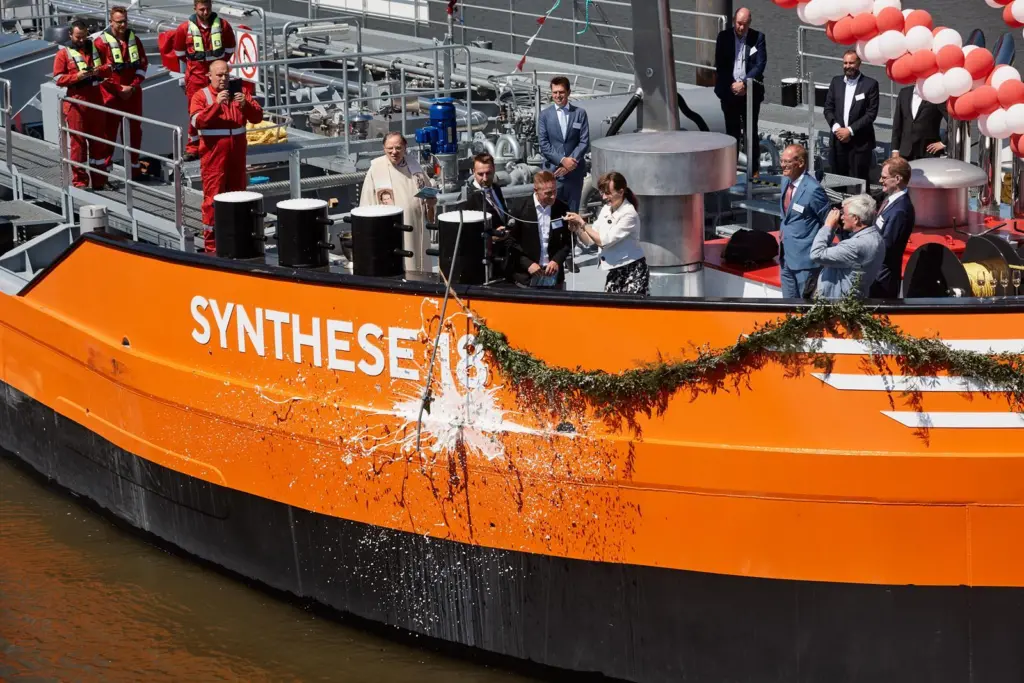
German inland waterway operator HGK Shipping has named a new shallow-water vessel Synthese 18 as it joins the group’s fleet.
The type C tanker was named at the Port of Rotterdam before setting off on its initial voyage transporting liquid chemical products along the river Rhine and its subsidiaries.
Synthese 18 is optimised for shallow water operations with a diesel electric drive system, which means it can operate during periods when the water is very low.
To enable the shallow draught, the vessel’s hull has been optimised with an uplift feature, which has been achieved by rearranging components such as the loading system and drive technology.
Like other additions to the fleet, the 110m vessel was built at HGK Shipping’s design centre with assistance from transport management firm Wijgula BV, which will operate the vessel with freight.
“Synthese 18 marks a real milestone in transporting liquid chemicals on European waterways. It will enable us to maintain our role as a reliable partner for industry even during periods when water levels are low,” said Norbert Meixner, Business Unit Director Liquid Chemicals at HGK Shipping.
”HGK Shipping’s innovative shallow-water tanker is designed in such a way that it can still transport a load weighing 300 tonnes if the water is just 1.05 metres deep. Synthese 18 will therefore help ensure reliable supplies for the chemical industry in future, even if the water level on the river Rhine is critically low. The maximum payload capacity is 2,700 tonnes.”
“Although the shape of the bow and stern are unconventional – among other things, the vessel is equipped with a so-called bulbous bow – the intelligent power management system ensures that the power that is available (1,200 kW) is fed in and used in the best possible manner,” said Tim Gödde, Business Unit Director Ship Management, HGK Shipping. ”The stainless-steel tanker demonstrates that a combination of sustainability and reliability of supplies doesn’t have to conflict with a high tonnage level per trip.”
The Santierul Naval Orsova shipyard in Romania was commissioned to build the hull and Dutch Scheepsreparatiebedrijf De Gerlien van Tiem shipyard in Druten handled the complete outfitting operations.
Related Articles
 SEAWORK NEWS
 INDUSTRY NEWS
 OTHER NEWS