![MaritimeJournal[Seawork]](https://www.maritimejournal.com/wp-content/uploads/2026/09/MaritimeJournalSeawork.svg)






Lockheed Martin tech developed for seabed structure anchorage
Offshore foundations engineering company Subsea Micropiles has launched a micropile anchor based on technology now exclusively licensed to it from US defence and aerospace manufacturer Lockheed Martin.

Subsea Micropiles says the micropile anchor, the first of which it has installed for the Orkney Harbour Authority in Scotland, will pose ‘a highly beneficial disruption’ to the offshore industry, enabling smaller vessels and remote seabed drilling systems to be used in large construction jobs, cutting costs and environmental impact.
Lockheed Martin developed the core subsea micropile technology to secure its Ocean Thermal Energy Conversion platforms to the seabed, and has now licensed it exclusively to Subsea Micropiles, which was founded in 2017 by Derek Robertson, former US Navy Officer and business lead for Micropiles at Lockheed Martin.
Micropile technology
Micropiles are tiny in the world of marine civil engineering – just 300mm in diameter – and are bored or drilled into the seabed to anchor subsea structures such as pipelines, or stabilise constructions such as offshore platforms or wind turbines.
They can be installed in difficult seabed conditions and where soil conditions are problematic or space is congested, and can be installed at an angle to accommodate axial and lateral loads. They are connected via couplings to achieve the desired pile length, which can vary from 6 to 20m depending on soil/rock type and strength. Once installed, central reinforcement bar and cementitious grout allow for load transfer into the bearing soil or rock.
For subsea applications, a robotic seabed drill is used to install and grout micropile anchor foundations. Mimicking the root piles of trees, the group response of multiple piles represents a highly efficient distributed anchor solution, capable of withstanding large loads.
Anchor jobs can be done with robotic drilling equipment and without heavy construction cranes, using smaller and more available work vessels at a time when the larger vessels are in short supply.
Micropile benefits
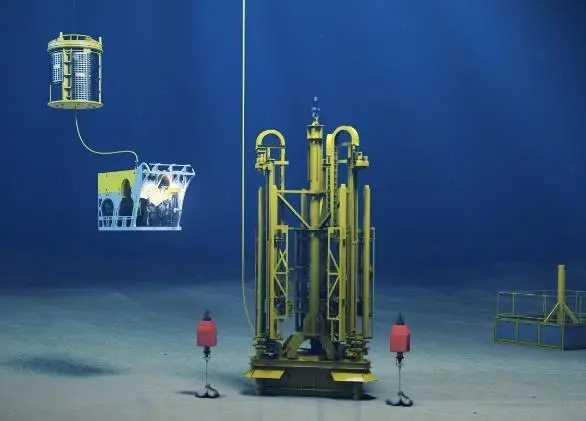
“The limited availability of large crane vessels to support construction poses a significant risk to the schedule and viability of projects in all markets, both large and small,” Robertson told Maritime Journal. “By keeping our crane requirements below 200t and only requiring a crane at the front of our offshore assembly line as part of industrialising our solution, Subsea Micropiles can take advantage of the lowest cost and largest selection of vessels on the global market.
“The offshore construction market is vast, and the planet will increasingly depend on sustainable development of ocean resources for food and energy for decades to come. Soil interventions are the essence of offshore construction, and Subsea Micropiles provides a literal and figurative ‘platform technology’ for a sustainable offshore economy.
“As part of a wider market for offshore anchors and foundations, the growth of the global offshore wind market to 2050 will require a greater number of soil interventions than all those preceding in human history, yet soil conditions pose the greatest cost and schedule risk to offshore projects. These circumstances drive a unique opportunity for innovative approaches to anchors and foundations, and for capturing a significant share of the offshore construction market.”
“We have invested heavily in the design of micropiled structures, development of new subsea drilling equipment, and the implementation of highly productive drilling technology with our industry partners at Mincon,” said Robertson.
Related Articles
 INDUSTRY NEWS
 MARINE CIVILS
 MARINE CIVILS