![MaritimeJournal[Seawork]](https://www.maritimejournal.com/wp-content/uploads/2026/09/MaritimeJournalSeawork.svg)






Caterpillar predictive monitoring
Last year Caterpillar Marine acquired US-headquartered ESRG Technologies group, a leading company specialising in vessel monitoring and data analysis in the marine industry.
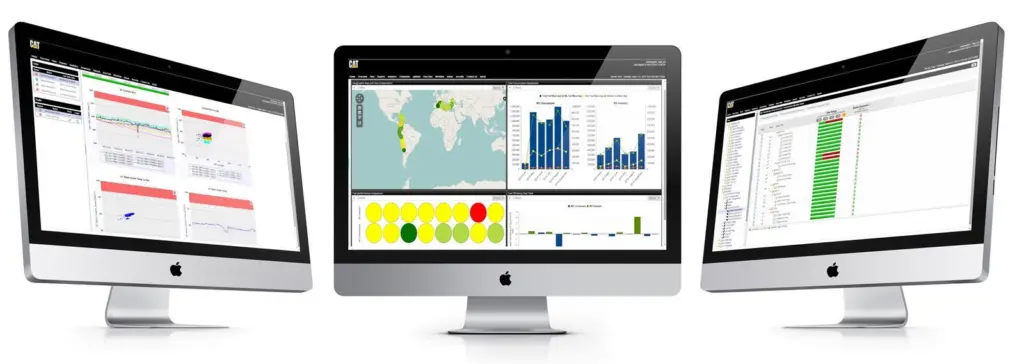
The acquisition included ESRG’s comprehensive software suite for the remote monitoring and diagnostics of more than 65 on-board systems. Also included was the expertise that allows the company to provide meaningful recommendations to vessel owners to help increase efficiency, reduce the downtime on their vessels and assist shipyards in reducing warranty expenses.
ESRG has provided leading-edge data analysis and remote monitoring technology for assets in both the commercial marine and naval defence sectors since its inception in 2000. ESRG serves as a data analytics provider for the United States Navy, providing services for the Navy’ fleet of warships. Currently the proprietary software is also monitoring the machinery and systems on board thousands of installations on vessels operating around the world, providing leading edge prognostic recommendations to ship operators and owners.
As a result of the acquisition of ESRG, Caterpillar Marine is now expanding its monitoring systems beyond just engine focused monitoring to provide monitoring and diagnostic solutions for all of the equipment on board a vessel. Nigel Parkinson, Caterpillar Marine’s managing director commented, “Our customers are asking for solutions to drive down operating costs and maintain leading-edge in service time. Together with ESRG’s experience, Caterpillar Marine is prepared to offer solutions to our customers today to help them achieve this goal. This acquisition enables Caterpillar Marine to move closer towards our strategic vision of serving our marine customers as a complete systems solutions provider.”
ESRG has become an integral part of Caterpillar Marine, and this has allowed Caterpillar to offer this new expanded range of monitoring services which can now include predictive failures. These are an expansion of the existing Caterpillar monitoring services and are much more all- embracing. A key part is that instead of the monitoring and analysis being done on board by the engineer, information including historical information is sent ashore where a much more detailed analysis can be carried out.
By the very nature of the job an onboard engineer has a limited knowledge of many aspects of the machinery. When the analysis is done on shore, specialist engineers can be brought in to analyse the various part of the machinery ensuring that specialist skills can be brought to bear to fine tune the analysis and to predict failure prospects.
According to Caterpillar, marine customers have been asking for this technology for the past few years as communication costs have declined and Big Data is becoming more commonplace. “However, managing data and establishing analytical driven rules are not the core competency of most operators today,” commented Leslie Bell-Friedel of Caterpillar Marine Asset Intelligence.
By Dag Pike
Related Articles
 INSURANCE, LEGAL & FINANCE
 EQUIPMENT
 EQUIPMENT