![MaritimeJournal[Seawork]](https://www.maritimejournal.com/wp-content/uploads/2026/09/MaritimeJournalSeawork.svg)


Intelligent awareness: a new way to navigate?
Today ships and boats are navigating with displays showing the radar and the electronic chart, the latter known as ECDIS. Radar gives the horizontal view of what is going on outside and the electronic chart gives a plan view. Now Rolls Royce has come up with a new addition to the navigator’s repertoire of displays, Intelligent Awareness (IA).
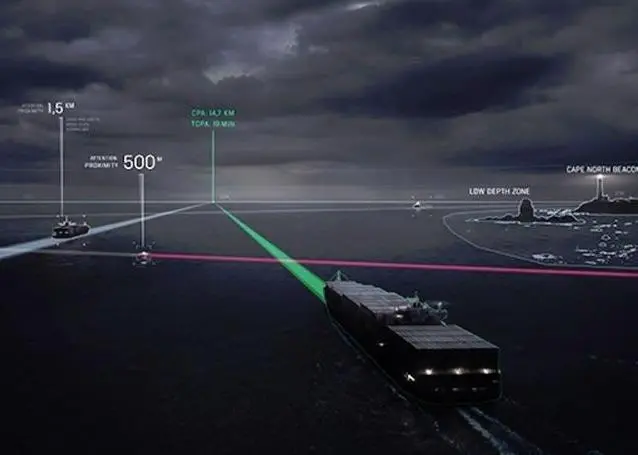
Essentially, what IA does is combine the data from multiple sources to provide a comprehensive overview of the vessel’s external situation. These can be displayed in four user interface modes, virtual reality in both 2D and 3D forms, augmented reality and a precision mode. Amongst the multiple information sources are the current systems such as radar, the electronic chart and AIS. These sources are supplemented by a LIDAR system that helps to create a 3D map of the vessels and land features around the vessel. Rolls Royce claims that this allows crews to ‘see what the human eye cannot see’.
LIDAR is Light Detection and Ranging where a pulsed laser beam is transmitted and from the returns this can measure distances very accurately. This LIDAR beam is transmitted around the ship and from its returns it is possible to build up a full 3D picture of everything that is around the vessel. Combine this with GPS positioning and the 3D picture can be built up with the user able to select the type of display that best suits his requirements.
The IA system was originally developed as part of the project which is the programme that is engaged in developing autonomous ships. With customer collaboration programmes with Stena and Mitsui O.S.K. Lines, Rolls-Royce has been able to develop technology that creates a 3D map of a vessel using LIDAR which can help to fill in any target detection gaps not found by radar or on the electronic chart. This fusion of multiple sensors with intelligent software helps to mitigate against the safety risks navigators face when operating vessels at night, in adverse weather conditions or in congested waterways. This Rolls Royce system is the first to be developed into a commercially available system.
Liro Lindborg, Rolls-Royce, General Manager, Remote & Autonomous Operations, said: “The IA system forms part of our ongoing development of the autonomous ship, but we decided to make the technology available today as it offers real benefits to the existing shipping environment. IA is undoubtedly one of the most significant advances made to-date in terms of ship navigation safety. It provides bridge personnel with a much greater understanding of the ship’s surroundings”.
By Dag Pike
Related Articles
 INSURANCE, LEGAL & FINANCE
 EQUIPMENT
 EQUIPMENT