![MaritimeJournal[Seawork]](https://www.maritimejournal.com/wp-content/uploads/2026/09/MaritimeJournalSeawork.svg)



Pioneering software assesses worldwide fouling risk
Dutch marine coatings business, AkzoNobel has revealed Intertrac, the shipping industry’s first, patented applied for software system that enables ship owners and operators accurately to assess and predict the risk of hull fouling.
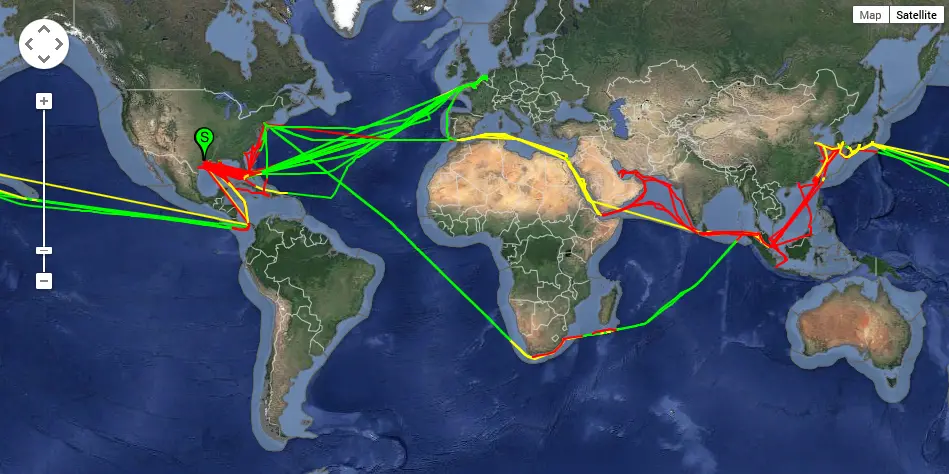
Development began in 2011 and the system has been trialled with customer partners since February 2013. Intertrac overlays a vessel’s route, speed and location data with a comprehensive fouling challenge data set enabling coating specifications to be tailored specifically to suit an individual vessel’s operations and trading routes. This ensures effective cost management for hull coatings, as well as maximizing a vessel’s operational efficiencies.
Intertrac uses location data that is provided by a vessel’s AIS – information that is available in the public domain – to establish operating profiles. A fouling risk profile is developed for each vessel, helping ship owners and operators to quantify the hull fouling challenge that a specific vessel has faced. The system divides the world’s oceans and coastal waters into 64 “large marine ecosystems”, each with its own fouling risk and characteristics.
Mike Hindmarsh, global marketing manager for Deep Sea Dry Docking said: “Intertrac is unique in that as well as tracking vessels it can also overlay detailed fouling risk assessment from across the world’s oceans and coastal regions.
“By combining details of a vessel’s voyage – both geographically and in terms of operating profile – with an analysis of the fouling challenge in the regions where she has traded, we can provide our customers with detailed information on the level of fouling risk that they face. From this, we can deliver real consultancy for our customers, and recommend the optimal choice of antifouling coating specification, ensuring cost effectiveness and maximizing their levels of operational efficiency.”
Hindmarsh continued: “For example, if a vessel was trading for long periods in cold northern waters where the fouling challenge is low, it is appropriate to reduce the antifouling coating specification and save money by doing so. Seasonality is an important variable, but Intertrac automatically tracks the time spent and the months involved.”
Over a specified period – such as a vessel’s last in service period since dry dock – a vessel’s trading profile detailing every voyage can be plotted, giving total sea miles, average sea miles per month, average draft and speed and importantly, the duration and frequency of time spent idle as well as time spent sailing above or below a certain speed. Whether or not a vessel was loaded on a certain voyage is also tracked.
By Jake Frith
Related Articles
 INSURANCE, LEGAL & FINANCE
 EQUIPMENT
 EQUIPMENT