![MaritimeJournal[Seawork]](https://www.maritimejournal.com/wp-content/uploads/2026/09/MaritimeJournalSeawork.svg)




Trials underway for Falmouth monitoring buoy
Falmouth Harbour Commissioners, the Trust Port Authority for Falmouth Harbour in the UK, are trialling innovative hardware and software developed in conjunction with Cornwall based company Triskel Marine Ltd.
The trial has been funded by the oil spill response focussed EU project ‘SPRES’ and the data collected currently contributes towards populating a database helping EU scientists better understand and forecast oil interactions with weather and water. For further information on SPRES visit http://www.spresproject.eu/ .
For Port Authorities and oil spill responders, the requirement for accurate, real-time environmental data such as direction and speed of wind and tide plus air temperature and pressure are just some of those which are critical for an effective response to an oil spill incident. The innovative software and hardware combines technologies which allow a standard marine buoy, fitted with environmental sensors, to transmit live readings via an online weblink. Moored to the seabed, fast relocation of the buoy to the site of a reported pollution incident is possible for harbour staff. Falmouth Pilot boat operators also currently make use of this resource to monitor weather conditions, sea state and tidal conditions in advance of shipping movements. Falmouth Harbour Commissioners intend to make this information available to the wider public by sharing the weblink on their website, following the end of the trial later this year.
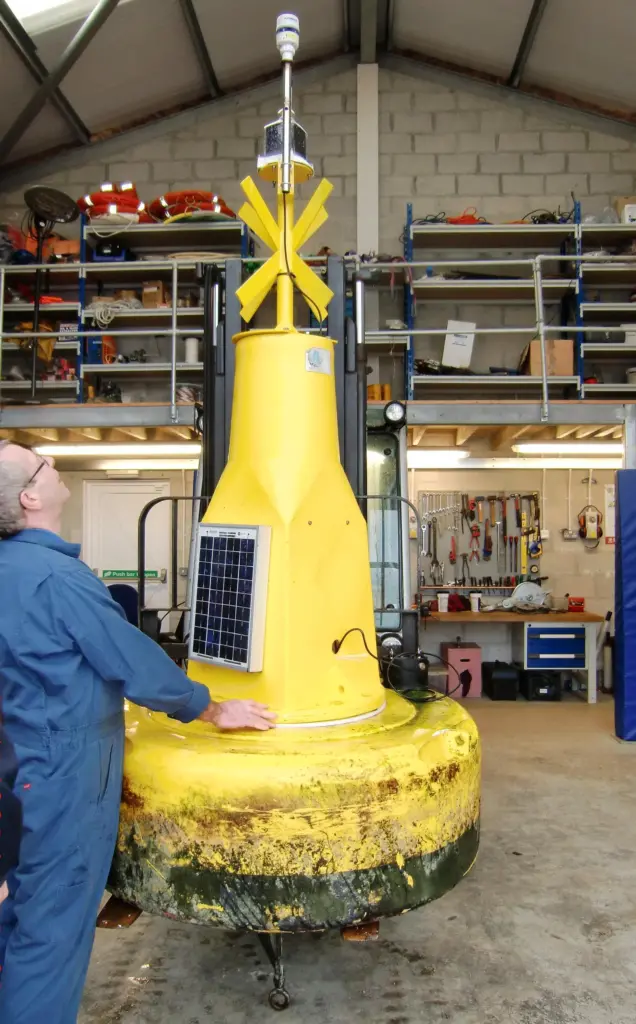
Fitted with a GPS, meteorological, water speed and tidal sensors, the monitoring buoy is suitable for both inner harbour and bay deployments. During the trial, access to the data is possible using a designated weblink and logins. By selecting the different tabs at the top of the webpage (‘position’, ‘airmar’ ‘water speed’ and ‘tide’) different graphical and logged views of the data are instantly available.
The 1.2m data buoy platform has been fitted with an Airmar 200WX ultrasonic weather sensor and an Airmar CS4500 current sensor, talking back through a TML GPRS web enabled data management system. The buoy has an autonomous remote system with solar and battery based power system. This is also linked back to a land based tide gauge through the same web page based interface.
Related Articles
 INSURANCE, LEGAL & FINANCE
 EQUIPMENT
 EQUIPMENT