![MaritimeJournal[Seawork]](https://www.maritimejournal.com/wp-content/uploads/2026/09/MaritimeJournalSeawork.svg)






Navigation buoys for Abu Dhabi’s channel
In only 90 days, Tideland Signal Limited has manufactured and supplied a total of 84 polyethylene buoys to guide navigation in a newly dredged 63.5km channel.
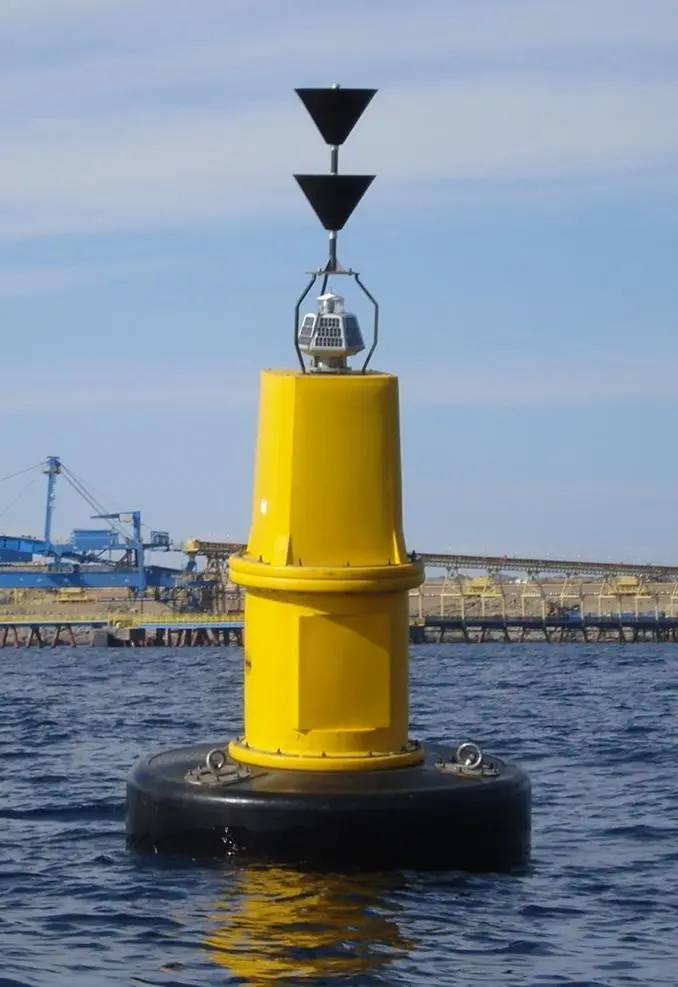
This allows ships of up to 9m draft to reach Abu Dhabi’s expanding Mussafah Industrial City.
The endless upscaling of ship size has resulted in pressure on ports’ deepening both their navigation channels and berths in order to keep their attraction for the shipping lines. Nearby cities are often growing apace, and the inward draw of both raw materials and manufactured products is increasing.
The channel outside Abu Dhabi has been dredged by the National Marine Dredging Company under a $409m contract from the Abu Dhabi Urban Planning Council. It has involved the removal of 65m cu/m of soil, using the latest cutter suction dredgers.
At the entrance to the channel, three Tideland SB-285P buoys provide fairway and port and starboard marks, while 22 SB-138P buoys and a further 45 smaller SB-98P units are deployed along its length to indicate the channel’s port and starboard limits. The buoys were supplied complete with topmarks, radar reflectors, solar power arrays and sinkers as well as a total of 14 spare buoys, covering each type.
The Tideland SB-2200P, SB-285P and SB-98P are all rotationally moulded polyethylene buoys with a solid core of expanded polystyrene foam. Their innovative mould and fill manufacturing process prevents significant ingress of water in the event of a puncture. Before moulding, the polymer is compounded with UV inhibitors and pigment so that the wall thickness is evenly UV stabilised and colour is uniform throughout. As a result, painting is never necessary. The buoys are also unsinkable, corrosion resistant, and marine growth resistant.
The 200m wide channel was begun at the end of 2008 and replaces a previous approach channel next to Abu Dhabi island that is now too small. The Mussafah industrial zone and the Industrial City of Abu Dhabi house a number of heavy industries which required better access both for raw materials and export of finished goods. There is also a network of shallows and sandbanks, making the approach difficult for ocean going vessels.
Related Articles
 VESSELS
 MARINE CONSTRUCTION
 VESSELS