![MaritimeJournal[Seawork]](https://www.maritimejournal.com/wp-content/uploads/2026/09/MaritimeJournalSeawork.svg)





New data buoy from Mobilis
The French National Centre for Scientific Research, the CNRS, has worked with specialist buoy manufacturer Mobilis to develop an advanced automatic data buoy. This has been located in Villefranche Bay and its aim is to measure the coastal marine environment and the impact of human activity on the littoral.
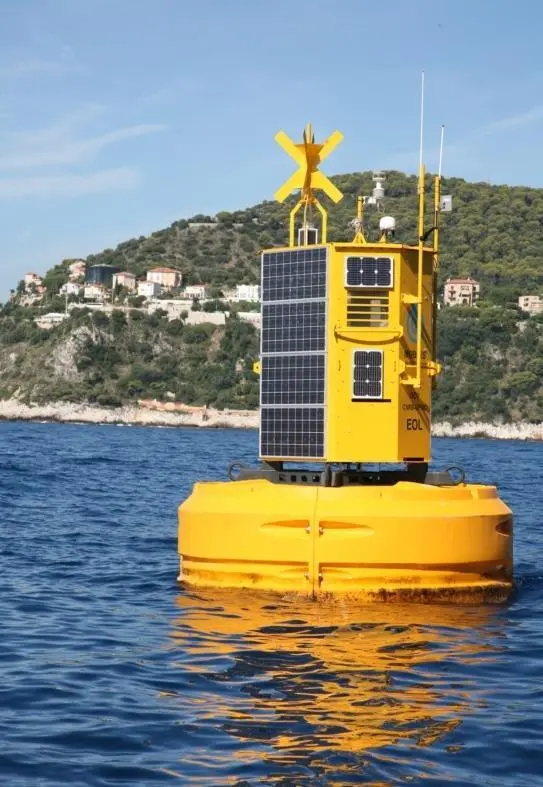
This advanced buoy is based on one of the largest data buoys in the Mobilis range. It is designed for a long life in unattended mode and it is claimed to be able to withstand the harshest storms. It is fitted with a bio-fouling system to prevent marine growth on the buoy and on its sensors and it can be located in areas with strong currents and deep water. This latest version is part of an evolving development programme that has seen the basic buoy evolve to a 3.6 metre unit.
With its wide variety of sensors, the buoy can measure both air and water parameters. From the air there are all the usual measurements including temperatures and pressures, wind direction and speed and moisture content. The unique feature of this buoy is that it has a multi-parameter probe that can be lowered on a winch to take daily measurement profiles of the water column that includes the chemical content, conductivity and sound measurements.
The buoy is solar powered with solar panels on the sides of the buoy superstructure. The information from the sensors is sent ashore via a radio link. The buoy itself weighs in at 3342 kg and the focal plane of its light is 4.25 metres above sea level with the total height of the buoy being just over twice this height.
By Dag Pike
Related Articles
 VESSELS
 MARINE CONSTRUCTION
 VESSELS