![MaritimeJournal[Seawork]](https://www.maritimejournal.com/wp-content/uploads/2026/09/MaritimeJournalSeawork.svg)



The Crown Estate has confidence in the future of offshore wind energy
Anyone who assumes The Crown Estate’s (TCE) role in UK offshore wind is simply allocating areas of seabed to developers and waiting for the rent to roll in, is clearly not aware of the organisation’s role and purpose.
In addition to the above, it also includes going to significant lengths in helping the industry move forwards, sending a clear and focused message that the UK’s offshore wind ambitions are both achievable and very much on track in helping the UK meet its renewable energy target commitments.
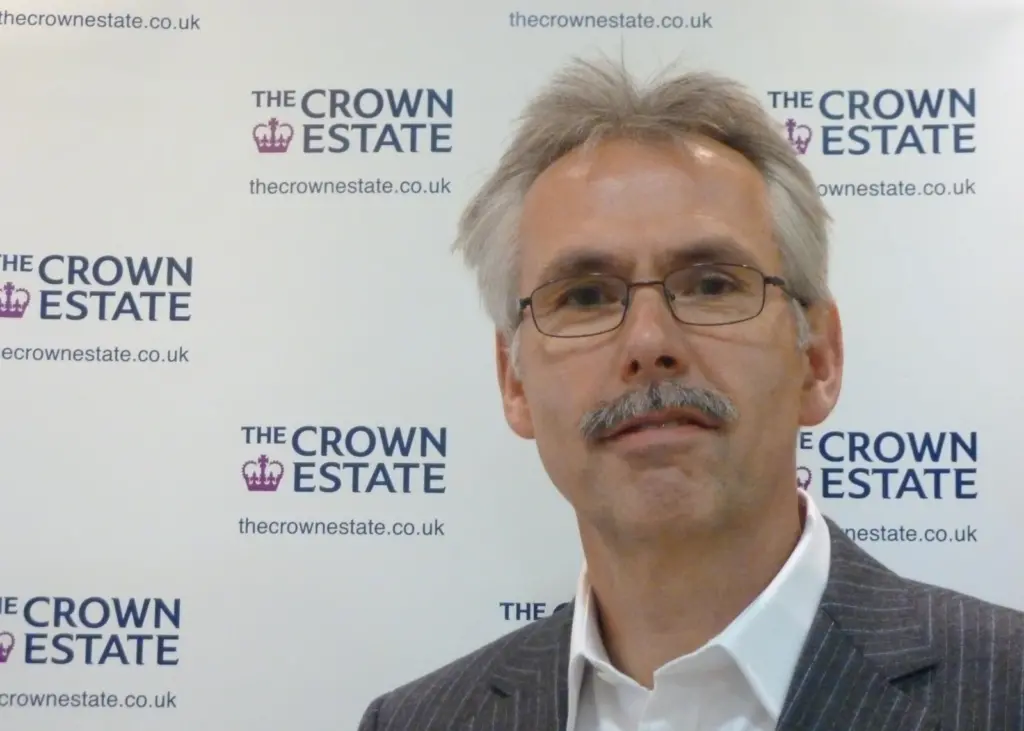
Maritime Journal recently had exclusive access to three of the top TCE offshore wind team in London, and in this first of a three part series, MJ’s marine renewable correspondent Peter Barker talks to Huub den Rooijen, Head of Offshore Wind, about the current state of play in the industry, including lifting the lid on the work of TCE, an organisation whose role is perhaps not fully understood, but is an important partner in guiding the industry’s efforts.
Mr den Rooijen has been in the role for just three months, having previously held senior positions in the offshore wind industry, and is therefore well placed to understand the challenges and opportunities of offshore wind, a quality well demonstrated through his clear and positive vision of where the industry is and of the road ahead.
The UK is approaching a significant milestone in the development of offshore wind energy, particularly with the progression of Round 3. For the industry and TCE, this comes at a time of financial instability and austerity throughout Europe, where confidence of investors, along with the political will of governments to support renewable energy policies, are increasingly important cornerstones in achieving the UK’s renewable energy aspirations.
Consent, costs and finance
The most basic question, is UK offshore wind on track, required an expanded answer and Mr den Rooijen provided a confident response, while adding a note of caution: “I believe the industry is on a growth path, and yes you always need to watch your growth, and you need to constantly work on the assumptions that you make, because nothing should be taken for granted. But the industry has demonstrated over the last ten years that it can grow from basically nothing to 1.5% of electricity supply, and that growth will continue; so to put that growth into perspective, last year UK offshore wind turbines have generated 1.5% of all the power generated in the UK and to me that is a very significant number and that is a very healthy growth”.
Considering the sustainability of that growth, he added: “I do believe that growth will continue and that the targets we have set out at TCE are achievable targets, in fact they are even realistic targets, however there are a number of steps that need to happen so it’s not just growth by itself, it’s not just planting a tree and watching it grow, we need to prune it, to weed it, we need to work on it”.
Referring again to growth, Mr den Rooijen pointed out, “The UK will be hitting roughly 3% by the end of the year, which is a number that will double and double again and that is achievable. What needs to happen in order to get there is that there will be a flood of applications coming for Round 3 projects this summer. Now we will need qualified people to work with the statutory authorities to be able to process these planning applications, we don’t want a logjam because there are, for example, insufficient bird experts to judge the ornithology component of planning applications. We shouldn’t let [a lack of] skilled people become the barrier to investment, there is a genuine risk of that happening if government departments and statutory authorities find it difficult to process consent applications”.
Controlling costs are clearly focusing attention at TCE, as Mr den Rooijen points out: “The other thing is that costs will have to come down, everybody knows this, everybody keeps telling each other, and we have done a lot of work with the industry to understand how costs could come down, and where we need to concentrate efforts to help costs move in the right direction. We see this in a study we have sponsored, due to be completed imminently, basically identifying if the treasury target of £100 per MWhr by 2020 is an achievable target and we see some very encouraging findings from that study and the supply chain seminars that we are organising.”
Addressing the wider considerations surrounding renewable energy, offshore wind and costs, Mr den Rooijen continued, “There is a third dimension to it [cost reduction] which is how does society think of all this, people do care about clean electricity, and very much care about reliable sources of supply, but they also think, is there something directly in it for myself? Employment is a huge issue and as offshore wind is presenting a very sound business case, we need to demonstrate that we can bring the jobs home if you want to keep the licence to grow your business and that is a very challenging question”.
Mr den Rooijen welcomed the positive signs surrounding financing of the industry: “What I have seen, now and in previous roles, is a great appetite in financing that applies to generation as well as transmission, including grid reinforcements that have to be done. We see new investors stepping in, we see pension funds getting in, so we see some very new investors which is very encouraging because they will take slightly more risk because offshore wind is a different risk from say a tall bridge, and there is a huge interest from the financial sector. Our role is to create the best possible investment conditions for investors. There is, potentially, enough capital in order for us to realise our vision of 25GW by 2020 although we will need to tap those fresh sources of money. It is a very interesting sector for those investors seeking a steady return on their capital”.
Investing in Round 3
With Rounds 1 and 2, TCE makes money (per MWhr) from lease payments when windfarms become operational. Unlike the earlier rounds however, TCE are investing in Round 3 up until consent stage is reached, and in expanding on this, Mr den Rooijen also explained most eloquently the role of TCE with such investments. “It is a bit more than £100m that we are investing in Round 3, into projects up to consent. Some of these investments get recycled to us because we want to make a return on those investments, so in that sense, we are acting very much like a property developer who has got a piece of barren land and says, if I can make some pre-investments and get somebody in who wants to build a nice block of houses, then I can capture the value from the land, so we are acting like a property developer in that regard”
Summing up the overall UK offshore wind picture, Mr den Rooijen spoke confidently about the future while also recognising the challenges to be addressed: “So [for TCE] it is all hands on deck, it can only work if all the components come together. We want to make sure these projects work their way through consent, we want to make sure the supply chain is there to deliver, we want to make sure that a lot of that supply chain will actually be sourced from the UK because if it all comes from abroad, it will be less attractive for politicians to stimulate the market than when it is leading to a significant amount of job creation in the UK. The beauty is that if all the elements work together, I am convinced we will see the results”
Asked if the word upbeat summed up his attitude, he was very clear: “Totally, I wouldn’t be here if I wasn’t upbeat. At the same time I am a realist but I see that offshore wind has a good story to offer, good in the terms of cleanliness of the fuel, no CO2, clean power. Finally, we are not alone in the UK, it is a regional and increasingly global market including China and Korea. I think the market is still very much in Europe now and Europe happens to be a good base in terms of manufacturing, shipping and offshore skills, so I think we have to energise ourselves to believe we can do it. If we just sit and watch, nothing will happen, we need to think of innovation, that is important, and of course there is a fantastic industry out there building on the experience of 30 years of the oil and gas industry. We need innovation and experience, it is up to everybody to play their part because it is not a steady state, it is moving, it’s a changing market.
Next month, in the second of the series, Supply Chain Manager Adrian Fox looks in detail at the challenges and opportunities for the supply chain.
Related Articles
 OTHER NEWS
 FEATURES & VIDEOS
 MARINE CIVILS