![MaritimeJournal[Seawork]](https://www.maritimejournal.com/wp-content/uploads/2026/09/MaritimeJournalSeawork.svg)






UK doubles subsidies for tidal and wave energy
UK changes to subsidies for renewable electricity could incentivise between £20 billion and £25 billion of new investment in the economy between 2013 and 2017.
The recently announced Banding Review for the Renewables Obligation will support jobs and deliver more clean power, with a reduction in costs to consumers between 2013 and 2015 according to Government Ministers.
Bandings were set for renewable technologies under the Renewables Obligation, the Government’s main mechanism for supporting large-scale renewable, for the period 2013-17 (2014-17 for offshore wind). This came ahead of the Government’s Global Investment Conference and series of 17 business summits taking place at the British Business Embassy at Lancaster House during the upcoming Games, which aim to secure further investment into the UK.
Edward Davey, Secretary of State for Energy and Climate Change said, “Renewable energy will create a multi-billion pound boom for the British economy, driving growth and supporting jobs across the country.
“The support we’re setting out today will unlock investment decisions, help ensure that rapid growth in renewable energy continues and shows the key role of renewables for our energy security.
“Because value for money is vital, we will bring forward more renewable electricity while reducing the impact on consumer bills between 2013 and 2015, saving £6 off household energy bills next year and £5 the year after.”
The Banding Review sets out that:
- Support for onshore wind from 2013-17 will be reduced by 10% to 0.9ROCs, as consulted on in Autumn 2011. This level is guaranteed until at least 2014 but could change after then if there is a significant change in generation costs. A call for evidence on onshore wind industry costs will be launched this Autumn and report in early 2013. If the findings identify a significant change, the Government will initiate an immediate review of ROC levels with any new support arrangements taking effect from April 2014, with grandfathering and grace periods for projects already committed. The call for evidence will also consider how local communities can have more of a say over, and receive greater economic benefit from, hosting onshore windfarms;
- Rates of support for offshore wind will reduce as the cost of the technology comes down during the decade;
- Support levels for certain marine energy technologies will more than double from 2ROCs to 5ROCs per MWh, subject to a 30MW limit per generating station.
By 2017, this package could deliver as much as 79 TWh of renewable electricity per annum in the UK, nearly three-quarters (74%) of the way towards the 108TWh of electricity needed to meet the UK’s 2020 renewable energy target.
These proposals are expected to bring forward 11 TWh more renewable energy in 2016/17 than current bandings, and stimulate between £20bn and £25bn of new investment. The proposals also provide industry with the certainty needed to make near-term investment decisions.
As part of The17 Global Business Summits are taking place at the British Business Embassy during the Olympic Games. The series of summits will be the largest set of trade and investment events ever held in the UK, with over 3,000 business leaders, policy makers and ministers from around the world attending, including half the companies in the FTSE 100.
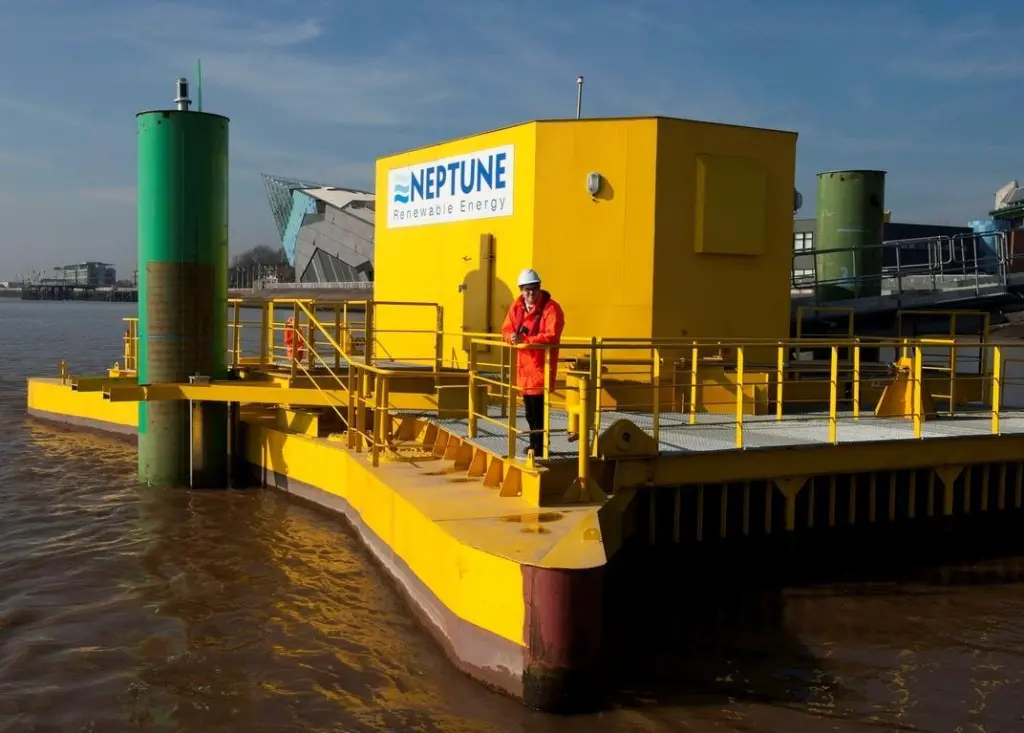
Among the companies welcoming the new banding is Hull UK based Neptune Renewable Energy, which already has its full scale Proteus tidal stream energy demonstrator operating in the Humber and is planning to deploy arrays of similar devices around the UK. Tidal stream energy, which attracted 2 ROCs under the old banding, now attracts 5 ROCs up until 2017.
Neptune Renewable Energy technical director Jack Hardisty said the new banding would create the certainty needed for further investment in the sector, adding, “Our business model is based on commercial viability and this is a tremendous boost for us and for our investors. The UK has great potential in tidal stream energy and today’s announcement demonstrates that the government recognises this.”
Related Articles
 OTHER NEWS
 FEATURES & VIDEOS
 MARINE CIVILS