![MaritimeJournal[Seawork]](https://www.maritimejournal.com/wp-content/uploads/2026/09/MaritimeJournalSeawork.svg)





UK renewables support ‘only a drop in the ocean’
An announcement by UK Climate Change Minister Greg Barker that the Government will provide up to £20m to fund new marine power technology has received a lukewarm response from the nation’s largest marine energy trade association.
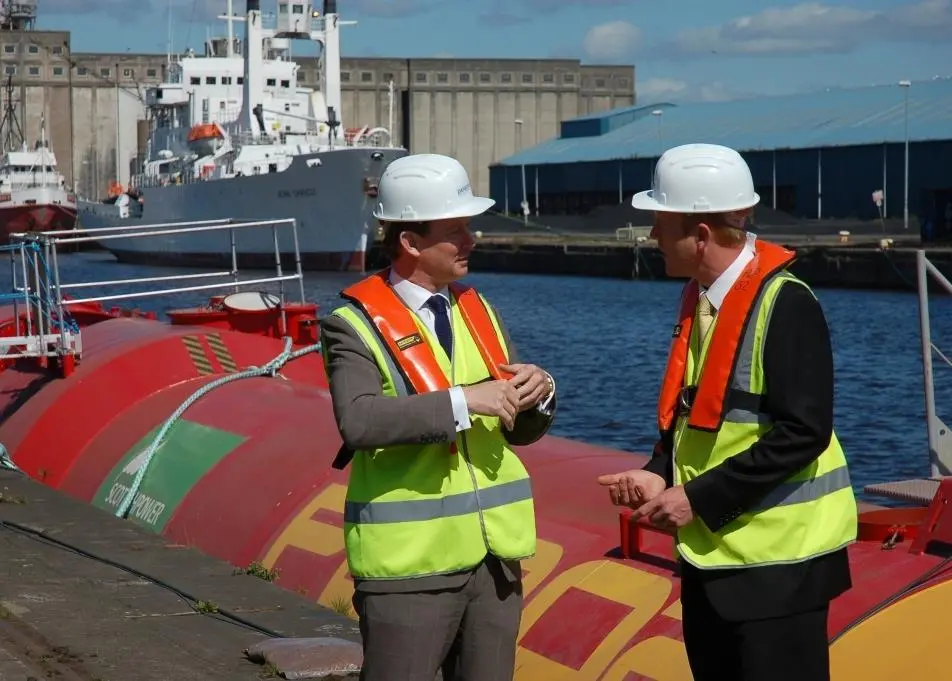
Up to £20m from DECC’s budget of over £200m to fund low carbon technologies, announced at the Spending Review, will help progress the development of marine devices from the current large scale prototypes to bigger formations in the sea.
Speaking at a visit to Pelamis Wave Power at Leith Docks in Edinburgh late last month, Greg Barker said, “Marine power has huge potential in the UK not just in contributing to a greener electricity supply and cutting emissions, but in supporting thousands of jobs in a sector worth a potential £15bn to the economy to 2050.
“Britain can be a world leader, as we have decades of expertise in offshore industries and the most advanced devices are already being developed here. Our geography gives us access to rich marine resources which act as a natural laboratory to test and run devices in realistic conditions, especially in Scotland and the South West, where innovative work is already being carried out.
“The money we’re announcing today will take marine power to the next stage of development in the UK and a step closer to being a real contender in the future energy market.”
The scheme is expected to open in spring next year and, subject to a value for money assessment, will support two projects to test prototypes in array formations, the final development stage in generating large scale electricity from marine power prior to commercial roll out.
RenewableUK, Britain’s largest wind and marine energy trade association, welcomed the Government’s announcement but warned that the amount is insufficient if Britain wishes to secure its position as the world leader in marine energy. Other measures are urgently needed, including a further £60 million funding from the Green Investment Bank, support from new regional enterprise zones, and a guaranteed 5 ROCs per MWh, to ensure this nascent industry is financially viable.
Maria McCaffery, Chief Executive of RenewableUK, said: “We want to work with the Government to ensure that the extraordinary innovations Britain has achieved in this dynamic new industry are not lost to our foreign competitors. RenewableUK is calling for the Department of Energy and Climate Change to take the lead on this, supported by the Department for Business, Innovation and Skills, and the Treasury.
“Overall, the first generation of marine energy projects is likely to cost £80m per 10 MW scheme, and we need at least 3 or 4 projects to drive costs down and achieve the best technical solutions to maintain our premier global position in this field. So £20 million is a good start, but it’s only a drop in the ocean”.
RenewableUK noted that when the coalition government was formed in May 2010, the Prime Minister David Cameron said he wanted it to be “the greenest government ever”. Mr Cameron had already stated in 2008 that he wanted “to make Britain the force for clean, green, marine energy”, promising that “the next Conservative government will put rocket boosters behind this area of research.” We urge the Prime Minister to stand by those promises fully and unequivocally.
The Government’s current announcement that it will support two flagship projects with £20m, £10m per project, is exactly 50% of the support government could offer under EU state aid rules. Without additional support measures it risks leaving plans to deploy at least 40MW of marine energy projects high and dry, at a time when the US Government has just ratified plans to invest $50m in marine energy in 2012.
Related Articles
 OTHER NEWS
 FEATURES & VIDEOS
 MARINE CIVILS