![MaritimeJournal[Seawork]](https://www.maritimejournal.com/wp-content/uploads/2026/09/MaritimeJournalSeawork.svg)

Seawork: USVs push DP regulations to the limit
Autonomy is reshaping offshore marine operations, but industry experts warn regulatory uncertainty around vessel autonomy and Dynamic Positioning (DP) vessels risks creating safety gaps.
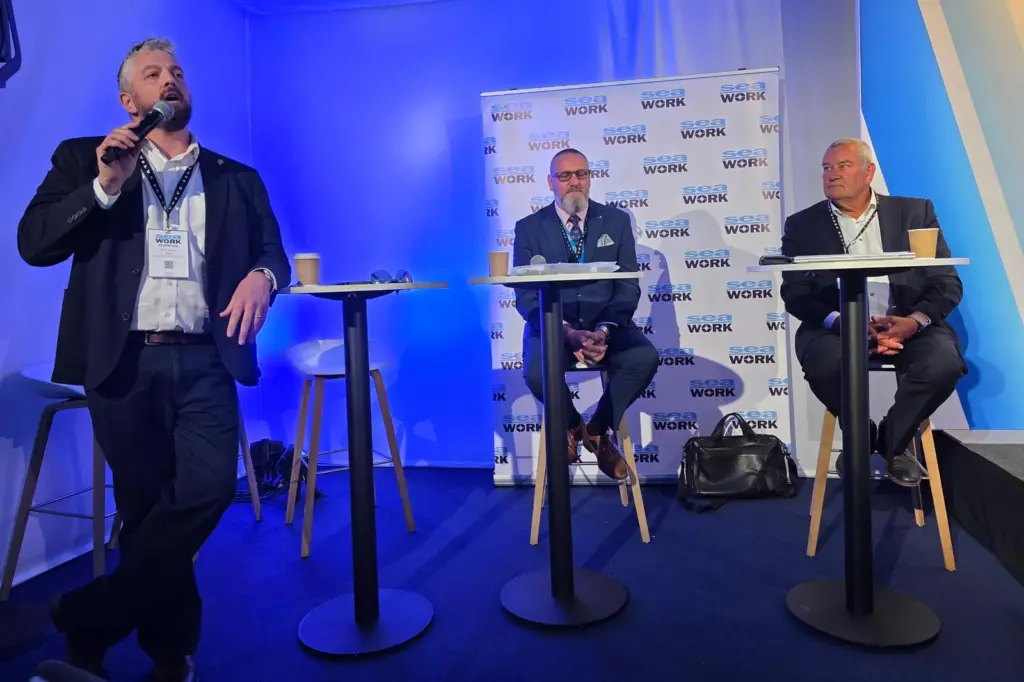
Speaking during the ‘Autonomy at Sea – The Future’ conference session at Seawork 2026, representatives from IMCA and DP & Marine Assurance Norway AS explored how rapidly evolving vessel autonomy technologies are challenging long-established definitions surrounding USVs and offshore operational safety.
The session, a follow-up Seawork Insight webinar ‘Autonomy at sea – the future of global regulations for autonomous vessels and underwater systems’, centred on whether unmanned and remotely operated craft using dynamic positioning systems should be subject to the same standards, assurance frameworks and operational requirements as conventional crewed DP vessels.
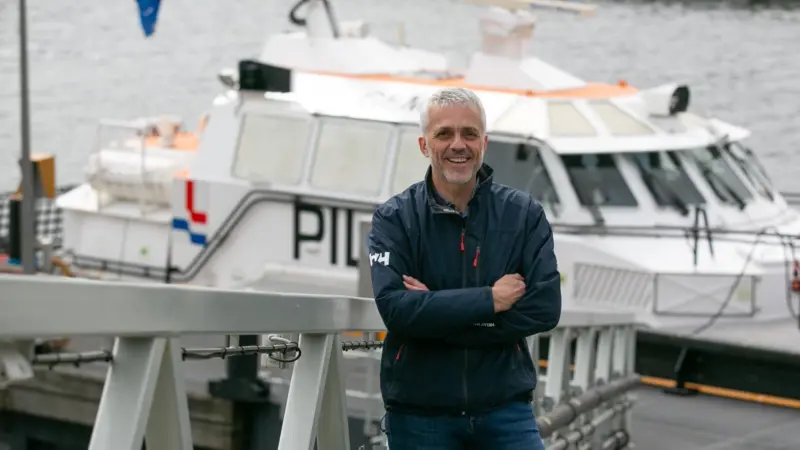
“Why should a USV be allowed to do the same?” asked Peter Solvang, managing director of DP & Marine Assurance Norway AS, comparing autonomous offshore craft with automated taxis soon expected on London’s streets.
“A driverless taxi has to follow all of the rules. You don’t allow them to drive around on bald tyres and brakes that don’t work, so why should a USV?”
Keeping pace
The session highlighted how vessel autonomy is advancing faster than regulation, particularly within offshore wind, survey and renewable energy operations where USVs are increasingly deployed for inspection, monitoring and subsea support.
Roger Moore, technical adviser – remote systems & ROV, offshore survey and competence and training at IMCA, said confusion has emerged because differing regulatory frameworks define automation and autonomy in fundamentally different ways.
Mr Moore explained that IMO definitions focus primarily on where human operators are located, while Defence Maritime Regulator (DMR) approaches concentrate on functional automation and operational capability. “The key distinction is that IMO is regulatory and ship level,” he said.
“DMR is operational and system level. It asks who decides and who executes.”
According to Mr Moore, this disconnect risks distorting wider vessel safety discussions because highly automated offshore systems may still technically sit within lower IMO autonomy categories simply because crew remain onboard.
He warned that “Automation does not automatically mean higher safety”, arguing instead that operational assurance depends on supervision, failure management and crew competence.
DP vessel or DP tool?
The discussion became particularly pointed when examining whether USVs using DP systems should legally and operationally be treated as DP vessels.
Mr Solvang argued current interpretations create “muddied waters” where unmanned craft can benefit from dynamic positioning functionality without necessarily complying with the full framework of DP regulations, testing and assurance requirements applied to conventional vessels.
Quoting one unnamed USV operator’s definition, Mr Solvang highlighted the argument that USVs merely use DP “as a tool” for functions such as station keeping or survey trackkeeping and therefore should not automatically be classed as DP vessels unless they possess formal DP class notation.
However, he countered that the official IMO and IMCA definition is far broader. “Any vessel maintaining a fixed position or following a predetermined track by exclusive use of thruster force is by definition a DP vessel,” he said.
That distinction sits at the centre of the current debate around vessel autonomy and vessel safety.
If a USV is not formally recognised as a DP vessel, it may avoid requirements surrounding redundancy, trials, Failure Mode and Effects Analysis (FMEA) testing, backup systems and onboard intervention capability, despite operating in the same offshore environments and often inside the same 500m exclusion zones as conventional DP vessels.
Mr Solvang repeatedly returned to the automotive comparison to underline the inconsistency. Driverless road vehicles remain classified and regulated as cars despite operating autonomously. Offshore, however, USVs are increasingly viewed as vessels equipped with DP functionality rather than DP vessels themselves.
“The trouble is, the systems do go wrong,” he warned. “If they didn’t go wrong, we wouldn’t need all the checklists and FMEAs.”
The concern is not theoretical. Mr Solvang questioned how unmanned vessels would respond during loss-of-control events or failures close to offshore infrastructure. Unlike crewed DP vessels, USVs lack onboard engineers and manual intervention capability if faults develop.
“The problems are on the vessel,” he said. “There’s nobody there to fix it.”
Regulatory uncertainty
Questions from delegates further exposed the regulatory uncertainty surrounding vessel autonomy. Discussions ranged from cybersecurity and GPS spoofing threats through to insurance implications and the challenge of applying international maritime rules across nearshore, offshore and international waters.
One particularly revealing exchange focused on autonomous underwater vehicles (AUVs), which can be classified as USVs under some conditions but not others.
Mr Moore explained that when an AUV surfaces outside a supervised operating area, or returns independently to port, it effectively crosses into a different regulatory framework and may then fall under autonomous surface vessel definitions.
Perhaps most striking was the acknowledgement that regulation may ultimately be shaped reactively rather than proactively. Asked whether the industry fully understands the operational complexity and legal implications surrounding vessel autonomy, Mr Solvang replied candidly: “It’s going to take an incident to find out the answer.”
For offshore operators, charterers and regulators alike, the session reinforced that the commercial deployment of USVs is accelerating rapidly.
Yet as vessel autonomy advances, the maritime industry still faces unresolved questions over classification, accountability and vessel safety – particularly when unmanned craft increasingly perform the same operational functions as fully certified DP vessels.