![MaritimeJournal[Seawork]](https://www.maritimejournal.com/wp-content/uploads/2026/09/MaritimeJournalSeawork.svg)



LNG support urged as Helgoland enters service
Europe’s first LNG ferry is on track for service from October as Germany’s maritime industry urges Berlin to do more to promote investment in LNG as an alternative fuel in shipping.
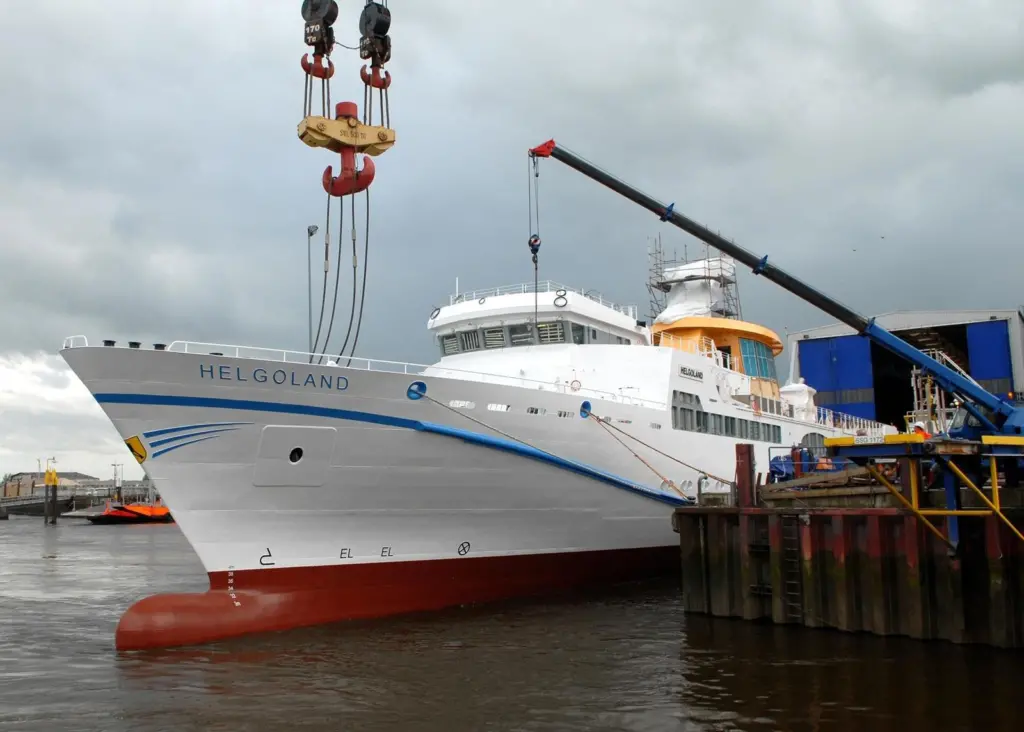
AG Ems, the German owners of the 83m long Helgoland, said work on the ship was going well. “The final technical hurdles will be taken soon and we can expect a start to service in October”, a spokeswoman told Maritime Journal.
She noted the company had already become the first in Germany to take an LNG-driven ferry into operation, with the converted Ostfriesland. Helgoland will be Europe’s first ferry newbuilding operating mainly on LNG and once that ship is also in service, AG Ems will be in a position to provide a great deal of experience in the LNG sector, she said.
Both ships have been fitted with 20DF medium-speed engines from Wärtsilä. “We have jumped all the new technical hurdles, fulfilled all the special classification demands and at the same time also been able to build up considerable know-how – which we will gladly pass on to others”, the spokeswoman declared.
Ostfriesland was lengthened from 78.7 to 94.07m at BVT in Bremen and entered service in June. Helgoland had been due for launch and her maiden voyage in May but that was rescheduled for technical reasons. Builders Fassmer Werft and operators Cassen Eils, an AG Ems subsidiary, said however they were confident of solving the “wide-ranging challenges” posed by the Helgoland project.
The EU contributed a total of €7.2 million towards the €31 million Helgoland and the €13 million Ostfriesland conversion and the head of the German Shipowners’ Association (VDR), Ralf Nagel, has noted that so far in Europe not a single LNG ship has gone into service without funding.
Nagel added that even shipowners who would like to invest in LNG could not do so without state help and said the investment costs for LNG engines could be up to 30% higher than for a conventional propulsion system and run into the millions.
He proposed that the German Government subsidise new and converted ships using LNG fuel to the tune of €15 million per ship and that €150 million a year be set aside as an investment incentive for ship owners.
Nagel was speaking at a meeting of the Maritime LNG Platform in Hamburg, at which the German Government was urged to take concrete steps to support LNG as an alternative fuel in shipping. The head of the Platform, Georg Ehrmann, said LNG in shipping had great potential in reducing emissions like sulphur, soot and nitrous gases in coastal areas and in port cities. It also met current and planned future emission regulations and was economical, he said.
By Tom Todd