![MaritimeJournal[Seawork]](https://www.maritimejournal.com/wp-content/uploads/2026/09/MaritimeJournalSeawork.svg)


‘Ariane’ answers new call of the deep
Ifremer’s hybrid, remotely operated vehicle (HROV) ‘Ariane’ has come about from pressure. Not the kind exerted by tonnes of seawater, but the need to map and record the oceans and keep track of our impact on them.
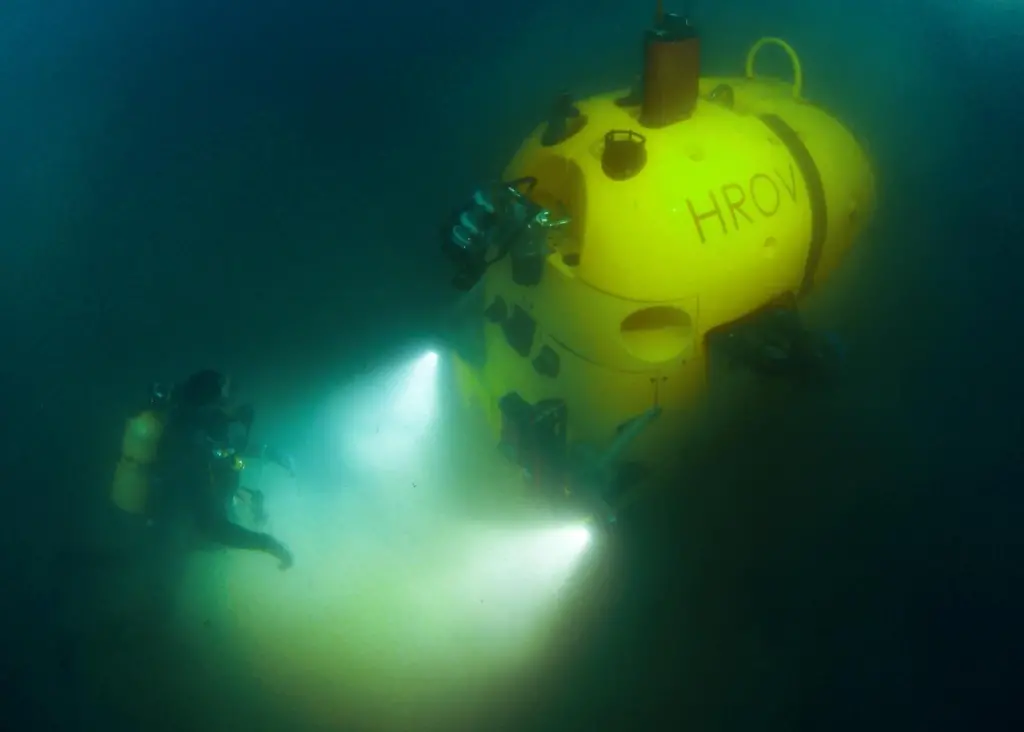
European directives that cover everything from marine strategy and protection to water quality, alongside new coastal research projects, deep-sea biodiversity exploration and subsea observatories means there’s more need than ever to actually go down and take stock. But the problem is that the older, more traditional ROVs have a few restrictions: Ifremer explorers Nautile or Victor 6000 need to be launched from full scale research ships, and these are both expensive and in short supply.
So Ariane, developed at Ifremers European Centre for Underwater Technology (CETSM) has made use of industrial partners such as SAFT, ECA Robotics, Prolexia and Robopec (who developed the software) and camera specialist Osean au Pradet in order to offer something a little different.
It is able to dive to a depth of 2,500m and will provide the scientific community with a vehicle for subsea operations, seafloor inspection missions and high-resolution mapping, even looking into rugged areas such as submarine canyons and cliffs, starting in 2016.
However, probably the best thing about Ariane is its flexibility. Roughly the size of a small car it can be tethered and remotely controlled via fibre optic cable with a management system that can compensate for movement of both ship and HROV: a mini-winch adjusts the length of the fibre optic cable while the float pack at the upper end is connected to a more resistant, traction tether that’s linked directly to the ship for shallower deployments (to 200m) or to a depressor weight for deeper dives. When the fibre optics cable is completely rewound, the float pack is clamped to Ariane for safety.
The important point is that it means the support boat doesn’t need to have a dynamic positioning system, making the charter deal much easier and cheaper.
On the other hand, Ariane can also operate in a free-swimming, untethered mode, communications transit acoustically to monitor mission progress, to transmit scientific data (according to the communication speed) or to change the course of the mission.
The propulsion has also benefited from recent technological advances. In contrast to the traditional solution, Ariane has 20kWh of SAFT developed, energy-dense lithium-ion batteries onboard. This means that the support ship doesn’t actually need to feed the HROV power, and this again also helps to reduce deployment costs.
More, Ariane can navigate in rugged terrain, such as Mediterranean submarine canyons because of its specially adapted propulsion, based on omni-directional thrusters and navigation sensors that can propel it along both vertical surfaces and flat bottoms.
By Stevie Knight
Related Articles
 OTHER NEWS
 MARINE CIVILS
 MARINE CIVILS