![MaritimeJournal[Seawork]](https://www.maritimejournal.com/wp-content/uploads/2026/09/MaritimeJournalSeawork.svg)


Carousel innovation aids underwater power link
The recent laying of the first and only power interconnector between the UK and the Netherlands meant a 260km cable connection between the Maasvlakte in Holland and the Isle of Grain in Kent.
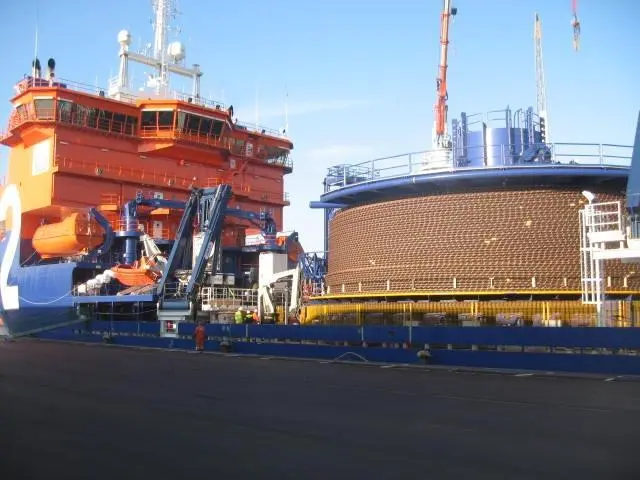
ABB, which has been in charge of the recent 62km section of the BritNed project, asked IHC Engineering Business (EB) to assist in the transfer a high specification flexible lay system to the North Ocean 102 vessel for use on the contract.
EB’s carousel system has a total capacity of 7,000 tons and features an innovative roller suspension system to deal with fluctuating operational loads. When first starting to spool cable on, all the weight is in the middle of the carousel. ‘So instead of using simple fixed rollers which would result in concentration of loads at the carousel core, the rollers underneath the carousel have a hydraulic load sharing system that spreads the weight evenly underneath’, explained Ben Webster of EB.
To alleviate stresses on the cable caused by vessel motion, the carousel has a combined spooling tower and compensator system which moves up and down or in and out as the cable comes off the carousel, accumulating or releasing the slack and avoiding unnecessary loads.
Following modification work on the Tyne to accommodate the lay system, the vessel transited to ABB’s factory in Sweden to collect its load of 5,000 tons of 1,000 megawatt power cable. Due to the distance involved DC (direct current) electricity is the only option to transmit power between the converter stations at each end. So, the cables are installed in a bundled pair of bi-pole high voltage direct current interconnectors. This results in a weight coming off the carousel of around 88kg per metre.
The twin lay of bundled cable makes for slightly different dynamics, explained Mr Webster. ‘The two cables spooled onto the carousel firstly as a separate pair, one on top of the other, so they come off the carousel at the same time. Then they are split, going left and right to separate SAS Gouda tensioners, used in a two track mode to control the cable as it leaves the vessel stern. As they come off the tensioners they are bundled together by a strapping machine, then over the chute and laid.’
This is only the second offshore project in which the carousel, one of the worlds largest, has been put through its paces, but ‘the operation went off straightforwardly’, according to Mr Webster.
Related Articles
 OTHER NEWS
 MARINE CIVILS
 MARINE CIVILS