![MaritimeJournal[Seawork]](https://www.maritimejournal.com/wp-content/uploads/2026/09/MaritimeJournalSeawork.svg)






JW Fishers acoustic pinger
The search for Malaysia Airlines Flight 370 has brought undersea technology into the media spotlight, especially with regards to equipment such as the Autonomous Underwater Vehicle (AUV) and acoustic pinger.
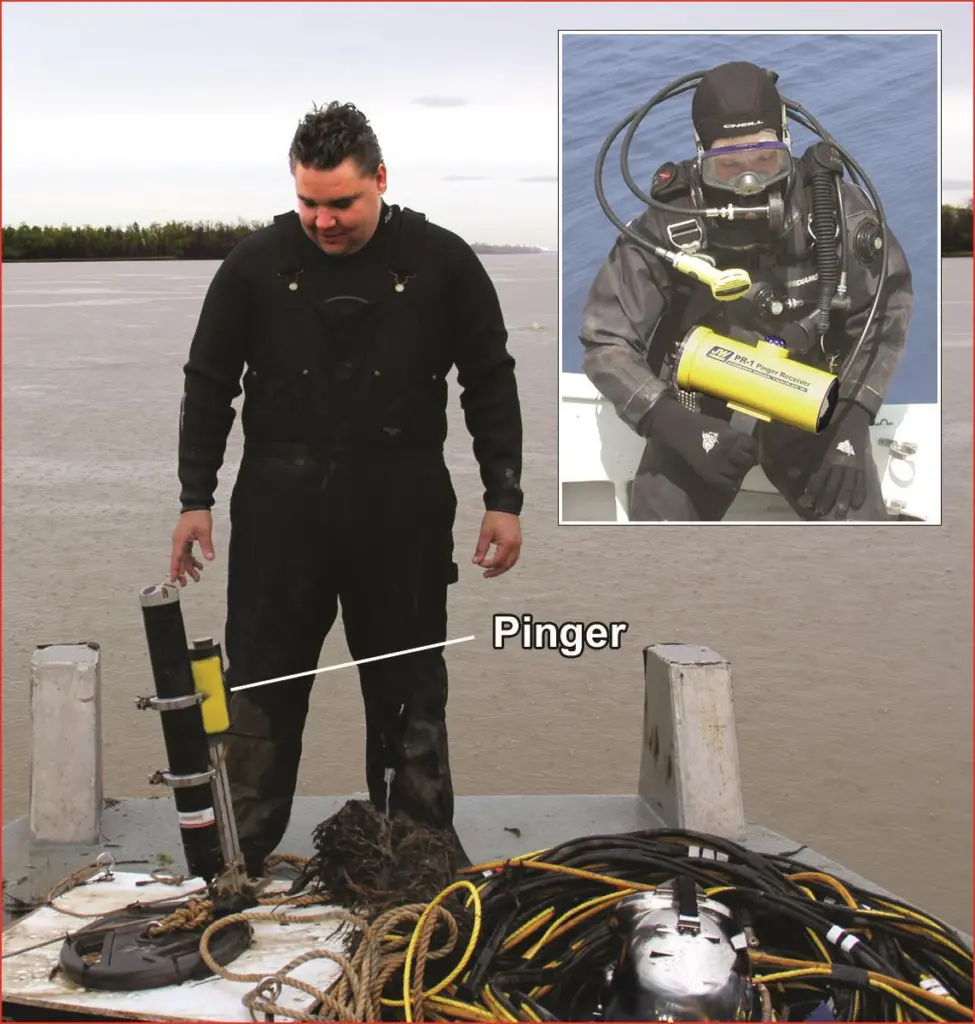
Pingers, or underwater signalling devices, have been around for a long time, and are used by a diverse group of organisations and institutions. A pinger receiver is used either by a diver or attached to an AUV to detect the sonar signal transmitted. Putting an acoustic pinger on an airplane’s black box is only one of the many purposes for this device.
JW Fishers has recently added a new low frequency pinger to its extensive line of acoustic devices. The new model has a significantly longer transmission range (3 to 6 miles compared to 2 – 3 thousand feet for a conventional pinger), a longer battery life, and a variety of other new features including delayed start which allows the pinger to lie dormant for up to a year before beginning to transmit.
The company has many clients in different sectors including The Jackson School of Geosciences at the University of Texas in Austin, USA. The team is currently conducting coastal restoration and hurricane protection projects by monitoring how water moves through coastal estuaries.
To capture this data, a Nortek Aquadopp current profiler (ADCP) is deployed to measure the speed and direction of water flow. The profiler must be retrieved to access the stored data. To ensure the profiler doesn’t get lost, a Fishers SFP-1 single frequency pinger is attached. This proved invaluable in a recent survey when the retrieval line on the ADCP was cut and a diver had to be deployed with the PR-1 pinger receiver to find it.
Another organisation using JW Fishers pingers is the Khalid bin Sultan Living Oceans Foundation, a non-profit environmental science and ocean research foundation established to help preserve, protect, and restore the world’s oceans and aquatic resources. Foundation researchers use a variety of oceanographic instruments along with the SFP-1 pinger attached to ensure safe recovery.
Related Articles
 OTHER NEWS
 MARINE CIVILS
 MARINE CIVILS