![MaritimeJournal[Seawork]](https://www.maritimejournal.com/wp-content/uploads/2026/09/MaritimeJournalSeawork.svg)






Long dive through tunnel for inspection AUV
An autonomous underwater vehicle (AUV) manufactured by Atlas Elektronik ‘dived’ through a water supply tunnel 24km long in a seven hour inspection, the first in 40 years.
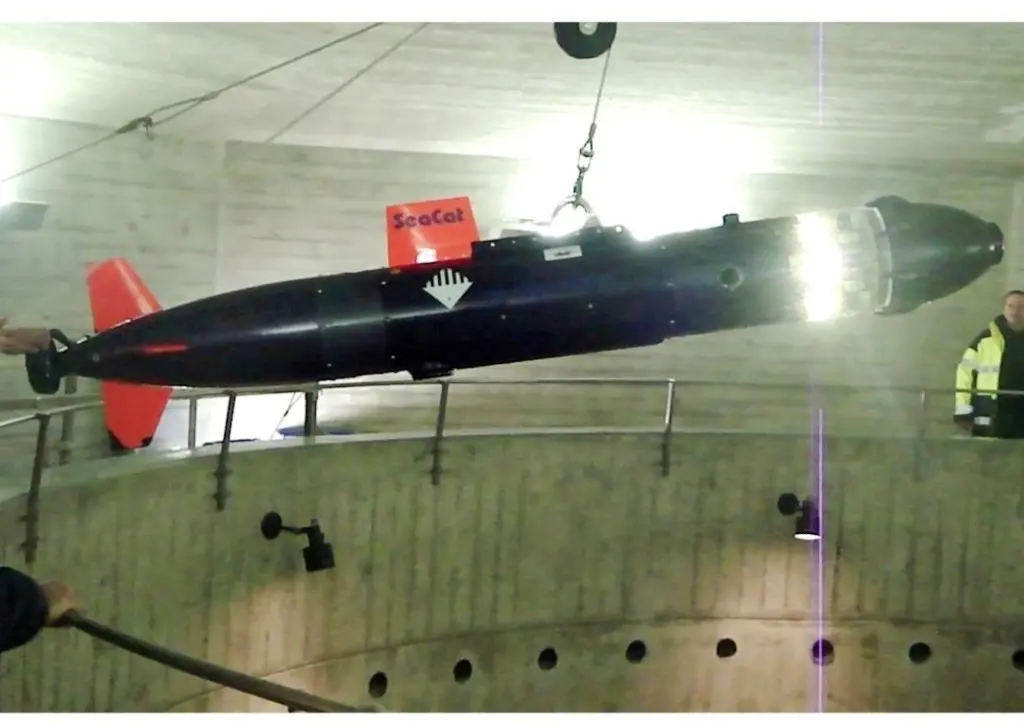
The Albstollen tunnel, with the length of 24km and a diameter von 2.25m, forms part of the water supply system operated by Bodensee-Wasserversorgung (BWV) with headquarters in Stuttgart. As the largest of the German long distance water distribution systems, it provides fresh water from Lake Constance to four million people in 320 communities.
Although the tunnel had been checked regularly in the course of its over 40 year lifetime through measurements of the hydraulic friction losses and through the leakage rate, a visual inspection of its condition over the entire length had not been technically possible until now.
After a thorough disinfection, the craft was lowered into the inflow reservoir at Büttnau and guided into the tunnel by remote control. For the first 300m, the SeaCat was controlled through a laptop via a fibre optic cable. After the vehicle had passed several obstacles in the first section, the cable was cut and the autonomous guidance system was activated to take control for the next seven hours and 24km. The speed was about a metre per second, corresponding about 2 knots or 3.6 km/h.
The vehicle was tasked with recording video data over the total length of the tunnel, while moving continuously through the concrete tunnel and remaining centred with the aid of laser distance sensors. For the first time in 40 years, it became possible to look deep into the tunnel and to document its present condition.
The exit point of the trip after 24km was the shaft surge chamber at Talheim, a concrete structure comprising a shaft 38m deep and about 8m in diameter. This pressure balancing well is normally half filled with water. The water tunnel is routed through the well, forming a semi-circular channel at the bottom. A diver’s lamp was positioned at this point to provide a light indicating that the AUV had reached its final destination. This visual signal was detected by the vehicle, causing the autonomous guidance system to stop the vehicle and let it rise to the surface.
Sven Hesse, head of the UUV programme at Atlas, said after the mission, “Never before has a water filled tunnel of this length been inspected by a diving robot navigating on its own. And rarely has such an entirely autonomous vehicle completed such a demanding task.“
Related Articles
 OTHER NEWS
 MARINE CIVILS
 MARINE CIVILS