![MaritimeJournal[Seawork]](https://www.maritimejournal.com/wp-content/uploads/2026/09/MaritimeJournalSeawork.svg)

New dive site medical equipment details
The Diving Medical Advisory Committee has published a revision to ‘Medical Equipment to be held at the Site of an Offshore Diving Operation’ (DMAC 15 Rev. 3). This supersedes all previous issues which have now been withdrawn.
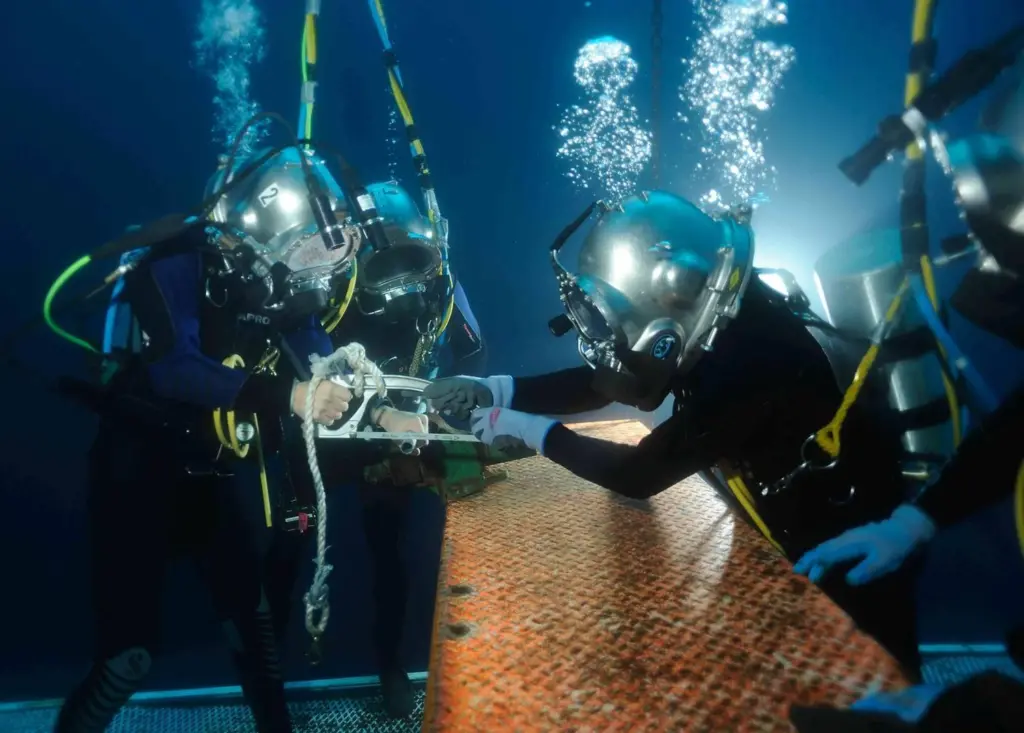
The list covers equipment suitable for the treatment of diving related disorders on the surface or in a decompression chamber, and for other potential problems (e.g. trauma) which may occur during diving operations. It takes account of situations where the diving operation may be remote from a vessel or installation sickbay and medical services. The list also includes equipment for use in an immediate first aid situation; equipment and drugs which may be used by personnel with advanced first aid training; as well as equipment which would almost certainly only be used by medical staff because medical staff who attend a casualty at a dive site may not necessarily be able to bring the appropriate equipment.
As the introduction to the document states, “Commercial diving operations include both surface supplied and saturation diving operations and cover a wide range of work activities. Appropriate medical equipment to be held at any particular site is best determined by an occupational health service with special knowledge of commercial diving operation. This list is designed to provide guidance on equipment to be held at the site where such advice is not available. It is recognised that, in certain circumstances, similar or greater facilities may be available from other sources, which are sufficiently close and reliable.”
The new document urges that equipment is regularly inspected (at least every six months) to ensure that all items are in working order (e.g. batteries) and to exchange drugs and other equipment nearing the end of their shelf life. People involved in the provision of care in diving situations should be part of a system of continuous training to help prevent skill fade.
DMAC 15 Rev. 3 – and other DMAC documents, can be downloaded from http://www.dmac-diving.org/guidance/ free of charge. DMAC can be contacted at Eighth Floor, 52 Grosvenor Gardens, London SW1W 0AU, UK. www.dmac-diving.org and info@dmac-diving.org
Related Articles
 OTHER NEWS
 MARINE CIVILS
 MARINE CIVILS