![MaritimeJournal[Seawork]](https://www.maritimejournal.com/wp-content/uploads/2026/09/MaritimeJournalSeawork.svg)






Pingers sleep soundly on the seabed
All sorts of agencies and marine service companies are finding a variety of uses for acoustic pingers and pinger receivers.
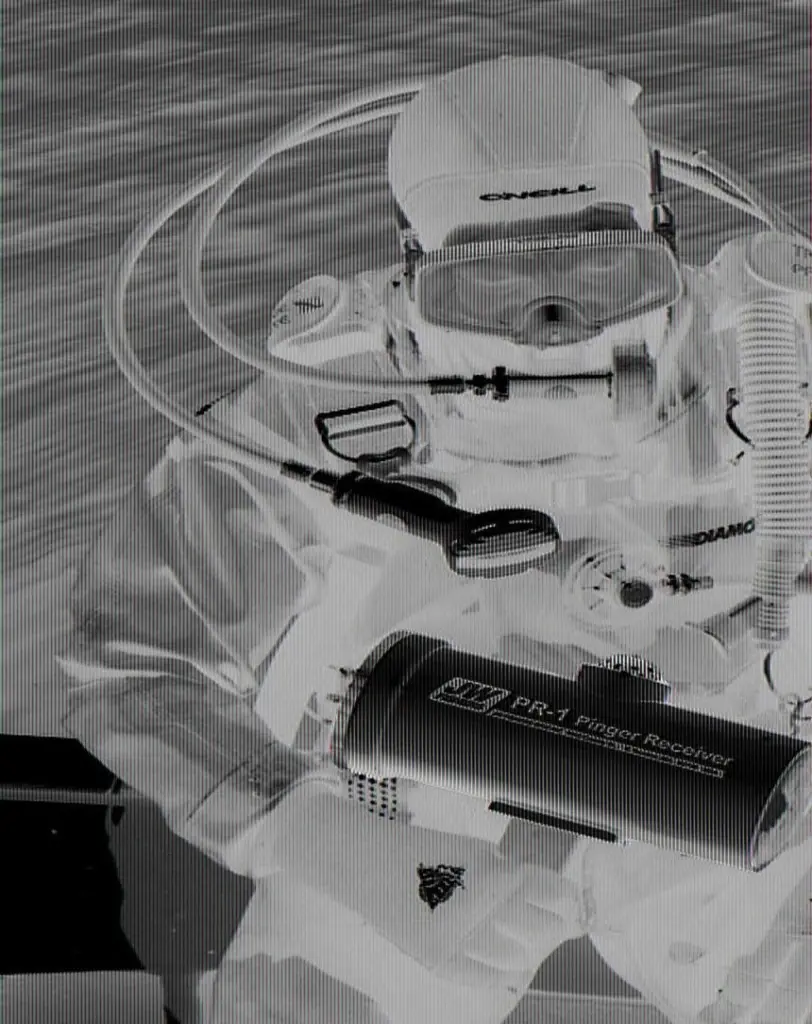
These pingers are signalling devices that can be attached to an underwater site or instrument package. Using the receiver (a gun-like instrument), a diver can follow a sonar signal transmitted by the pinger to its source. A diverse group of underwater researchers attach these little transmitters to expensive monitoring instruments in order to keep track of expensive probes or research subs. This is especially useful for the unmanned variety, ‘when they don’t do what they are told’, said Bill Parnella of the University of Delaware. They are equally good for the manned type, Dutch manufacturer U-Boat Worx uses them as an additional safety feature.
These acoustic beacons have also caught the attention of many public safety dive teams, which attach pingers to their divers so, should one run into trouble, other team members using the receiver can quickly locate the individual in distress.
The military frequently use pingers to identify the location of mines or other unexploded ordnance, but they’re not the only ones interested in finding these devices. In Italy, the Societa Explosivi Industriale, a government group charged with finding and disposing of explosive devices, is using these pingers to mark unexploded ordnance discovered during marine construction projects and harbour dredging.
Given the wide range of applications, improvements in a pinger’s deployment life adds enormously to its usefulness. For example, JW Fishers has developed a delayed start mechanism which allows the pinger to postpone the beginning of its acoustic transmission from a minute up to 99 days. This feature is extremely valuable when marking sites that may not be revisited for months at a time. During ‘sleep time’ the pingers draw a very small amount of power, significantly increasing the life of the batteries, 9V cells that can be added to by virtue of an extended housing, tripling the operating time.
The delayed start is available on single frequency and multifrequency pingers. The single frequency unit transmits only one out of four possible frequencies which the user selects at time of order. The multifrequency pingers allow the operator to select any of 60 different transmit frequencies in the field. Both models allow the operator to choose the number of pings per second, the amount of time each ping lasts, and the output power, all of which determine how long the device will operate and how far away it can be detected. So now pingers now can sleep soundly, conserving energy for their wake up call.
Related Articles
 OTHER NEWS
 MARINE CIVILS
 MARINE CIVILS