![MaritimeJournal[Seawork]](https://www.maritimejournal.com/wp-content/uploads/2026/09/MaritimeJournalSeawork.svg)

ROV key to salvage safety
With the ill-fated cruise liner ‘Costa Concordia’ finally in dock, Italian marine contractor Micoperi reports that the Saab Seaeye Falcon ROV played a vital role in diver safety during the largest maritime salvage operation in history.
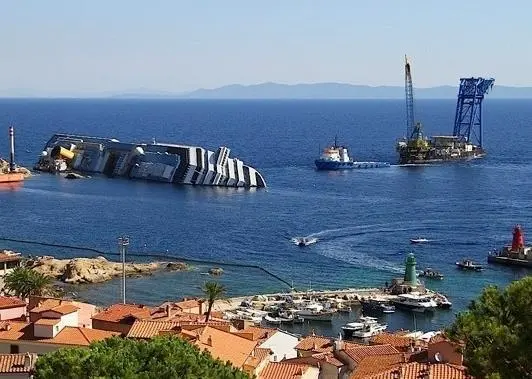
Fabio Bartolotti of Micoperi, the contractor responsible for the project, says that the Falcon worked every day of the salvage operation, spending over 1000 hours in the water. He says that every single time a diver entered the water the Falcon was deployed in their support and for their safety.
The ROV was sent into places too dangerous for divers, and on examination and survey missions without the need for divers. In addition the Falcon was employed for tasks including the scanning procedure needed to measure the distance between the legs of the support platform built below the ship ready for the raising of the vessel.
For salvage operations such as this, Saab Seaeye claim that the Falcon has the advantage of being small enough to be easily manhandled into the water, yet has the thruster power to work in strong currents and the intelligent architecture to handle a range of tools including manipulator, cutters, cameras and survey and sonar systems.
Powerful cutters were fitted to clear debris and entanglements – including polypropylene rope up to 19mm thick and steel rope up to 12mm diameter.
Cameras, along with variable intensity lighting, were employed to view places too difficult or too confined for divers to access safely.
When divers did have to be deployed, the ROV was able to preview the area, identify hazards and pinpoint the site of interest. It could then take down a safety line, if needed, ready for the diver to decend safely to the location.
The salvage contract was won by Micoperi in partnership with the American company, Titan Salvage, as best able to fulfil the main objectives set out in the tender specifications: removal of the wreck in one piece, minimal risk, minimal environmental impact, protection of the local economy and tourism industry, and maximum working safety.
By Jake Frith
Related Articles
 OTHER NEWS
 MARINE CIVILS
 MARINE CIVILS