![MaritimeJournal[Seawork]](https://www.maritimejournal.com/wp-content/uploads/2026/09/MaritimeJournalSeawork.svg)






Sim goes deeper
Although the benefits of simulator training are well known, until now it has tended to focus more on the surface.
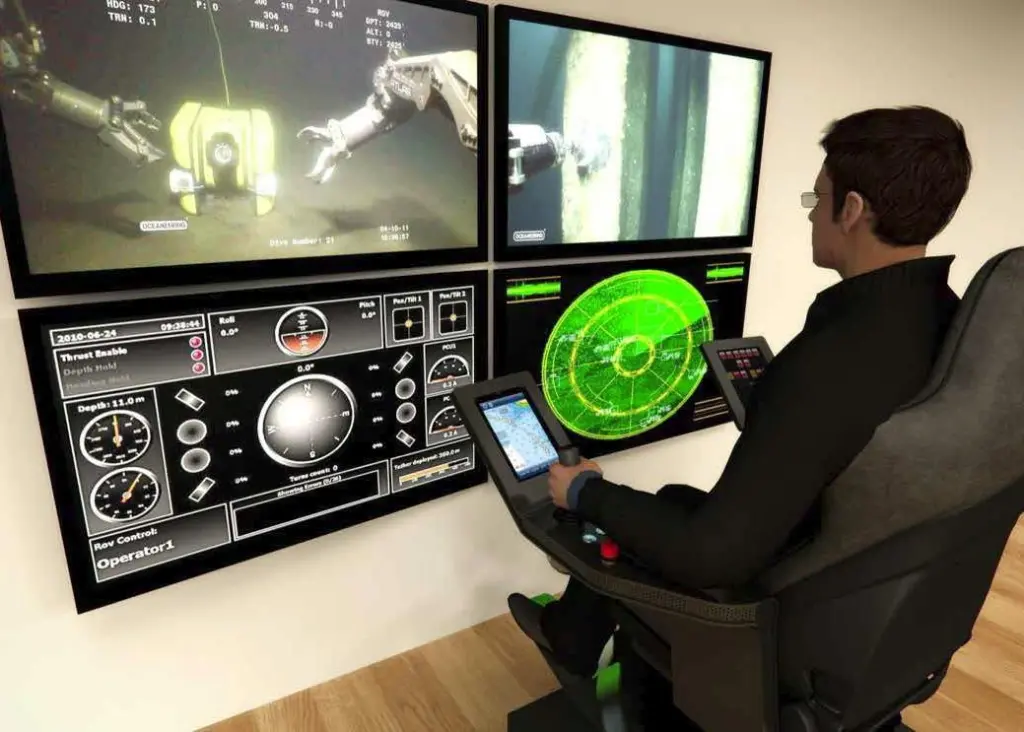
But the rising scale of subsea construction – whether alternative energy or oil and gas related – is putting pressure on deep water operations and it has become unfeasible to leave the all-important working ROVs, a crucial element of any deployment, out of the picture.
So, the Norwegian simulation suites at a new training centre at Fosnavåg and Rolls-Royce’s similar suite in Ålesund, have both started to remedy the situation.
These two facilities – which are working together, rather than in competition with each other – are not just developing an underwater work ROV trainer, but linking it up with the other modules which tie the various crew positions into a virtual world; this means that the whole deployment team, from bridge and crane to ROV operator, is able run through these difficult subsea operations together.
What’s more, the suite can be programmed to replicate a complete procedure with the module in question also simulated: this can be rather complex as underwater handling is rather different to the way mass responds in air as water resistance plays a huge part. What this means is that a team can try out different ways of handling the module and getting it into position, so that by the time they do it in reality, they don’t make any costly mistakes.
Interestingly, behind all this lies cooperation on a different scale. A handful of companies and landside interests Fosnavåg have woven themselves together in order to create the new Ocean Academy: Havila, Remoy Shipping, Bourbon Offshore and Olympic have together with the town raised around NOK60m (€7.08m) for the entire complex which includes the education centre plus a hotel and cinema with the idea of presenting a very complete ‘one stop shop’ for training.
While Norwegian companies are very accustomed to working together in a technology cluster, this investment has also required a particular vision.
“We are committed to a partnership of at least 10 years, which allows us to project ourselves over the long-term,” says Bjorn Remoy, MD of Bourbon Offshore Norway, adding that the centre will allow the companies not just to adapt to clients needs but those of their seafarers as well.
Although owned by this group, the aim of the Academy isn’t to be part of a closed shop and its facilities will be open to any marine company who needs the backbone of specialised training.
By Stevie Knight
Related Articles
 OTHER NEWS
 MARINE CIVILS
 MARINE CIVILS