![MaritimeJournal[Seawork]](https://www.maritimejournal.com/wp-content/uploads/2026/09/MaritimeJournalSeawork.svg)






Underwater welding speeds dock gate repair
When the No. 4 dry dock gate in Falmouth Docks UK was removed recently by owners and operators A& P Falmouth Ltd for repairs to the lifting wire sheaves, diving contractors Sub Marine Services Ltd were asked to conduct an underwater inspection and video survey of the stainless steel sealing face and hinge boxes to check for any damage or defects before reseating the gate.
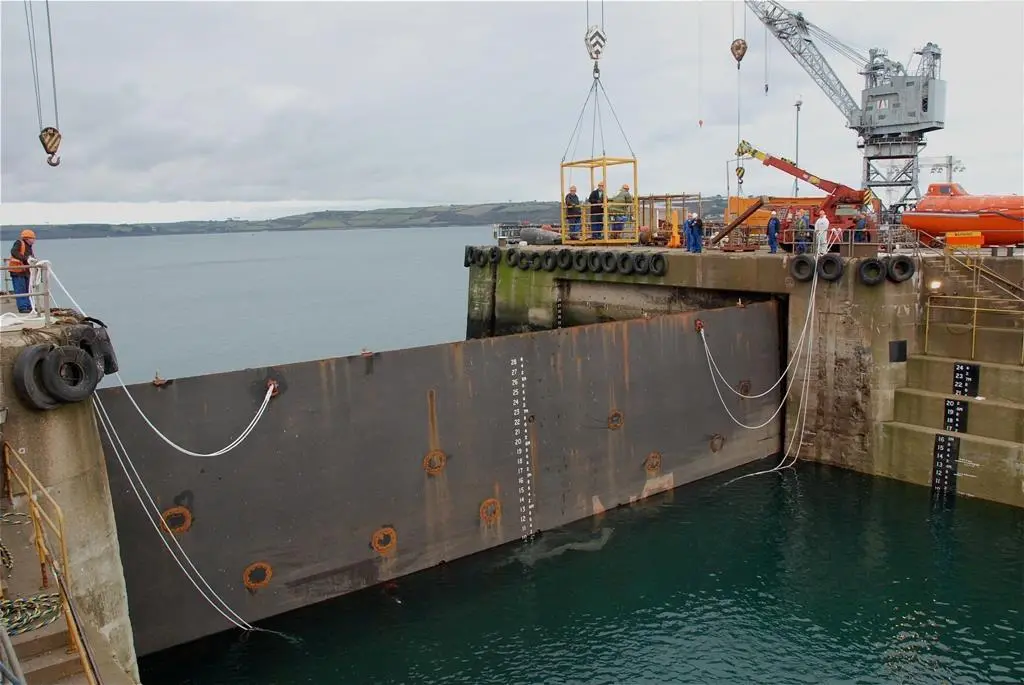
From the survey it was evident that the structure had suffered some severe localised damage and corrosion defects in way of the original fabrication welds to both the East and West lower sections of the stainless steel sealing face and hinge boxes. Following completion of further in-water inspection work and offsite testing of the stainless steel for underwater weldability, it was agreed that a permanent repair in the wet could be satisfactorily effected.
A test weld was undertaken on location in the dock using part of the original damaged seal and a piece of the new steel to be used for the repairs. The test ‘coupon’ was positioned and welded so as to simulate the actual weld required for the repair. The test coupon was then mechanically cut and broken in the A&P Falmouth Engineering Workshop for detailed structural examination.
The results of the test weld were extremely good and finally confirmed that a very high standard of wet weld repair could be effected using the selected materials and ‘Hydroweld X34 Wet Welding System’ electrodes.
The Sub Marine Services team, including a specialist underwater wet welder, proceeded to cut out the damaged sections of the stainless steel sealing face and gained access to the hinge boxes using hydraulic cutting equipment.
Fabrication of the new stainless steel seal sections and the associated fillet plates was carried out at the A&P Falmouth Engineering Workshop, and following some necessary adjustments, all pieces were tack-welded and then fully welded in place using temporary dogs and wedges to prevent any distortion during welding. Finally all of the welds and any scars were flush ground so as to achieve a perfectly flat sealing face, to eliminate any water ingress at the gate mating faces.
Where surface defect damage or denting had occurred to the seal face the stainless steel was built up using weld. All welds were then flush ground and finally checked for alignment.
With the necessary repairs having been completed as an underwater operation, the gate was reseated and back in commission with minimal downtime. The cost saving to the client was also significant as the alternative repair method would have required sheet piling and dewatering the gate area to gain dry access to carry out the repair works.
Related Articles
 OTHER NEWS
 MARINE CIVILS
 MARINE CIVILS