![MaritimeJournal[Seawork]](https://www.maritimejournal.com/wp-content/uploads/2026/09/MaritimeJournalSeawork.svg)


WW1 wrecks make way for modern energy port
Subsea excavation specialist Marin Group has played a key role in salvaging eight World War 1 wrecks from the main shipping lane serving the Dutch port of Eemshaven.
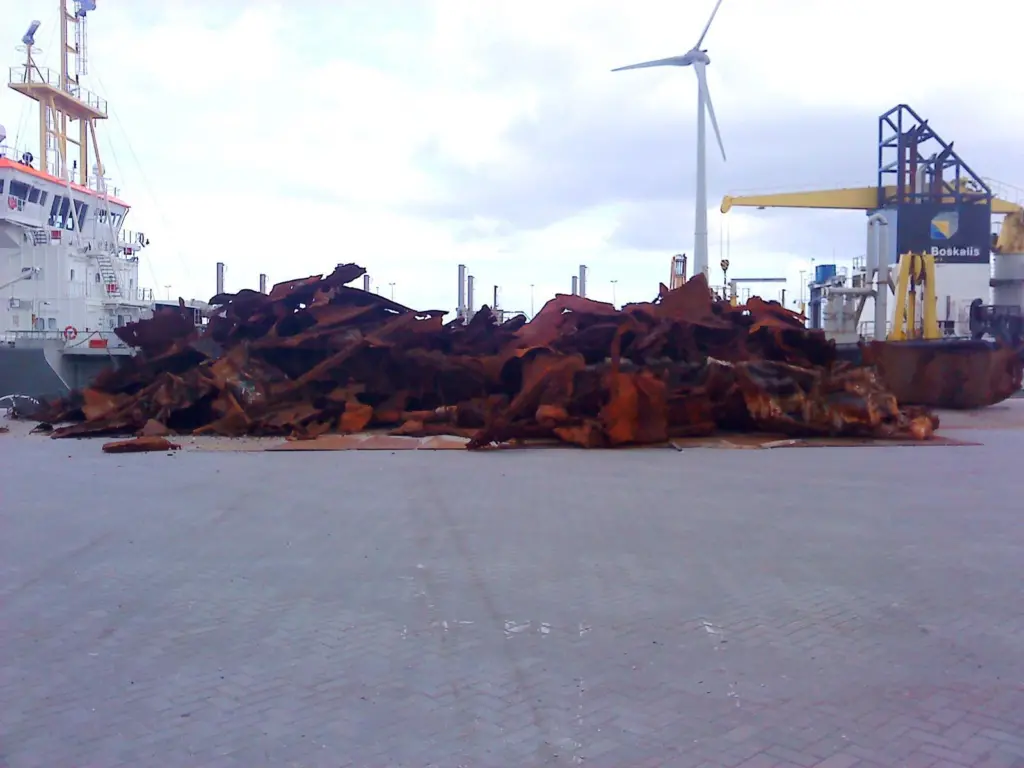
Marin Group company Marin Subsea was contracted by Van Den Herik of Sliedrecht and GPS Marine Contractors of Chatham in Kent UK to supply mass-flow excavation tools for the high profile project.
The salvage marked the first stage in a major operation commissioned by the Rijksvaterstaat water authority on behalf of the Dutch government to clear, widen and deepen the channel ahead of Eemshaven’s development as an energy hub.
When work is complete, the port will be accessible to a broad range of shipping, including Panamax bulk carriers and Q-max type LNG vessels.
Nine WW1 wrecks were obstructing the shipping lane between Eemshaven and the island of Borkum in German waters to the northwest. Six were located inshore and the remaining three offshore in the North Sea to the north and east of Borkum.
Marin’s Evo 300 MFE tool was used to clear sand and loose material in 18 to 20m of water from the inshore wreck sites, and the Evo 150 and Mono-Jet system to excavate in consolidated clay soils at two of the three offshore sites. The remaining offshore wreck was partially excavated, but the operation had to be abandoned due to worsening weather.
The Marin spread was deployed from Van Den Herik’s Rhine barge Prins 4, with GPS Marine Contractors’ self-propelled crane barge Apollo providing crew accommodation and operational support. Excavation and debris removal took place between July and September 2010.
Marin Group primarily serves the energy sector, supplying a range of specialist excavation services to oil, gas and renewables clients worldwide through four complementary companies with bases in Aberdeenshire, Scotland, and across Asia.
CEO George Stroud said the Eemshaven project had presented challenges for which Marin’s MFE technology was ideally suited. ‘The Evo 300 excavation tool, which was used to de-bury the inshore wrecks, operates in non-cohesive soils up to 200mm particle size and is capable of excavating up to 1,000 cu/m an hour.
‘The Evo Mono-Jet was installed on the Evo 150 for the offshore excavations near Borkum. Here the soils were denser, with compacted clay beneath a shallow layer of sand requiring the focused power of the Mono-Jet, which has a cutting rate of up to 6,000 cu/m an hour.’
He added, ‘We are proud to have played a part in this important operation, and only the deteriorating weather prevented us achieving 100% completion for our clients.’
Related Articles
 OTHER NEWS
 MARINE CIVILS
 MARINE CIVILS