![MaritimeJournal[Seawork]](https://www.maritimejournal.com/wp-content/uploads/2026/09/MaritimeJournalSeawork.svg)


Bibby hires builder of first electric CSOV
A Spanish shipbuilder will build the first electric Commissioning Service Operation Vessel (eCSOV)for UK-based Bibby Marine.
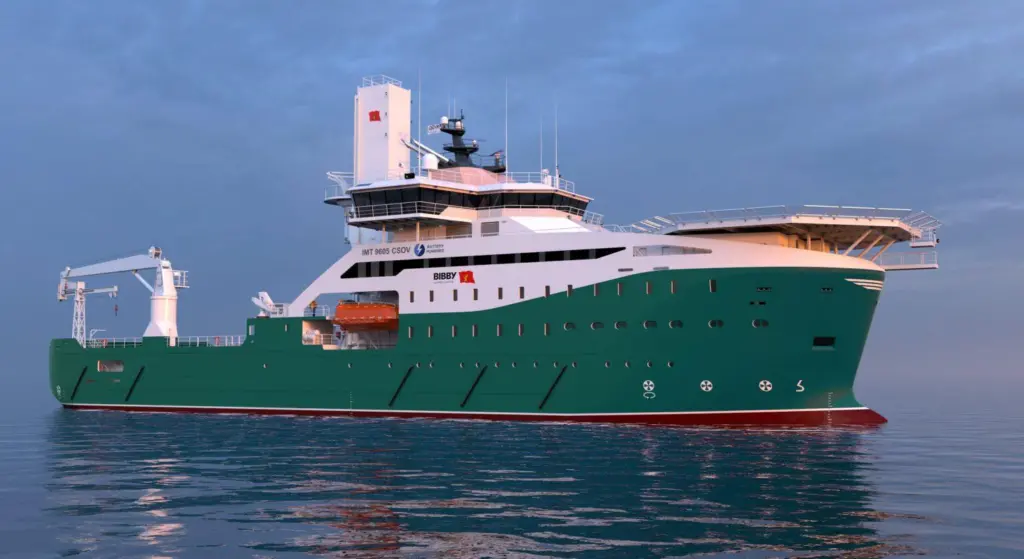
Gondan Shipbuilders has been contracted to build the eCSOV for Bibby Marine that has received UK government funding under the Zero Emission Vessels and Infrastructure (ZEVI) scheme.
The vessel will contain 20MWh lithium iron phosphate battery packs that can be charged offshore if the infrastructure is there, and likewise onshore. The onboard charging equipment will be capable of receiving high-voltage charging – 11kv – which Kathryn Doyle, at Bibby Marine, believes is a first.
“This involves a significant amount of electrical equipment and design on the vessel and we believe we are the only ones who have done this date,” she said. ”We are also working closely with offshore charging suppliers to ensure the vessel interfaces are prepared for accommodating their equipment for physical connection to the offshore charging network.”
The eCSOV will also have hybrid engines for back-up that run on methanol or marine gas oil (MGO), with the capability of operating on 100% diesel mode or dual-fuel mode, which is 90-99% methanol with pilot injection of diesel only, she said.
”Methanol is around 50% less energy dense than diesel but is approximately the same weight. Due to it being 50% less energy dense, it requires us to carry double the methanol to meet the same vessel range as diesel. We recognise at this time sourcing green methanol is not easy, however with rising demand we are expecting supplies to increase over the next five years, and therefore availability.
”We will continue to work alongside our partners to secure green methanol.”
Doyle says Bibby Marine’s ’journey to green’ began in 2019, when a feasibility study, WaveMaster Zero C, looked at various criteria to focus on the concept of an electric CSOV, with a large battery that could be recharged offshore.
“We looked at the various challenges of the concept, such as offshore charging, marine batteries etc,” she said. “We have subsequently been involved in a number of CMDC funding rounds. The ZEVI competition, which started last year, kick-started the project with part-funding for zero emission vessels, and one year down the line, our concept is finally going to reality.”
The vessel, which has been designed in collaboration with UK ship designers Longitude and is planned to be delivered in 2026, will operate in UK / European waters.
Related Articles
 OTHER NEWS
 ACCESSORIES & EQUIPMENT
 SPECIAL REPORTS