![MaritimeJournal[Seawork]](https://www.maritimejournal.com/wp-content/uploads/2026/09/MaritimeJournalSeawork.svg)





Composite workboats: Fact, fiction and form
Composites have a lot to offer the commercial maritime world, but haven’t there been issues with strength, size, weight and above all, cost? Stevie Knight has found some straightforward answers alongside some interesting, slightly trickier ones.
Let’s tackle the strength issue first: “Earlier fibre-reinforced plastic [FRP] composites were initially used in applications where weight was critical – and they just weren’t that tough,” says Miles Pinchin of naval architectural and composite design services company M2ED. “But today you can engineer a robust structure that meets all the requirements.”
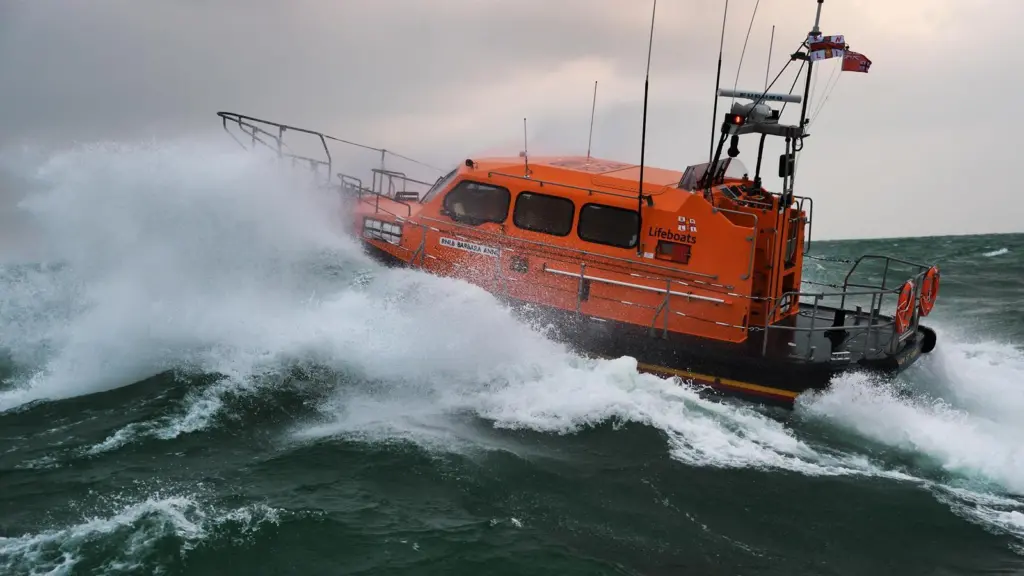
Take the RNLI’s composite lifeboats.
“These have a defined, bad-weather recovery method,” says Chris Sherliker of FISH Marine Design. “Just drive them straight up the beach.”
There is even a video of them hitting shingle at around 18kn: “You wouldn’t do that in an aluminium equivalent – well, not twice. The boat’s life would be pretty short.”
It’s also interesting that lifeboats on a 10-year maintenance schedule had substantial metal degradation but the composite hulls needed little attention – despite a decade of hard work in a punishing environment.
So, how has that been achieved?
“They adapted the structure according to requirements,” says Simon Corner of the National Composites Centre (NCC), which provides open-access R&D.
He adds that modern high-performance boat structures often feature a variety of sandwich cores: very thick and dense on the bottom for slamming resistance, graded through a lighter, thinner core on the sides and a comparatively light sandwich for the deck and wheelhouse.
Resilience also has a central role in the workboat arena.
Sherliker’s colleague, Peter Murphy, points to a Port of London Authority catamaran and MOD vessels, both used for surveys. Each, he explains, had ‘grounding’ capability at the heart of the specifications.
“It can all be planned in,” he says.
Price
However useful, when people talk about composite vessels it’s often in same breath as moulded design and yes, for one-offs, that can be expensive.
“Even with straightforward glass [fibre-reinforced plastic], you need to be making at least four or five of them to be worth it for the price of the tooling,” says Corner.
“These numbers do vary depending on structural complexity,” says Pinchin, “but as soon as enough repeats of the same vessel are required, composites become the most cost effective solution… for that reason, smaller passenger ferries were an early shoo-in for mass FRP production.”
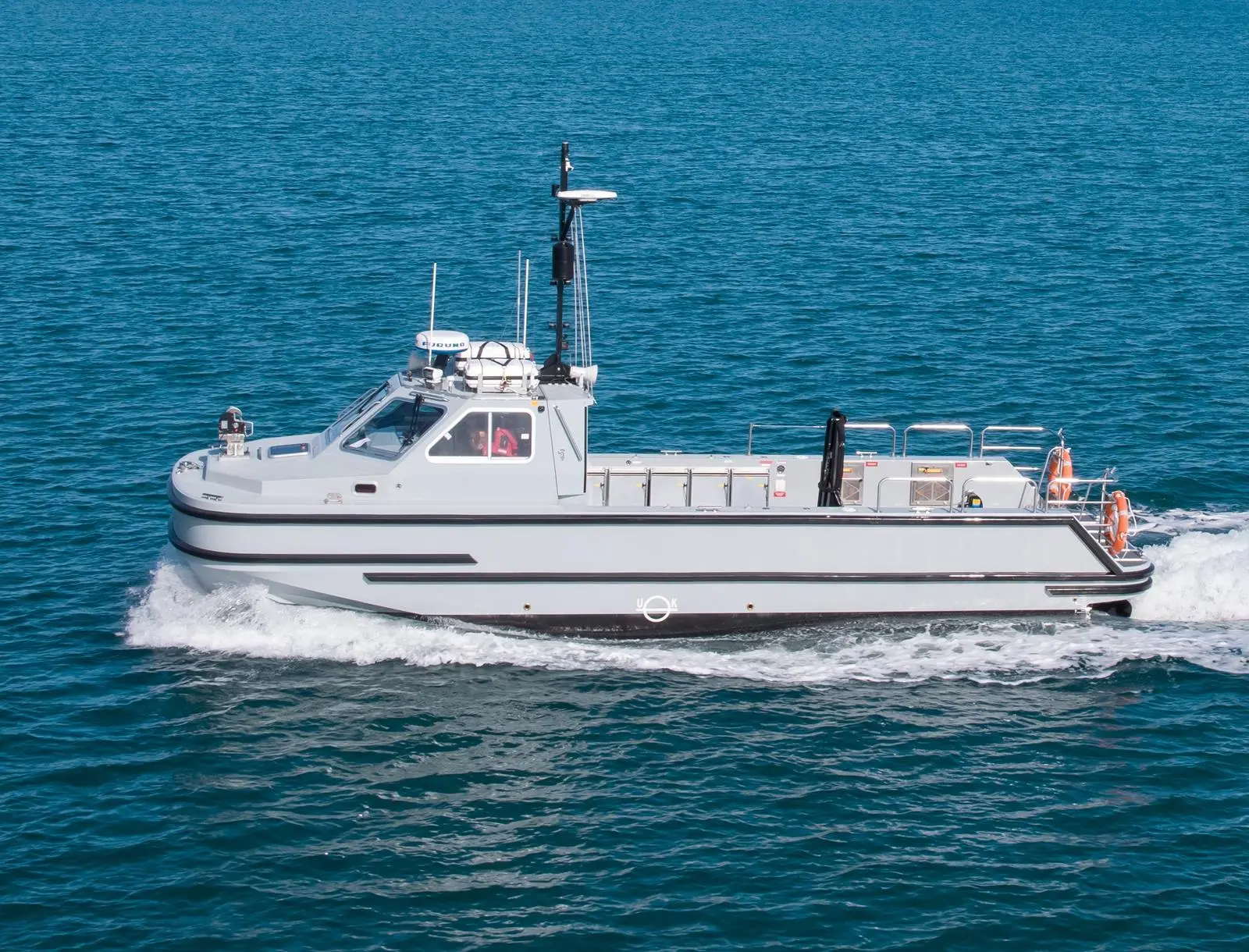
There is an issue here: structural or size changes usually require a new set of moulds. However, with ingenuity – and a decent number of predicted builds – it is possible to box clever. Take the Royal Navy’s recent SEA Class workboats, a project with FISH Marine Design, M2ED, and Atlas Elektronik (AEUK).
The Vahana series can be adapted to a range of different tasks, from dives, surveys and hydrography to passenger transfers and training, plus there’s an autonomous mine-hunting variant.
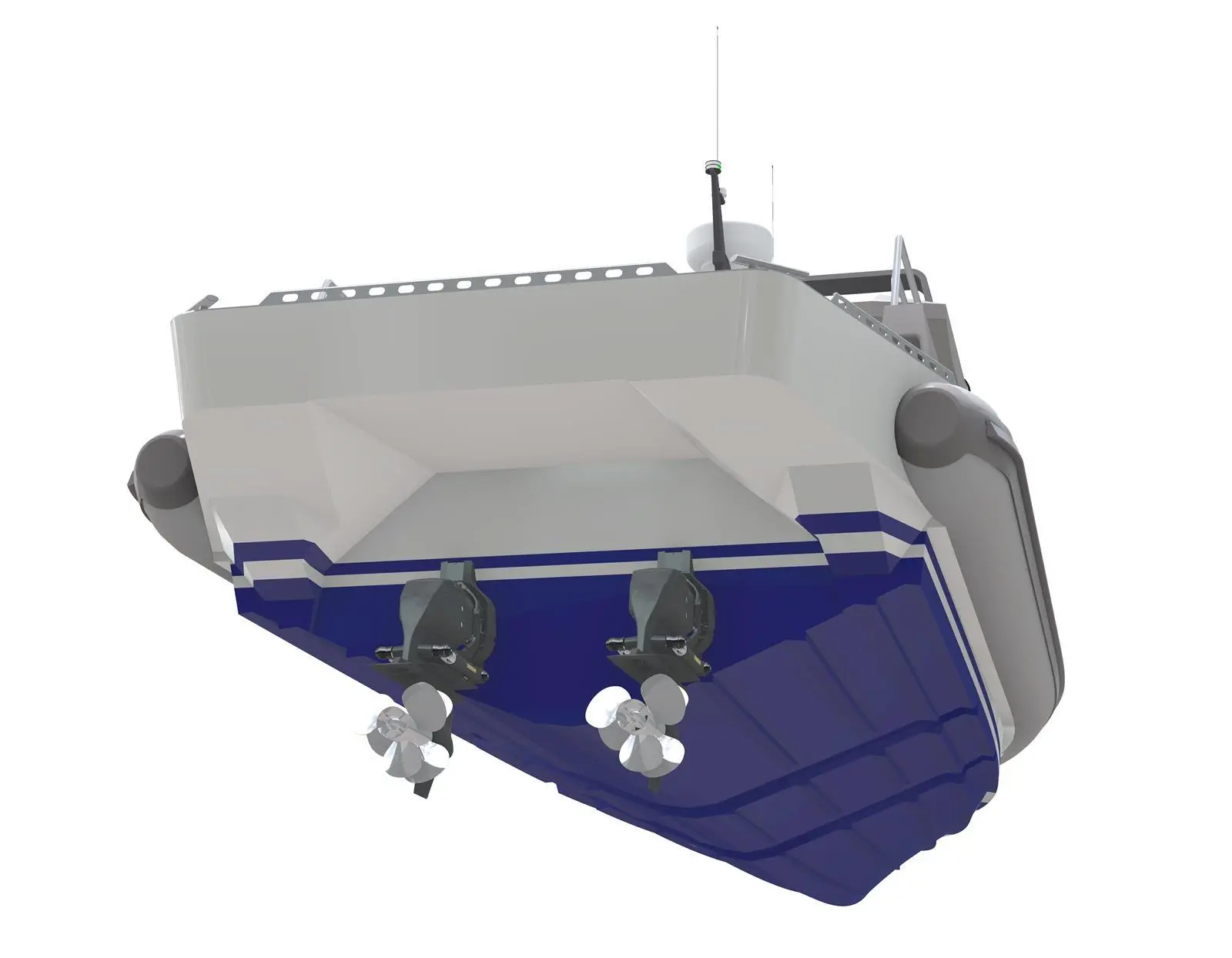
Centrally, the tooling has been designed to yield a couple of different length hulls and a variety of superstructures.
The approach – with careful engineering – can generally be used in modular composite boat building: mould sections that fit together to allow different builds.
Size
With the right equipment and know-how, it is possible to create large vessels by resin mould infusion (notably 60m ships for the Russian navy), but it’s not the only method.
According to both Murphy and Sherliker, composite builds can be achieved in a similar way to aluminium, by laying up against panelling and placing them in a jig before bonding together. That allows large, 30m-plus, one-off builds.
“The beauty of it is you have much more control over the material than you get with aluminium,” says Sherliker. “We’re able to ask, what is needed, what are we actually trying to get out of it? Does this area need to be stiff and light or do we need huge durability?”
It’s come a long way from the more traditional multi-framed construction.
“It was really time consuming, and really heavy,” says Murphy.
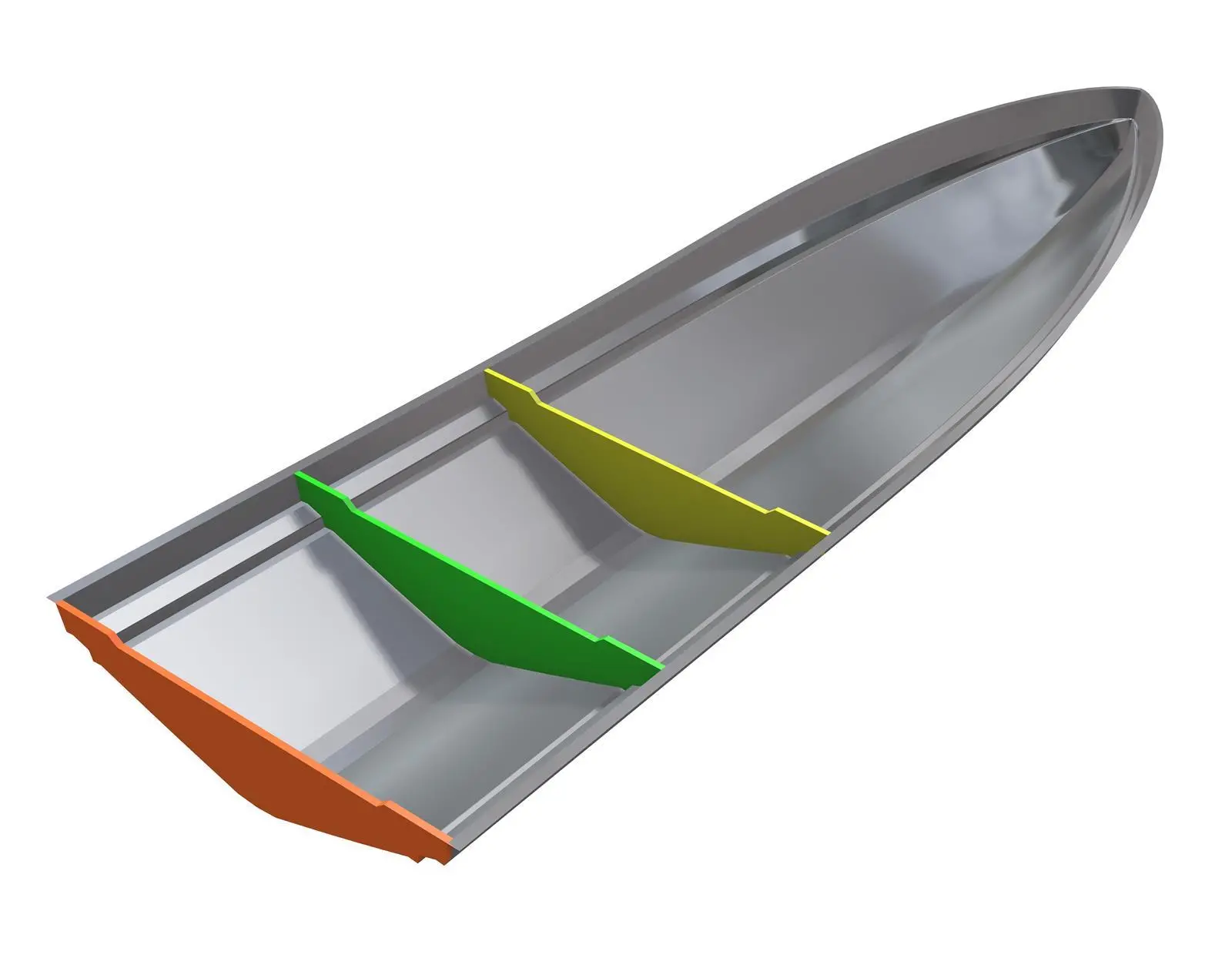
Instead, FISH’s designs use thicker shaped cores sandwiched between the fibre layers. These really punch above their grade: for example, comparing a single, 6mm laminate to a sandwich that puts a 40mm H100 core between two 2.4mm skins might (including resin) raise the weight by 123%, but it increases stiffness by 167 times.
Just re-read that: these cores make it 16,700% stiffer. “It’s easy to see why we use them,” says Murphy.
Finally, the resulting, layup stack allows for a one-shot vacuum infusion that efficiently propagates the resin throughout the laminate. After all, while the resin protects the fibres and spreads the load, it’s the other elements that do the work.
“The idea is to get just enough resin to fill all the gaps in the fibres and no more,” says Sherliker. Too much or too little and it can become brittle and prone to cracking.
Done right, says Murphy, and the result is not just light, but phenomenally strong and stiff.
“It also massively cuts down your labour hours – which without a doubt will take more of the spend than materials. “However, you have to invest in the skills and technology.”
Exotic
There’s more to say about costs and materials – but it’s tricky.
“If you go to exotic materials, there’s no doubt you’ll see significant weight savings even on much larger builds. But you’ve got to get your wallet out,” says Corner.
Carbon fibre is eye-wateringly expensive: more than 10 times that of more standard FRP.
Still, performance or other characteristics could be essential.
As Corner’s colleague, Tim Young, points out: “To some extent, if the only way of getting there is with carbon fibre, then people will pay. That tends to be why it’s used – often it’s because it is the only way to deliver what’s needed.”
This can include both lowering emissions and operating costs.
“There are clear advantages from reduced structural weight on vessels that have an intense duty cycle,” says Pinchin. “Fuel becomes a significant factor.”
In fact, energy consumption is by far the largest ongoing bottom-line burden for many commercial craft and, according to composite provider Gurit, over the boat’s lifetime that can easily work out to be four or five times the purchase price. It also opens the field for alternative propulsion, including batteries.
This was the attraction for New Zealand’s fully electric high-speed passenger ferry, Ika Rere, launched in December 2021 by operator East by West Ferries, to transport up to 132 passengers several times a day across Wellington Harbour, initially on a shore plug-in (fast-charge, 1MW infrastructure coming later).
Its top 20kn service speed is around 43% speedier than the previous ferries on the run and importantly, East by West reported a 75% reduction in the cost of energy per return trip compared with a traditional diesel.
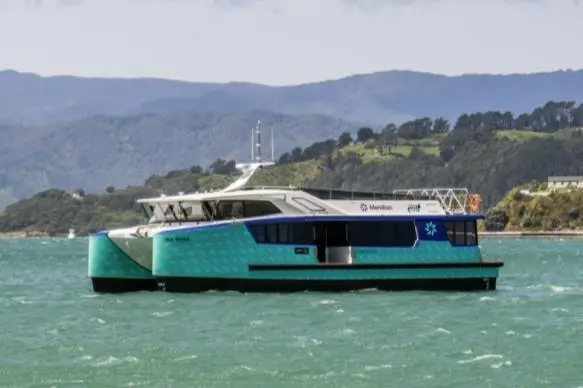
However, it’s a carbon-fibre catamaran construction – and at the time, the price of this 19m boat came in around NZ$8.5 million (€4.5 million), says Mat Jonssen, East by West general manager, although he admits that’s a rather fuzzy estimate and depends on whether you include batteries, tooling, design and so on.
Still, the initial prediction was that Ika Rere could pay for itself before 2033, although Covid19 and other revenue impacts have now pushed ROI to somewhere between 12 and 18 years.
Despite this, the choice of carbon-fibre has led to a ‘positive efficiency cycle’, says Jonssen, rather than tipping into what he calls a ‘death spiral’, where a heavier boat needs more batteries, which again leads to an even heavier boat.
Instead, Ika Rere exceeded its design parameters and is both lighter and more efficient than predicted.
“We’re getting more use out of it than anticipated,” said Jonssen.
So, what of the potential for composite workboats that aim at meeting new industry and environmental demands?
There’s more to be discussed, read Part Two in Maritime Journal, coming soon.