![MaritimeJournal[Seawork]](https://www.maritimejournal.com/wp-content/uploads/2026/09/MaritimeJournalSeawork.svg)




FEATURE: Catch-up with ‘Seacat Columbia’
Under the umbrella of decarbonisation, the need to reduce fossil fuel consumption during the maintenance of offshore wind farms has not only seen stakeholders steered towards targets set by the IMO, but in 2020, inspired a unique venture into radical design that combined the latest Americas Cup hydrofoil technology with a novel hull design, to produce an ultra-efficient vessel that took seakeeping to the next level.
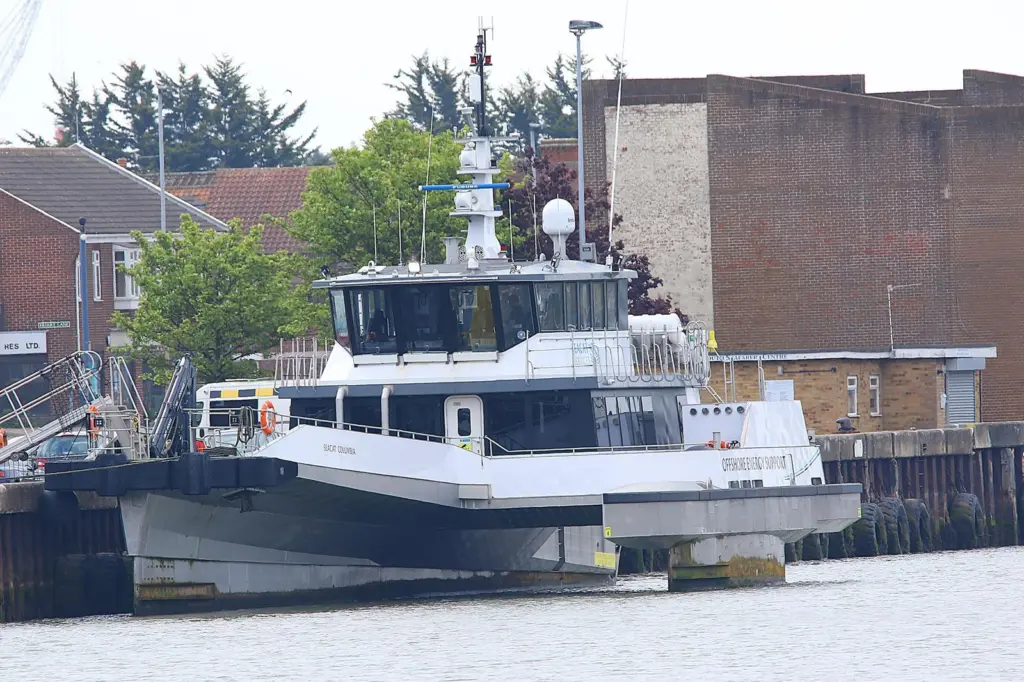
The resulting vessel was a special collaboration between BAR Technologies of Portsmouth and the owner-operator Seacat Services of Cowes. The result: the remarkably efficient Seacat Columbia, built by Diverse Marine, launched in 2022 and featuring a ground-breaking hull configuration which truly is one of a kind.
The vessel appeared on the pontoons at Seawork in 2023, and now two years later, Serena Shores catches up with her and developer BAR Technologies.
“BAR Technologies was started in 2016 as a spin off from the British Americas Cup, as a way of leveraging the knowledge and tool sets developed within the Americas Cup environment to decarbonise the maritime industry,” says head of Vessels and Operations Oliver Pendleton. “The ethos of the company to improve maritime sustainability through simulation driven innovation.”
It could be said that the renewable energy industry had a complex and paradoxical problem. When building and maintaining wind farms, it was not just an issue of fossil fuel use and the resulting green-house gas emissions in transport and installation, but many of the early vessels used as CTVs weren’t fit for purpose. Alongside the design of the BAR Tech 30, BAR Technologies had also installed their patented FOSS system onto Seacat Sceptre and Seacat Sovereign, as a way of improving an existing CTV design, by achieving the holy grail of optimum comfort and fuel efficiency. The FOSS system gives a 12% fuel saving and helps to reduce the vertical accelerations that cause sea sickness.
“The concept for the BAR Tech 30 was to completely re-imagine what a CTV would look like, but using the same weight of aluminium and deadweight as a benchmark vessel, (in this case Seacat Sceptre),” says Pendleton. “The ambition was to also make the vessel ‘drive train agnostic’, meaning the efficiency of the vessel was secondary on the chosen propulsor.”
FOSS and outrigger
The BAR Technologies team specialises in technically challenging multidisciplinary design, leveraging machine-learning tool chains developed in the Americas Cup. For the design of the BAR Tech 30 they designed thousands of virtual hull forms that were then evaluated against specific criteria. This was then coupled with BAR Technologies’ patented Foil Optimised Stability System (FOSS): an active ride control system designed to control vessel trim and roll, improving seakeeping performance and increasing the hydrodynamic efficiency of the hull even further.
“We have the foil-assisted Seacat Sceptre and Seacat Sovereign – conventional catamaran hulls with FOSS technology,” says Seacat Services Founder and Director Ian Baylis. “They have tangible benefits including increases in passenger comfort and reduced fuel consumption.
“The FOSS system on these vessels consists of a large static hydrofoil just forward of midship and two active foils mounted on the transom of each hull. On acceleration to 18 or 19 knots, the systems help push the boat over its speed hump and onto the plane. The trim of the vessel is then adjusted for optimal fuel efficiency up to its top speed. The onboard control system measures the vessel state over 100 times a second – adjusting the foils to make sure the optimal trim for each speed is maintained.
“Subsequently, the fuel efficiency of these vessels increased 10 to 12 per cent across their operational profile compared to standard boats, with the top speed increased by two knots. On the other hand, the 30m BAR Tech crew transfer vessel Seacat Columbia is a truly unique concept.”
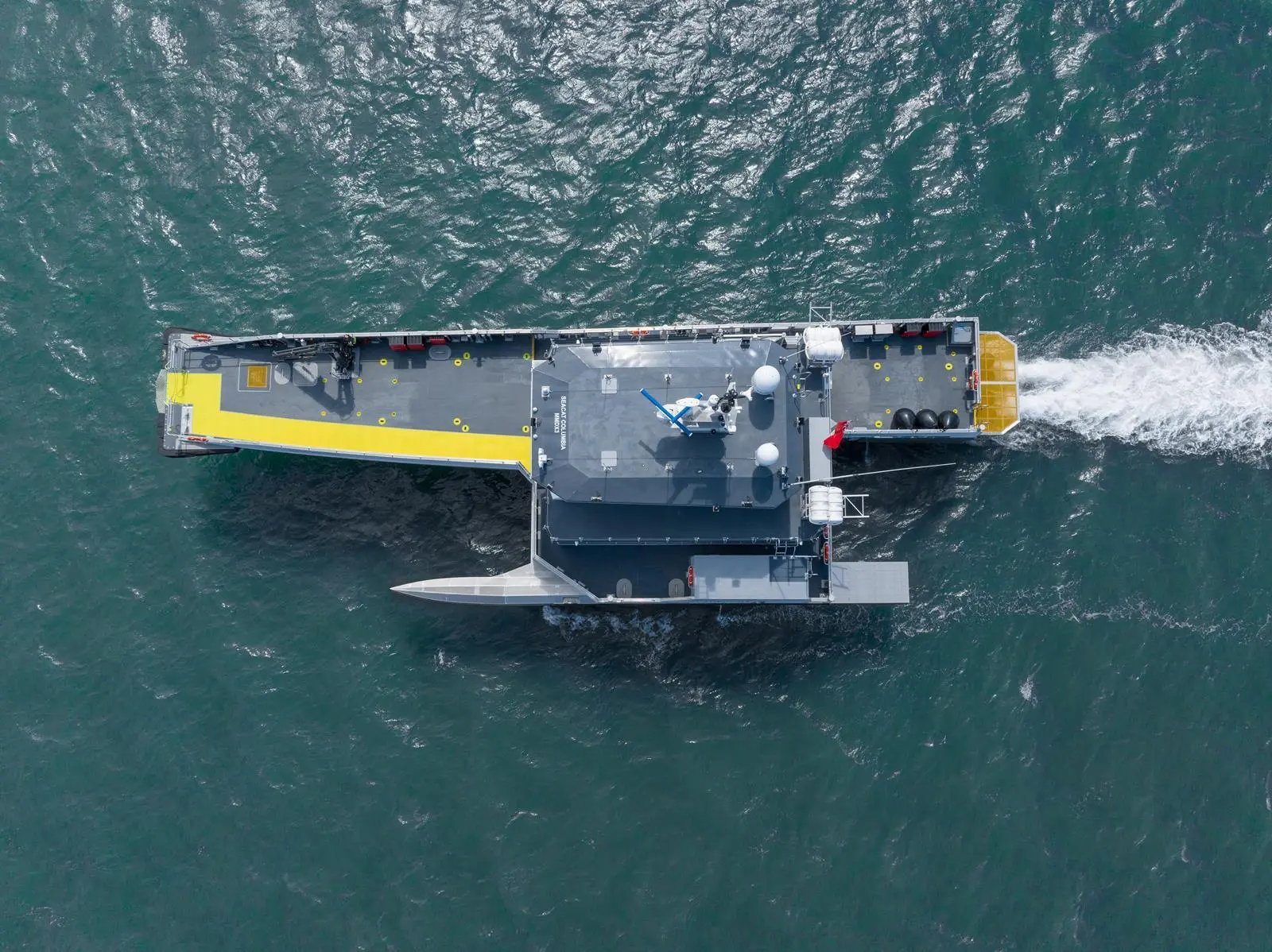
As planned, the 30m, 1.49m draft, 85T vessel was constructed in aluminium and has a service speed of 26 knots and a sprint speed of 31 knots using 2 x MTU 12V2000 M72 Rolls-Royce engines with Kongsberg Kamewa Waterjets. It has space for 3 x 20 Ft containers and a crane for cargo operations.
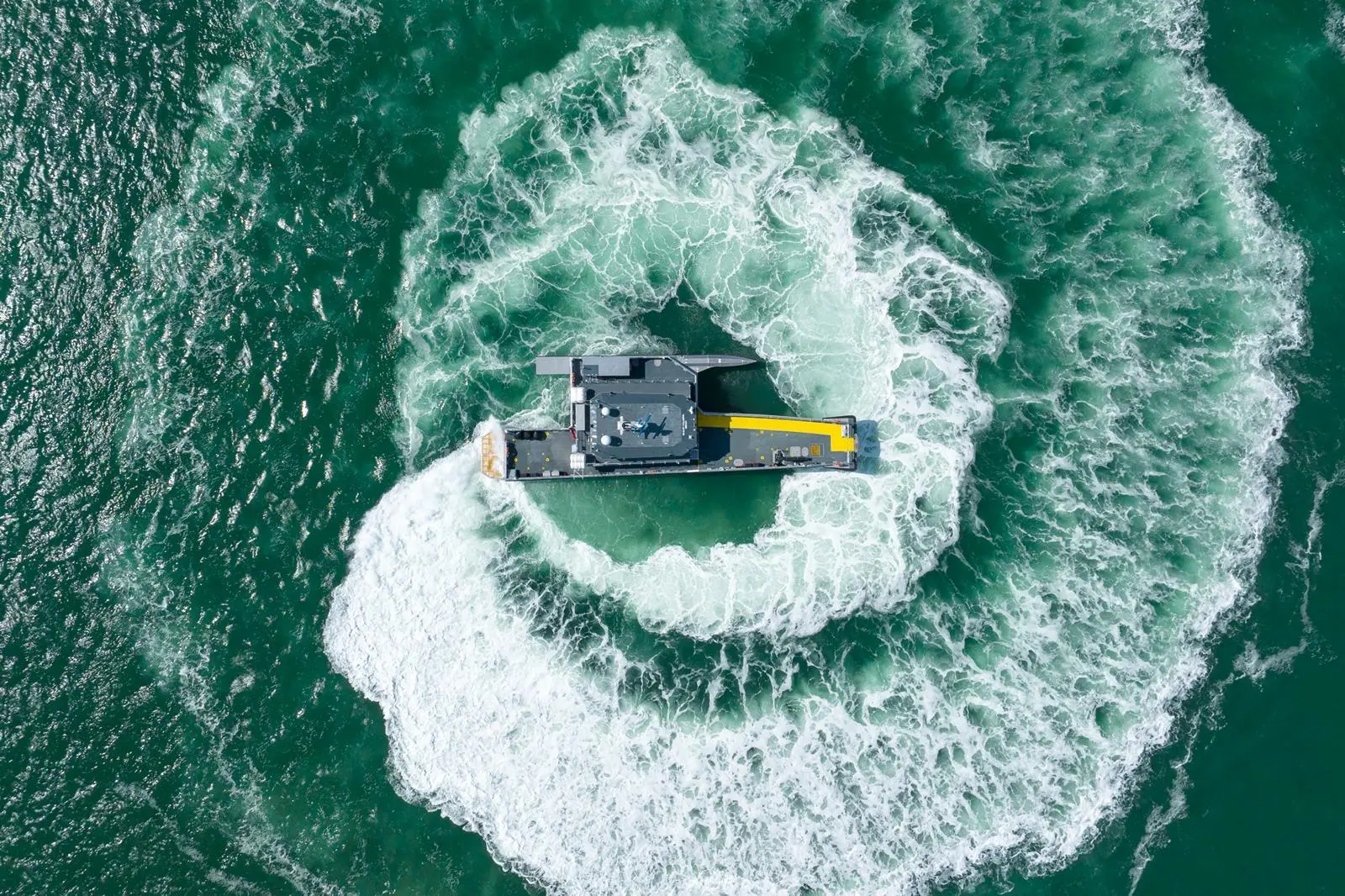
The active foiling system corrects for pitch and roll and coupled with the ‘proa hull form’ helping to reduce vertical accelerations by up to 70% compared to the baseline vessel. The vessel is 50% more fuel efficient in transit and 30% more fuel efficient across its operational profile – therefore producing far less GHG than the equivalent vessel.
The design of the vessel coupled with the FOSS system also enables it to operate in higher sea states, so the turbines can be serviced and maintained on more days, thus saving the OEMs downtime and considerable expense.
“The concept behind the BAR Tech 30 was to design a very efficient slender main hull with minimal transom immersion and then combine that with a SWATH outrigger, to give the slender hull more stability,” Pendleton says. “So, Columbia is half SWATH and half ultra efficient mono hull. The efficiencies of combining a monohull and SWATH are historic and reliable, as seen in Polynesian canoes.
“The addition of the outrigger also allows for a wider deck and cargo area. As well as controlling vessel pitch, the aft foil (which is the full width of the main hull transom) carries a large proportion of the vessel displacement when under way – circa 20 tonnes at top speed. On Columbia, the second foil is fitted to the SWATH outrigger pointing inboard, much like a stabiliser fin on a larger vessel. This foil is used to control roll and is very active, especially in larger sea states, and goes a long way to reducing the vertical accelerations experienced on standard catamaran CTVs.”
Fleet standards
Seacat Services operates a fleet of IACS-classified multi-purpose offshore energy support vessels, which are recognised in the offshore energy industry for their focus on passenger comfort and welfare, excellent performance and safety in operation. All vessels in the Seacat fleet are built according to priorities of safety, crew familiarity and vessel availability, as well as offering customers a high level of service. To facilitate this, all vessels are specified with exactly the same equipment.
Development of the BAR Tech 30 Seacat Columbia involved BAR Technologies leveraging their machine-learning tool chains to develop a truly unique hull form. At this stage and later, Seacat Services was heavily involved in the styling and practicalities of what customers require for operations, including deck space. They brought all their expertise, in particular working on making the route from the passenger lounge to the bow fender of the vessel as seamless as possible.
“For us, it’s more about the transitions than diving straight into the next division,” says Baylis. “Columbia is a fantastic operations and maintenance vessel, has similar cargo capacity and is hyper-stable. The hull form with the SWATH outrigger and FOSS system make her static under way and as a by-product, she has an amazing static ability at zero speed – in fact she is rooted to the turbine before backing off for shore. In industry standards there are lots of knowns already, so the BAR Tech 30 hull form does throw the design ball really far. It was crucially important that we contributed our winning ingredients, as what is key to successful CTV operations is reliability and we are currently running at over 99 per cent technical availability fleet wide. After due diligence the BAR Tech 30 concept made sense, so we took the plunge.”
‘Build and they will come’
Seacat builds all vessels speculatively, so when they took the plunge, it was a case of who would charter Columbia.
The decision to hold the philosophy ‘build it and they will come’ had been bolstered by the fact that the procurement divisions at large energy companies had made positive noises about the vessel, although Baylis admits that CTV operations tend to be chicken and egg, even though excitement around the design showed they believed in it.
It was very much a case of the boat needing to do the job and justification came when Columbia won her first charter when in the water during sea trials. Although battery technology is developing at a rapid pace and more electric/hybrid boats are bound to be seen, currently what customers require is both speed and the ability to carry 20 to 30 tonnes’ load and this is fulfilled using internal combustion engines with a semi-foiling hull form.
“Columbia has a hull form and structure we love, the benefit of waterjets and an engine and electrical installations we know inside out,” says Baylis. “With complicated hybrids the concept has to be proven, but if we build another BAR Tech 30, we will incorporate additional technology, as that is the logical pathway. Decarbonisation technology generally envelops the familiar Tier III industry standard, whereas we went down the road with BAR Tech and found tangible benefits, such as no requirement for further investment by the customer on infrastructure: there is nothing like Columbia out there.
“I suppose we are breaking black eggs to make a green omelette, and the next step could be using alternative fuels with a combustion engine. She will remain in service, but our relationship with our customer is paramount. I’m proud to say Columbia is well accepted and she does the job.”