![MaritimeJournal[Seawork]](https://www.maritimejournal.com/wp-content/uploads/2026/09/MaritimeJournalSeawork.svg)



First of 4 Rolls-Royce-powered customs vessels launched
Germany has launched the first of four ‘state-of-the-art’ customs vessels, each powered by Rolls-Royce’s mtu gas engines.
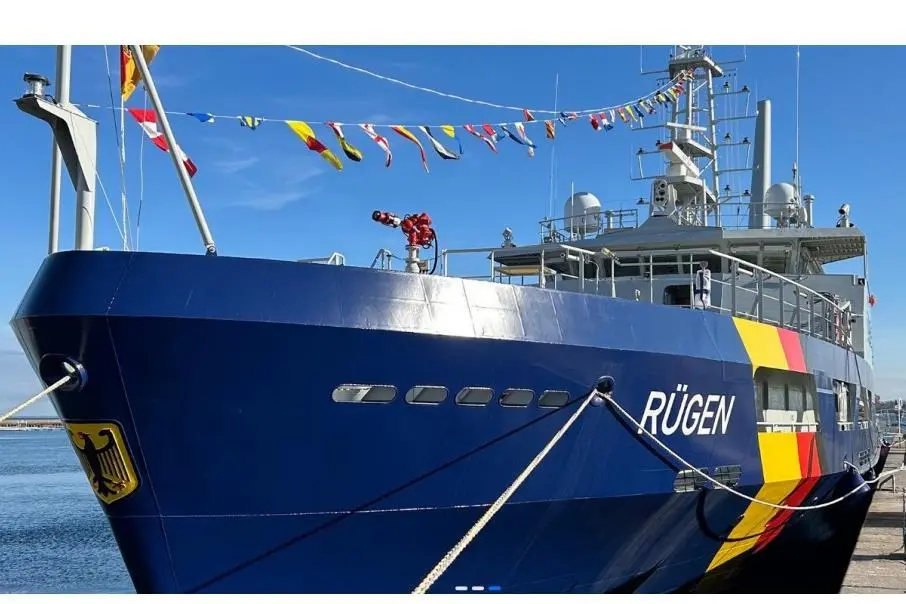
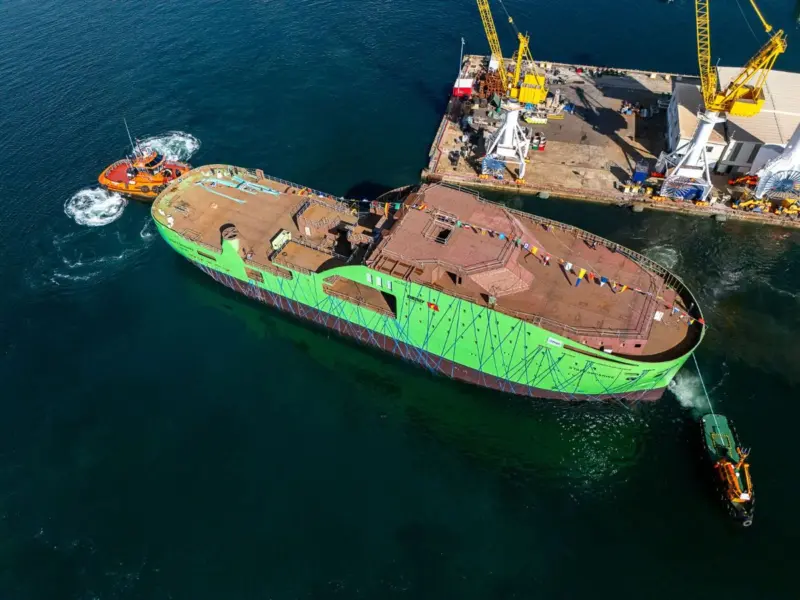
Rügen was officially christened and put into service on Tuesday March 18 in Stralsund with four mtu engines providing propulsion and another two generating electricity.
At 67 metres in length, Rügen is the largest in the fleet and is designed for operating for several weeks at sea.
In a statement, Rolls-Royce said the vessel, built at the Fassmer shipyard in northern Germany, is powered by four 16-cylinder mtu Series 4000 gas engines and two controllable pitch propellers.
“Together with electric motors and two on-board power generators (also 16V4000 mtu gas engines), the ship can be operated in different modes as required: purely gas-electric, purely gas-mechanical and in booster mode,” the statement said.
“When in booster mode, all four main engines, each with an output of 1,492 kW, and the electric engines, which receive the power from the on-board units, can take the Rügen up to a maximum speed of 23 knots.”
Three further vessels, each 55 metres in length, are being built at Peene-Werft, owned by the shipyard group NVL, in northern Germany. They will be equipped with mtu series 4000 gas engines, each driving a fixed-pitch propeller, with a power boost of 10% to reach 26 knots.
Rolls-Royce says the engines fall well below the current emissions limits guidelines without needing exhaust after-treatment.
”The particulate mass is below the detection limit and they only emit small amounts of nitrogen oxides,” says Rolls-Royce. “Thanks to the double-walled design of the gas system, the engine room can be designed similarly to a diesel drive.”
Similar engines, says Rolls-Royce, power many tugs and ferries in Europe and are noted for being quiet, smooth, and emitting no black smoke or odours.
“With the commissioning of the Rügen, we are setting an important milestone for the strengthening and, at the same time, sustainable modernization of our customs fleet,” said president of the Generalzolldirektion (German Customs Administration) Dr Armin Rolfink.
“This state-of-the-art customs vessel combines high performance with innovative and environmentally conscious technology, which will enable us to carry out our important customs duties at sea even more efficiently in the future.”