![MaritimeJournal[Seawork]](https://www.maritimejournal.com/wp-content/uploads/2026/09/MaritimeJournalSeawork.svg)




Hydrogen CTV retrofit wins RINA approval
A Green Marine-led consortium has won approval from the Royal Institute of Naval Architects (RINA) for a project that could lead to the fuelling of CTVs with hydrogen.
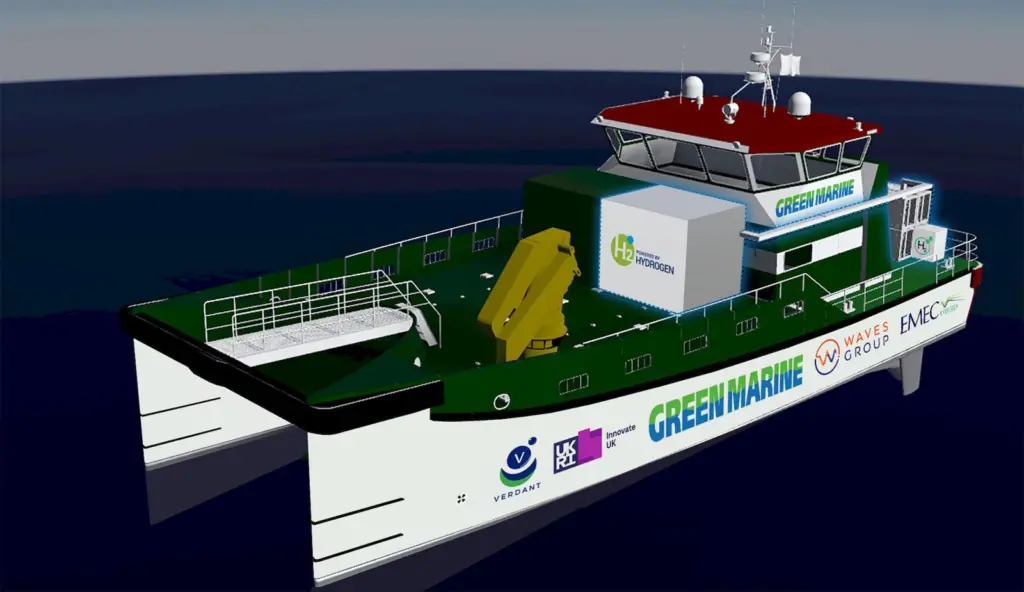
Project Verdant, which also includes the Waves Group, Energys, Engineered Marine Systems, Innovate UK and EMEC (European Marine Energy Centre), has now completed its first phase and has been deemed ‘viable’ by RINA.
This will open the door to subsequent phases that will seek to put the design into practice and go on to conduct sea trials.
The design incorporates hydrogen fuel cells connected to electric motors that work in conjunction with the diesel engines already on the vessel. The diesel engines can be switched off when the vessels are travelling at slow speeds while serving a wind farm.
According to the Offshore Renewable Energy Catapult (OREC), the offshore support sector will be worth around £26 billion (€30.8 billion) by 2050, and an additional 1,200 vessels will be needed to service UK industry alone. There are approximately 400 CTVs are currently operating in offshore wind farms around the UK and Europe, and this could increase to 700 by 2030.
Each member of the Project Verdant consortium lent its own expertise to the project.
Energys provided engineering and modelling for the marine fuel cell generators and hydrogen systems, while Engineered Marine Systems, which has worked with many hybrid CTVs before, designed the battery room.
Green Marine is an offshore services provider with a fleet of workboats, CTVs and other vessels; the Waves Group is a marine consultancy firm; and Innovate UK is the government agency with an annual budget of £1 billion (€1 billion) to invest in innovations.
“The system is designed to enhance vessel redundancy and flexibility by using locations where hydrogen is, or will be, readily available,” said Waves Group Engineering director Jeremy Panes. “This approach creates a testbed to advance maritime decarbonisation in a challenging sector without significantly impacting the vessel’s operational profile.”
“With technical feedback supplied by RINA we now have all the necessary input to progress to the detailed design and implementation phase,” said Green Marine UK’s managing director Jason Schofield. “Retrofitting CTVs in the manner prescribed by Project Verdant provides a means of significantly de-risking the implementation and testing of hydrogen fuel-cell vessels in the coastal environment.
“Once the concept has been proven up, there is potential to rapidly replicate. This would enable economies of scale to be leveraged and remove barriers to adoption.”