

The conversion to LNG DF drive of a second North Sea ferry for German operator AG Ems was being completed in the Netherlands as the New Year got underway, writes Tom Todd.
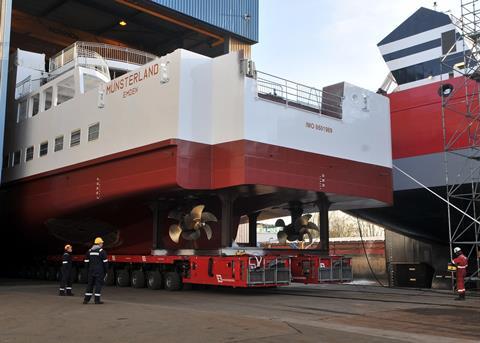
The 78.83 x 12.6m RoPax ferry Münsterland left German island service in September last year and sailed to Dutch shipyard Niestern Sander in December after being prepped for the €17.5 million German and EU-funded rebuild.
The ship was being cut and joined to a new 15m x 12.6m stern section, which has been under separate construction at Niestern Sander for some months.
AG Ems spokeswoman Corina Habben told Maritime Journal in December that conversion completion was now expected sometime soon in the New Year. Münsterland would go back into service in the German Bight in summer, she said. No dates were given. Completion was originally scheduled for February but delayed because of the Coronavirus pandemic.
Having the ship’s new stern built separately by the Dutch has meant Münsterland could remain in service longer and avoid construction delays, lost service time and income .That happened in 2015 when the almost identical AG Ems ferry Ostfriesland underwent similar work at Bremen’s BVT. That ground-breaking job was the first LNG conversion of a serving German flag ship and involved teething delays.
Münsterland’s new 15m x 12.6m stern will increase its length to 93.83m. The section will house its two new Wärtsilä 6 L 20 DF main engines and Wärtsilä LNGPacs. Also on board will be a Scania-based 232kW auxiliary. The ship will also have two Veth azimuthing VL-1250i-CR pod drives with counter-rotating propellers and a Veth Jet 2-K-1300 422kW bow thruster.
The new stern will also house the new Wärtsila Type C gas tank. Like the Wärtsila engines it is the same type as on Ostfriesland – only bigger boasting 53m3 instead of 45m3. AG Ems says the larger volume has been achieved by increased inner tank diameter and improved insulation, which has meant a thinner membrane. The gas valve units can now be housed in the tank storage room, freeing up extra space in the engine room.
The new stern also provides Münsterland, which carries 1,200 passengers and 55 cars, with room for 15 more cars, two new public areas and a bigger sun deck.